When travellers around the world say they are in pursuit of a greener trip, what are they really looking for?
Although the pursuit of a greener trip has increasingly moved to the front of the traveller's considerations, the definition of a greener trip varies wildly from person to person.
The average consumer who seeks an eco-friendly trip but needs to know how, might benefit from a crash course on where to look for such products and services.
Trip.com Group is committed to becoming world travellers' sustainability partner, providing insights and guidelines as they transition to less carbon-intensive ways of travel.
The latest sustainability study from Trip.com Group is a handy primer on how to travel more sustainably.
According to its Sustainable Travel Consumer Report 2022, respondents agree that using "greener" modes of transport, taking short-haul trips and offsetting carbon footprint are the three most common forms of sustainable travel.
Using greener modes of transport emerged as the most-voted option for travellers, with 38.3% of those surveyed claiming they had chosen more environmentally friendly transport such as bike and bus over more traditionally desired modes of transportation.
As the concept of sustainability evolves, local tourism, or shorter-distance travel, has also risen in popularity, with close to 30% of travellers admitting to having taken local trips since this generates fewer carbon emissions.
Another interesting revelation in Trip.com Group's study is that 22.6% of respondents have offset their carbon footprint when travelling.
This number might not seem significant, but it indicates a greater eagerness to embrace new, innovative ways to reduce the environmental impact of travelling -- even if this incurs extra expenses.
According to Trip.com Group's survey data, 47.5% of respondents would consider carbon offsetting if the price is right. Another 11.7% noted that they always pay to offset CO2 emissions during their journeys.
In contrast, only a fifth (20.4%) replied that they are unwilling to give extra expense towards carbon offsetting.
Still, approximately 20% of respondents said neither yes nor no to this relatively new type of sustainability option precisely because they needed to be made aware of or had scant access to carbon offsetting. Specifically, 13% explained they had never been offered this option, while it remained almost unheard of to 7.4% of travellers.
The presence of this "neutral" group speaks volumes about the need for booking platforms, online travel agencies (OTAs) and other travel service providers to expand the accessibility and visibility of carbon offset products -- and reap the rewards thereof.
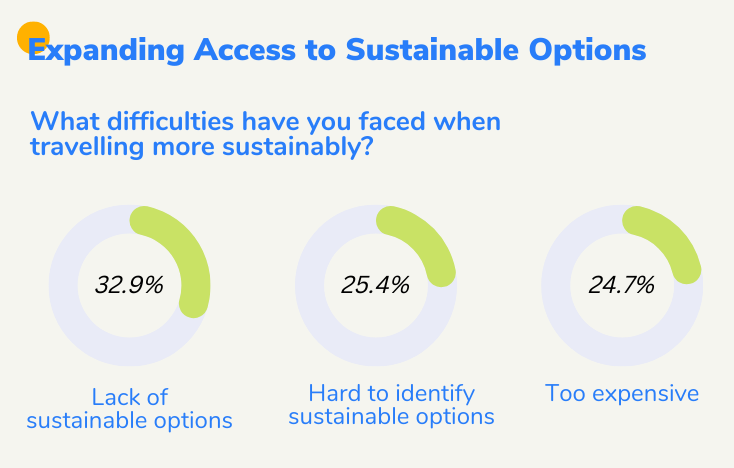
While travellers come across sustainable travel options and even actively look for them online, Trip.com Group's report shows that nearly 80% encountered barriers of various sorts to travelling sustainably.
For instance, 32.9% pointed to a lack of sustainable options, followed by another 25.4% who criticised travel service providers for failing to clearly label sustainable options, thus preventing them from making informed purchases.
This is where Trip.com Group comes in. As part of its Green Tourism Goals, the Group aims to promote sustainable travel concepts and engage 100 million travellers in low-carbon practices. Travellers will better understand their roles in fostering responsible tourism through various awareness campaigns, events and activities. As a result, booming consumer demand will spur industry practitioners to develop more sustainable options and clearly mark them as such.
Trip.com Group's study found that the proportion of travellers willing to pay a higher price for sustainable options peaked at 38.3% when the premium amounted to no more than 5% of the total expense.
The percentage of travellers comfortable with extra payment, however, slumped to 20.1% for a surcharge of 5%-10%, to 5.9% when the additional cost ranged between 10% and 20%, and further to 3.4% when it made up more than 20% of an entire trip's budget.
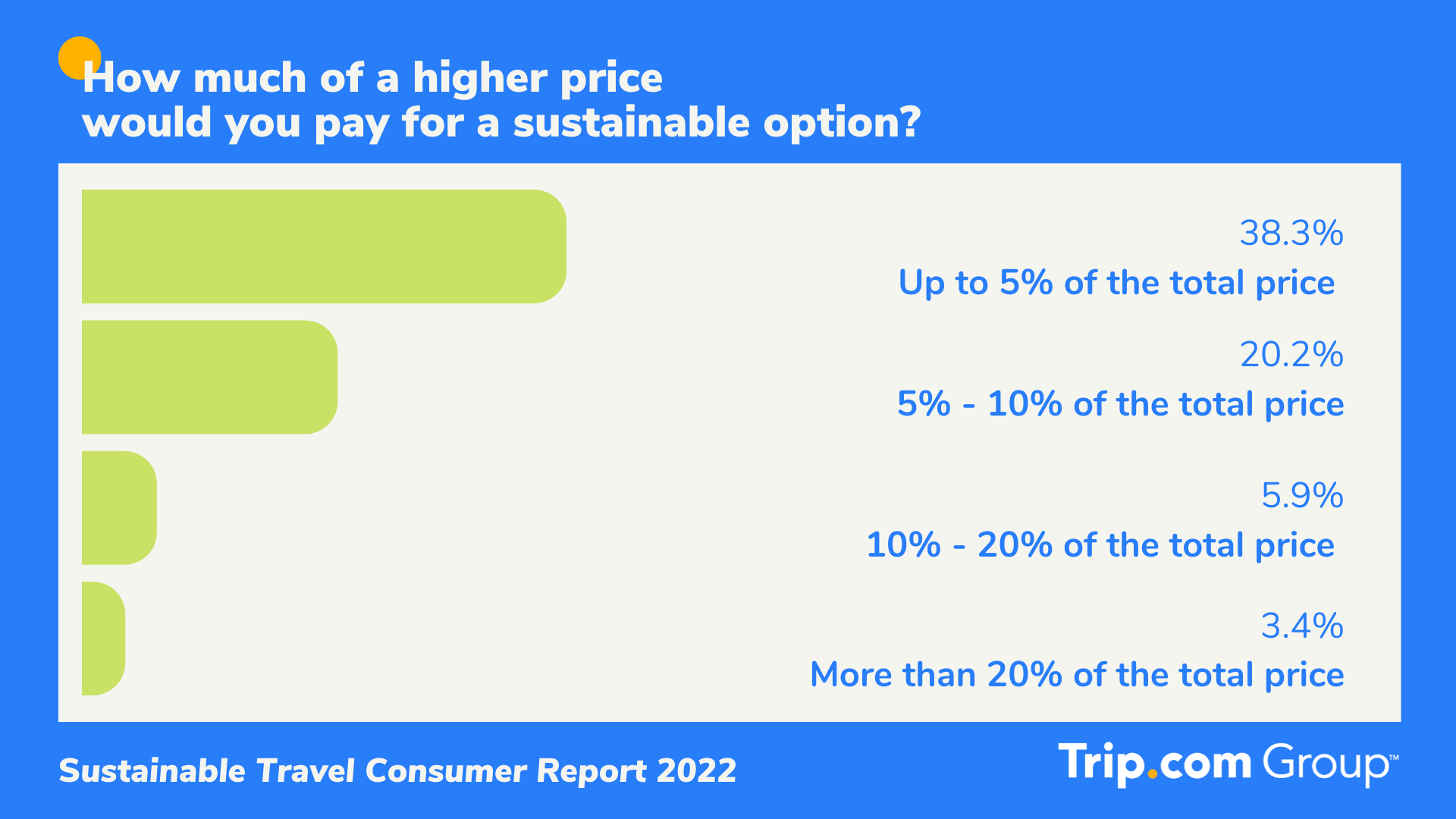
This demonstrates that price sensitivity is still a significant factor to reckon with if travel providers are to tap successfully into people's growing appetite for sustainable travel.
A lesson for OTAs and booking platforms is that other than increasing the supply and visibility of sustainable options, an equally important mission is to roll out reasonably priced travel products to meet consumer expectations.