Things to do in Jimsar
Explore top experiences
Top 10 attractions in Jimsar

Thousand Buddha Cave
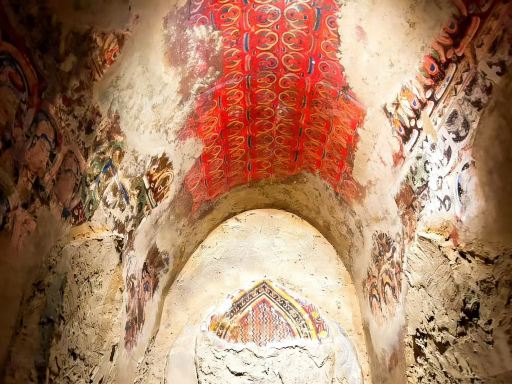
Jimusar Thousand Buddha Caves are located on a loess hillock 5km southwest of Jimusar County at the northern foot of Tianshan Mountain. The Thousand Buddha Caves are rectangular in an east-west direction, with a mountain gate on the east side. The main hall faces west and is a civil structure. There are auxiliary rooms on the north and south sides, which are brick and wood buildings. The main hall is divided into three parts: the front hall, the middle hall, and the back hall. There is a statue of Sakyamuni Buddha about ten feet high in the front hall, and the middle hall is painted with Buddha preaching pictures and statues of 18 Arhats; there is a reclining Buddha in the back hall; the three parts are closely connected to form a whole. There is a stage in the southwest of the temple for the theater troupe organized by the temple fair. The original Thousand Buddha Caves were built in the Tang Dynasty, and the current Thousand Buddha Caves were built in the Qing Dynasty. They were rebuilt and destroyed four times. The one we see now was built with donations from the Jimsar Buddhist Council, and it looks different from the historical Thousand Buddha Caves. The murals and statues were all re-sculpted and painted by modern craftsmen.Jimsar · 5.4 km from downtown

Kalamaili Nature Reserve
The reserve was established in April 1982 with a total area of 17,000 square kilometers. Rare animals that are protected by the state include Mongolian wild ass, "Przewalski's wild horse", argali, goose-throated antelope (yellow sheep) and so on. Today, the main object of protection here, Mongolian wild ass, has grown to more than 700, and there are more than 10,000 goose antelopes (yellow sheep). In addition, wild camels, Przewalski's horses, argalis, hoofs and other rare wild animals with "hoofs", kestrels, golden eagles, great bustards, sand chickens and other birds, and sand lizards and other reptiles are all different. degree of reproductive increase.Jimsar · 73.4 km from downtown

Site of Bashbaliq City
Beiting Duhufu is an administrative unit established in the Tang Dynasty of China in the north of the Tianshan Mountains in the Western Regions. In the second year of Wu Zhou's Chang'an year (702), Wu Zetian established Beiting Duhufu (now Beipochengzi, Jimusar, Xinjiang) in Tingzhou, replacing Jinshan Duhufu and managing the former land of Western Turks, still under the Anxi Duhufu. Jurisdiction is currently west of the Altai Mountains, east of the Aral Sea, north of the Tianshan Mountains and the surrounding area of Balikun Lake.Jimsar · 11 km from downtown

Cheshi Trail
Jimsar · 6 km from downtown


Tianshan Tianchi
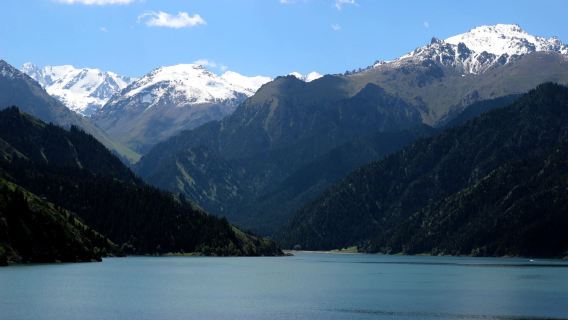
Tianshan Tianchi, also known as Tianchi National Geological Park and called "Yaochi" in ancient times, is located in Fukang, Changji Prefecture, on the northern side of Bogda Peak. It is approx. 110 km from Ürümqi and is a famous tourist destination in Xinjiang. In ancient Chinese mythology, Tianchi was also the bathing place of the Queen Mother of the West. Tianchi Lake sits at an altitude of 1910 m, with a maximum depth of 105 m. The lake reflects the Bogda Peak, surrounded by spruce trees, creating a fairy-tale-like scenery. The attraction encompasses natural views such as alpine lakes, wetland meadows, and forested canyons. In 2013, it was designated as a national geological park. When visiting Tianchi, don't just explore the lakeshore—you'll miss many surprising sub-attractions. Recommended hiking routes, lakeside pier - Haixi beach, lakeside pier - East small heavenly pool (Flying dragon pool) The Tianchi attraction features three water bodies: the main lake plus two others on its eastern and western sides. The eastern one is "East Xiaotianchi," also called Heilong Pool, located 500 m east of Tianchi. Below the pool lies a sheer cliff where a waterfall plunges down like a rainbow, giving the site its name "Hanging spring and jade rainbow." On the west side lies "West Xiaotianchi," also known as Jade Maiden Pool, located approx. 2 km northwest of Tianchi Lake. The pool, shaped like a full moon and encircled by towering pines, earned its poetic name "Dragon Pool under the jade moon" from the serene moonlit reflections on its surface. A waterfall cascades beside the pool, plunging dozens of meters like a silver river descending from heaven, dubbed the "Jade belt with silver curtain." Above the pool stands the Sound of Waves Pavilion, offering a unique vantage point to admire the waterfall. All attractions within the scenic area are connected by boardwalks, accessible on foot. On the eastern shore of Tianchi Lake stands the Temple of the Queen Mother of the West, originally built during the Yuan Dynasty. The current structure was reconstructed in 1999 on the original temple site, dedicated to the worship of the Queen Mother of the West, hence also known as the "Queen Mother Temple". It can be reached by hiking along the lakeside boardwalk (approx. 2 hrs) or by taking a cruise. The temple offers excellent views of Tianchi Lake. Maya Mountain requires taking a shuttle bus + cable car. The towering cliffs and numerous stone peaks present a breathtaking sight; from afar, they resemble a row of horse teeth, while looking up, they appear as if jagged rocks are competing in grandeur and stacked cliffs are vying in beauty, creating a mesmerizing view. This view of Maya Mountain is formed by rock weathering.The summit of Maya Mountain is relatively flat, featuring lush grasslands covered with butter grass in summer and dotted with colorful flowers. Standing here, you can take in the panoramic view of Heaven Lake to the north, while the Bogda Peak to the east and the snow-capped mountains to the south seem within reach. To the west, the farmlands on the outskirts of Urumqi are also clearly visible.Fukang · 86.7 km from Jimsar

Fire Mountain
Huoshao Mountain is located in the Wucaiwan Scenic Area of Changji, with an area of only 10 square kilometers, but it is a dazzling scenic spot on the 216 National Road. Huoshao Mountain is different from the Flaming Mountain in Turpan. The Huoshao Mountain is famous for its high temperature, while the Huoshao Mountain is famous for its color. It is also easy to confuse Huoshao Mountain with Wucai City. The difference between the two lies in the rolling hills here. The mound is not colorful, but an ochre red all made of sintered rock. If you look around, you can hardly see any other colors. The many gently undulating hills of Huoshao Mountain are composed of brick red and orange-yellow rocks, with bright colors and hard texture. Looking from a high distance, the fog is shrouded in the valley, and the colorful hills plated by the sun are more exquisite and translucent, like an open colorful umbrella. Especially in the morning, noon and evening, it will show different appearances, leaving people with different feelings of interest.Jimsar · >100 km from downtown

Wild Wolf Valley of Jimshaer County
Jimsar · 33 km from downtown

JIANGBULAKE
People often say nature favors Switzerland, but only when you witness Jiangbulak can you truly grasp the profound meaning of "nature's divine craftsmanship." Jiangbulak is a national forest park, a 4A-level tourist attraction, and recognized by the Chinese Academy of Sciences as one of the most well-preserved oasis ecosystems. Covering 48 square kilometers, it stands as a key scenic area along the ancient northern Silk Road, featuring expansive dry wheat fields, the mysterious Tianshan Slope, the ancient Han Shule City, wooden walkways, and Black Lake. The attraction boasts exceptional natural resources, blending majestic landscapes, historic cultural sites, and vibrant ethnic traditions into a distinctive and picturesque destination. It offers both globally rare natural wonders and uniquely shaped mountains and waters, drawing countless domestic and international visitors each year. Today, Jiangbulak has become a renowned brand in Xinjiang's tourism industry and a premier leisure resort. What does Jiangbulak look like in your eyes? Some describe this picturesque natural scenery as "Van Gogh's wheat fields meet Monet's haystacks." Yet even the brushes of master painters might not capture all the beauty here. The attraction allows self-driving entry, camping, and pets. Visitors can also bring pets to the check-in area at the attraction's visitor center. Introduction to main sub-attractions: Tianshan Wheat Sea: One of the spectacular wonders of Jiangbulak. For thousands of years, it has rested gracefully in Jiangbulak, captivating visitors with its breathtaking beauty. Located in the Tianshan Mountains at an average elevation of 1,700m in the foothills and rolling hills, it forms a stunning contrast with the snow-capped peaks. Tianshan Mystery Slope: Nature's craftsmanship creates this wonder regardless of seasonal changes. Witnessing and experiencing the Mystery Slope not only brings surprises and amazement but also accompanies every visitor with an air of mystery, inspiring them to ponder and explore the marvels of nature. Majestic Canyons: The chill lingers only at dawn and night, while the radiant snowscapes are but fleeting glimpses of Jiangbulak's many splendors. Summer and fall take center stage here. Bask in the cool, gentle breezes as you marvel at the emerald grandeur of mountain ranges and the awe-inspiring beauty of Tianshan Canyons.Qitai · 62.2 km from Jimsar

Grape Valley
As a valley under the Flaming Mountain, Huoyan Grape Valley Resort is located at the northeast of Turpan. Grape Valley is a shady and cool oasis in the scorching Flaming Mountain area. It is also known for its grapes grown in the grape valley, making it one of the most famous scenic spots in Xinjiang. Scenic spots in the resort include the Effendi Garden and the Music and Art Hall of Wang Luobin. Here, visitors can enjoy hundreds of types of grapes, appreciate Uyghur singing and dancing, and experience the Uyghur dwellings.China · Turpan

Xinjiang International Grand Bazaar
The Xinjiang International Grand Bazaar in Ürümqi's Tianshan District is a favorite destination for visitors of Ürümqi. “Bazaar” is the Persian word for “marketplace”. The architectural style of the Xinjiang International Grand Bazaar has a distinctive Islamic design, yet it combines culture, shopping and entertainment. There are many shops selling goods full of distinctive characteristics of the local ethnic population. Visitors can buy all sorts of local Xinjiang specialties such as raisins, dried apricots and essential oils. This is also a one-stop shop for all kinds of Xinjiang delicacies. You can taste nearly every kind of Xinijang fruit, rice pilaf, lamb and more.China · Urumqi
Experiences you can't miss in Jimsar
Featured Outdoor experiences in Jimsar
View all Outdoor experiences
4.4/5
· 21 reviews· 126 bookedInstant confirmation
FromINR 6,134.66
5.0/5
· 1 reviewFree cancellation
Instant confirmation
FromINR 6,909.56

Free cancellation
Instant confirmation
FromINR 8,862.96

FromINR 20,986.97

FromINR 25,830.12

FromINR 32,368.37
More ways to travel from Jimsar
Free things to do in Jimsar
Thousand Buddha Cave
Jimsar · 5.4 km from downtownKalamaili Nature Reserve
Jimsar · 73.4 km from downtownSite of Bashbaliq City
Jimsar · 11 km from downtownCheshi Trail
Jimsar · 6 km from downtownTianshan Tianchi
Fukang · 86.7 km from JimsarPre-selling, Cancel anytimeFire Mountain
Jimsar · >100 km from downtownWild Wolf Valley of Jimshaer County
Jimsar · 33 km from downtownJIANGBULAKE
Qitai · 62.2 km from JimsarBook now for tomorrow, Cancel anytimeGrape Valley
China · TurpanXinjiang International Grand Bazaar
China · Urumqi
What travelers say about Jimsar

九龙羊肚菌June 24, 2023
3.0
The Buddha statues inside are well-maintained, majestic, and gilded, which feels great.
Thousand Buddha Cave

还不曾去过倒悬山!November 26, 2020
4.0
It may seem dead and silent from the outside, but if you go deeper into the hinterland, you will see Mongolian wild donkeys. In winter, wild donkeys will form a mighty herd, running at a maximum speed of 60 kilometers per hour, which even wolves cannot catch up with.
Kalamaili Nature Reserve

番茄爸October 8, 2025
4.0
This year, I worked six days during National Day. I wanted to relax for the last two days of the long holiday. I came here alone, in my own car, with a single heart, admiring the city's reputation. I returned to Jimsar, a key city in the Beiting Protectorate, to fulfill a wish I left unfulfilled after my last trip to Jiangbulake! To understand the history of the Western Regions, one must delve into this place. To understand Beiting, a visit to the Thousand Buddha Caves was merely a learning experience. My visit to the ancient city of Beiting was merely a superficial study!
Beiting is a thousand-year-old city, a junction of several roads, one of the Tang Dynasty's most important military and political institutions in the Western Regions, and a center of cultural fusion in the northern borderlands. Here, there are horns blowing in the cold, passionate poetry, the sound of reading, and graceful singing and dancing. This is a snapshot of a medieval northern border city, a magnificent chapter of frontier culture. The frontier of the Western Regions, home to passionate soldiers, has also nurtured magnificent poetry. "Drunk in a village in the borderlands, I feel no sorrow, yet I yearn to build Luntai for my country." "Suddenly, as if overnight, a spring breeze arrives, and thousands of pear trees blossom." For millennia, the rugged, vigorous, and fantastical culture of the Western Regions has nourished Chinese culture, providing every scholar raised in the "gentle and honest" Confucian tradition with a reason to travel far and wide, and becoming one of the most romantic and fantastical elements in the DNA of Chinese culture.
As the largest central town in the northern foothills of the Tianshan Mountains from the 7th to the 14th century AD, the remains of the Beiting Ancient City bear witness to the Tang Dynasty's significant efforts to manage the Western Regions and ensure the smooth flow of the Silk Road through the oasis and grasslands through the establishment of military and political institutions such as Tingzhou, Beiting Grand Protectorate, and Beiting Jiedushi. Its remains as the secondary capital of the Gaochang Uighurs, along with the ruins of the Gaochang Uighur royal family Buddhist temple, bear witness to the ancient Gaochang Uighur civilization in the Western Regions. The remains of the Beiting Ancient City from the Tang Dynasty and the Uighur period, as well as the ruins of the Gaochang Uighur Buddhist Temple, bear witness to the intermingling of various ethnic groups in the northern foothills of the Tianshan Mountains. Beiting Ancient City was the primary central town along the Silk Road in the northern foothills of the Tianshan Mountains from the 7th to the 14th century AD. It served as a crucial military and political center and transportation hub for the region north of the Tianshan Mountains. Approximately 1.5 kilometers long from north to south and 1 kilometer from east to west, its layout, influenced by the Tang Dynasty's Chang'an City, consisted of two inner and outer walls, both with an irregular rectangular plan. To the north of the city lies the Yangma City, within which 12 building foundations have been discovered. 700 meters west of the city, on the terrace east of the Xihe Dam, stand the ruins of the Gaochang Uighur Buddhist Temple (Beiting West Temple). Beiting belongs to China, to the Silk Road, and to the world! Bring your children here when they're older to learn more about its history!
Site of Bashbaliq City

囡囡的家August 20, 2020
4.0
Cheshi Ancient Road, the former Toudao Bridge, was a place where the local and surrounding Kazakh Aken played music and raced horses when I was a child. I don’t know when it became a place for raising wolves to attract investment, and later it was renamed Wild Wolf Valley. This is only part of the Cheshi Ancient Road. The Cheshi Ancient Road is also a popular place for hiking and adventure. I will come and see it later.
Cheshi Trail

_We***00October 16, 2026
5.0
Tianchi Lake in the Tianshan Mountains truly lives up to its legendary reputation as a fairyland on earth! However, getting to the scenic area is highly dependent on the weather. The shuttle bus takes you up the mountain, and upon arriving at the lakeside, you're instantly awestruck. The crystal-clear lake rests serenely amidst the mountains, with the majestic Bogda Peak standing tall in the distance, surrounded by a vast forest of spruce trees. The snow-capped mountains, the lake, and the blue sky frame each other—a breathtaking panorama that needs no filter. Strolling along the lakeside boardwalk, the air is fresh and invigorating. You can also take a boat trip on the lake for a closer look at the scenery. The scenic area is clearly marked and well-equipped, combining natural beauty with the mythical significance of the Queen Mother of the West. The mountain breeze soothes all travel fatigue, making it a must-visit destination when in Xinjiang.
Tianshan Tianchi

带着檬宝去旅行September 24, 2019
4.0
Huoshao Mountain is a reddish-brown sintered rock. At dusk, under the reflection of the morning sun or the sunset, the mountain seems to be burning, and all the mounds are painted with a golden hue, which is magnificent and rare.
Fire Mountain

M49***66April 12, 2023
5.0
The Ulagai Wolf Valley Scenic Area aims to create a national 4A-level tourist attraction, with wolf watching as its core product, enriching tourism formats and innovating tourism products as its means, and relying on word-of-mouth marketing and service-oriented services to upgrade the internal sightseeing roads of the scenic area.
Wild Wolf Valley of Jimshaer County

M11***68October 21, 2026
5.0
Jiangbulak is breathtakingly beautiful. Although you can see snow-capped mountains and wheat fields along the mountain road, it makes sense to fence off the scenic area and charge admission. Speaking of which, the admission fees for scenic spots in Xinjiang are really reasonable, and they are all very well maintained and clean. Compared to many 5A-level scenic spots in inland China, the value for money is much higher.
JIANGBULAKE

Anonymous userOctober 3, 2026
4.0
There were so many people visiting during the National Day holiday. 90% of the grapes had already been harvested; the remaining 10% were quite unique. However, the sightseeing bus service was extremely chaotic, with pedestrians everywhere and no order whatsoever.
Grape Valley

毛哥牛逼June 9, 2026
4.0
It's a great place to experience the rich ethnic culture of Xinjiang. The architecture is very unique, and the atmosphere is especially wonderful when the lights come on at night. The food, handicrafts, and song and dance performances are all quite local. If it's your first time visiting Xinjiang, it's definitely worth a visit. However, the area is quite commercialized, and many goods and restaurants are on the expensive side. I suggest you shop around and compare prices before making any purchases. It's better to treat it as a place to experience local culture and take photos.
Xinjiang International Grand Bazaar


