https://https://www.trip.com/toplist/tripbest/recommend/chibi/best-nightspots/10070001135142/?locale=en-US


Night Attractions

Popular Night Attractions in Chibi [2025]
Table of contents

Show All Photos

The Ancient Street of Yangloudong
4.3
/5
19 reviews
4.1
25.3 km from downtown
Phone +867155863263
Address: Yangloudong Town, Chibi City, Xianning, Hubei Province
Recommended sightseeing time: 0.5–1 day
38% positive reviewsRecently viewed by 1,000+ people
Verified user reviews



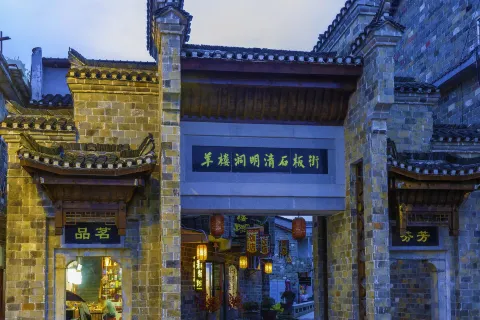
The winding bluestone paths, their varying depths of horse hoof prints etched with stories of time, flank the streets, lined with Ming and Qing dynasty-style houses, teahouses, and workshops. The delicate aroma of Songfeng tea lingers. Despite a touch of commercial embellishment, the charm of the bygone "hometown of brick tea" remains unwavering. It's a perfect place to slow down, touch the mottled brick walls, listen to the gurgling water, and experience the tranquility and vicissitudes of centuries.
The following is an evaluation of Yangloudong Ancient Town:
History and Culture
🔷Long history: Yangloudong Ancient Town has a history of over a thousand years. It is the origin of "Songfeng Tea" and "Dong Tea", the birthplace of Hubei Laoqing Tea, and is also the "No. 1 Ancient Town in the World's Tea Industry" and "Hometown of Chinese Brick Tea". Tea has been planted and processed since the Taihe period of the Tang Dynasty. The Ancient Tea Horse Road was formed in the Song Dynasty. It reached its peak in the Ming and Qing Dynasties. At its peak, there were more than 200 tea houses and a population of nearly 40,000. It was known as "Little Hankou". It is one of the starting points of the Tea Road and has witnessed the rise and fall of China's tea trade. It has a profound historical and cultural heritage.
🔷Cultural integration: The ancient town integrates a variety of cultural elements such as tea culture, religious culture, and architectural culture. In terms of tea culture, there are many tea shops and teahouses, where you can taste authentic green brick tea and learn about the production process of brick tea; in terms of religious culture, there are ancient temples such as Yuantong Temple, with unique architectural styles. The carvings and murals in the temple tell the stories of the years; in terms of architectural culture, most of the buildings on both sides of the ancient street are from the Ming and Qing Dynasties, two-story buildings, brick walls and wooden doors, carved window lattices, and simple and elegant styles. Walking on the ancient street, it seems to be able to travel back to ancient times.
Architectural landscape
🔶Ancient street style: The main street is 4 meters wide and 2,200 meters long. It is paved with bluestone. There are more than an inch deep grooves on the stone road that were crushed by the "chicken bus" for transporting tea, which is a witness to the prosperity of commerce. There are many shops on both sides of the ancient street. Although it has gone through the years, you can still see the prosperity of the year. Now it has been restored to its original state and the street has been opened, recreating the production and trading scenes of the time.
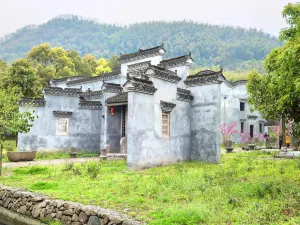
🔶Special buildings: There are display shops such as the Lijin Bureau, the Post Office, the Yanglou Academy, the Hecha Gang, the Guangjitang Pharmacy, the Fuchang Tea House, and the Xintai Tea Factory, as well as relatively well-preserved Hui-style ancient buildings such as the Lei Family Courtyard, with white walls and black tiles, towering horse-head walls, and carved beams and painted buildings at the gate, showing the richness of the Qing Dynasty architectural culture.
Tourism experience
◼️ Tour route: You can stroll along the bluestone road from the entrance of the ancient town, appreciate the buildings and shops on both sides of the ancient street, and feel the tranquility and simplicity of the ancient town; visit Guanyinquan and Yuantong Temple to experience the religious culture of the ancient town; you can also go to the Green Brick Tea History Museum to learn about the development of Yangloudong's tea culture and production technology; if you have enough time, the surrounding Zhongsongshan Tea Garden is also a good place to get close to nature and feel the scenery of the tea garden.
🔺 Food recommendation: In addition to tasting authentic green brick tea, the ancient town also has special foods such as Jiangjia Noodle House, which can satisfy tourists' taste buds while playing.
🏠Accommodation options: There are homestays such as Qingshi Inn in the ancient town, which have unique decoration styles and allow tourists to experience a different accommodation experience. The price is also relatively moderate.
Current situation and development
🔶 Protection and development: The local government attaches great importance to the protection and development of the ancient town, and has carried out restoration work to restore the old as it was. At the same time, it is also constantly improving tourism supporting facilities and improving the quality of tourism services. For example, it has introduced many Internet celebrity check-in shops such as talk show beer bar, Wu Di Yi Photo Studio, and Ming Juan Second-hand Bookstore, realizing the integration of traditional culture and modern tourism style, creating a strong Chinese style and fashion trend.
🔶 Ecological governance: The advancement of the Yangloudonggang small watershed comprehensive governance pilot project has improved the ecological environment of the ancient town, laid the foundation for the sustainable development of the ancient town, and made the ancient town
1

About
Payment methods
Our partners
Copyright © 2025 Trip.com Travel Singapore Pte. Ltd. All rights reserved
Site Operator: Trip.com Travel Singapore Pte. Ltd.
Site Operator: Trip.com Travel Singapore Pte. Ltd.