
Split save train tickets - Explained


Have you ever purchased a train ticket and seen the option for a split ticket (or split-save train ticket)? What does that mean, exactly? And how can it benefit you? Split-save train tickets are a great way to save money when traveling by rail if you don’t mind (a small amount of) extra work. In this guide, we break down what a split-save train ticket is, how to use it to your advantage, and what to watch out for.

What is a split-save train ticket?
Split-save tickets involve breaking a journey into multiple segments and purchasing separate tickets for each leg of the trip. Although this may sound more expensive (two journeys should be more expensive than one, right?), in many cases this actually means a cheaper journey.
With proper planning, this often results in staying on the same train! So you may not even have to move seats to save money.
Simply put, instead of buying one ticket for your entire journey, you buy multiple tickets for different parts of the same route.
Sounds complicated? Trust us—it's not. Let Trip.com break it down for you.
How do you split train tickets?
Split ticketing on a train means breaking your journey into multiple segments and buying separate tickets for each leg. Some providers, like Trip.com, offer an option to do this for you automatically with the click of a button.
- Plan your journey: Determine your starting point, destination, and travel times (i.e., when you want to leave and arrive).
- Identify 'splitting points': Research potential splitting points along your route where purchasing separate tickets may result in cheaper fares. These ‘splitting points’ are typically stations where trains stop or change services, and they tend to be well-known stations. A good tip is to check the more popular stations first.
- Check train schedules: Use an online journey-planning tool to discover when your train will arrive at the ‘splitting point’. Ideally, you’ll be able to time this switchover so that you can remain on the same train and not even move from your seat. Seat availability will be a deciding factor here. You may be able to stay on the same train, but you may need to move seats for this to work.
- Calculate costs: Next, compare the combined cost of both tickets with the price of the entire, unsegmented journey. Make sure to consider any discounts or Railcards you intend to use.
- Purchase tickets: If you’ve identified a valid split-ticket saving opportunity, buy the tickets and double-check that you’ve aligned the dates, seats, and times properly. Some apps will display the tickets on your phone, but you might need to visit the ticket office at the station or use a self-service ticket machine to collect your tickets before your journey.
- Travel: You’re all set! Make sure you have both tickets handy when traveling if a conductor or inspector comes to check. Also, watch for when the 'split' occurs so you don’t miss your changeover.
When to consider splitting tickets?
Here are a few things to keep an eye on when you’re using split-save train tickets:
- Transfer times: When segmenting your journey, consider the transfer times between your split point(s) to ensure seamless connections between trains. In some cases, you won’t even have to leave your train or seat (if planned well), but in others you may have to. Give yourself a buffer between trains to avoid missing connections, especially if you need to change platforms or stations. Check the train schedule for connecting services and factor in any potential delays or disruptions that may affect your journey.
- Transfer times, ticket validity, and seat availability: Be mindful of any ticket restrictions associated with split-save tickets, like limited validity or specific travel times. Some split train tickets may only be valid for certain services or travel periods, so be sure that your tickets are valid for the trains you intend to travel on. Check each ticket's terms and conditions to avoid issues during your journey.
- Seat availability: If you’ve found a split-ticket opportunity that lets you stay on the same train for the whole journey using two (or more) tickets, you may still have to change seats mid-journey. If so, watch for different stations on your route so you know when to change.
- Discounts and Railcards: Explore any available discounts and Railcards that could further reduce the cost of your split-save tickets. Railcards offer discounts for various groups, including students, seniors, families, and disabled passengers. Check the eligibility criteria and benefits of different Railcards to determine if you qualify for additional savings on your rail travel.
- Fare calculations: Probably the most important thing to check—make sure that you’re actually saving money by splitting the ticket! If not, then it’ll be far more convenient (and possibly cheaper) to simply buy a direct ticket.
Examples of split-save train journeys
London to Edinburgh
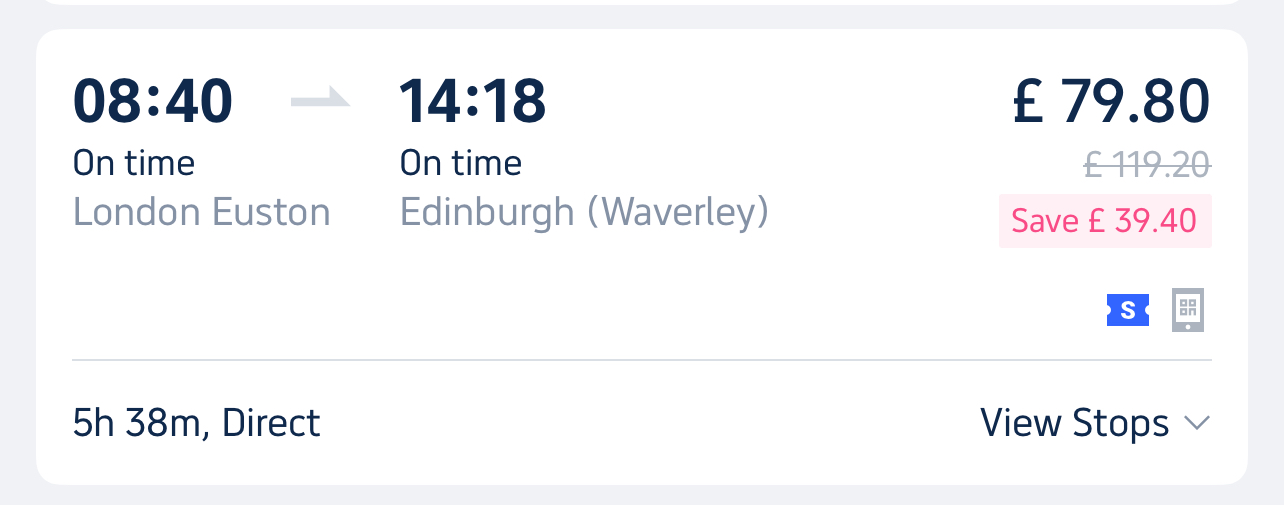
Even better, you don't necessarily need to change trains. You may need to change seats and cars if you're assigned them, but that's it!
London to Manchester
Edinburgh to Bristol
Glasgow to London
How to save even more on split-ticket fares?
Split ticketing is just one way to save money when traveling on trains in the UK. To find the cheapest way to travel, consider splitting your train ticket with:
- Railcards: Most offer around a third off when traveling off-peak and super off-peak, although minimum fares and time restrictions may apply.
- Advance tickets: Booking ahead for a specific train is often cheaper where available. These tend to sell out quickly, so get in there while you can.
- Travel during off-peak: Train fares tend to be lower during off-peak times to encourage people to travel later in the day and fill empty seats on quieter trains. This is a good way to avoid congested commuter trains during rush hour and save you money at the same time.
How to buy cheap split train tickets through Trip.com?
But how do you find these train split ticketing opportunities? That's where we come in. At Trip.com, we're dedicated to making your travel experience as easy and affordable as possible.
Our app provides a user-friendly interface to help you navigate the ins and outs of split ticketing. When you're searching for the train journey you'd like to book, we'll show you the cheapest option, including split ticketing. What’s even better is that a checkbox should appear for you to select split tickets—it really is that easy!
So why not try train split ticketing on your next UK train journey? It might take a little extra planning, but your wallet will thank you for it afterward. And remember, every penny saved on travel is a penny more to spend on creating unforgettable experiences. Happy travels!
Split ticket FAQs
How do split tickets work?
Split tickets work by taking advantage of pricing discrepancies between different segments of a journey. Passengers can identify splitting points along their route where buying separate tickets for each segment is more cost-effective than buying a single ticket for their journey. This helps travelers save money on their rail travel.
Imagine you're traveling from Point A to Point C. Instead of buying one direct ticket, you buy two: one from Point A to Point B, and another from Point B to Point C. The train doesn't need to stop at Point B, and you don't necessarily need to change trains or seats. The magic is that, often, the combined cost of these two tickets is less than a direct ticket. That's split ticketing!
How do I find splitting points for my journey?
You can identify splitting points by researching train schedules and route maps to see where trains stop or change services along your journey. Look for intermediate stations where you can break your journey and purchase separate tickets for each segment. Online journey planning tools and ticketing websites may also provide information on splitting points.
Are there any restrictions with split tickets?
While split tickets can offer significant cost savings, passengers should be aware of any restrictions associated with each ticket. These may include limitations on train services, travel times, or validity periods. Restrictions can vary by journey and provider. Therefore, passengers should carefully read each ticket's terms and conditions to ensure compliance with any restrictions.
Are split tickets legal?
Can I use split tickets for any journey?
Split tickets can be used for most train journeys within the UK, including both short- and long-distance routes. However, availability and cost-effectiveness may vary by route and train operator. Passengers should research and compare split ticket options for their journey to find the best savings opportunities.








- What is a split-save train ticket?
- How do you split train tickets?
- When to consider splitting tickets?
- Examples of split-save train journeys
- How to save even more on split-ticket fares?
- How to buy cheap split train tickets through Trip.com?
- Split ticket FAQs






- Our 5 best food cities to visit by EurostarPublished: November 18, 2026
- Elizabeth line: First and last train times explainedPublished: November 18, 2026
- Eurostar schedule: routes, departure times & frequencyPublished: November 18, 2026
- GWR lost property: how to get your missing item backUpdated: November 18, 2026
- Avanti West Coast lost and found: how to get your missing items backUpdated: November 18, 2026
- Thameslink lost and found: how to get your missing items backUpdated: November 18, 2026
- LNER lost and found: how to get your missing items backUpdated: November 18, 2026
- ScotRail lost and found: how to get your missing items back?Updated: November 18, 2026
- Trenitalia discounts: Latest offers & dealsPublished: November 17, 2026
- UK delay Repay: how to claim train delay compensation?Published: November 17, 2026
- Heathrow Express delay Repay: how to claim compensation for late trains?Published: November 17, 2026
- Lumo delay Repay: how to claim compensation for late trains?Published: November 17, 2026