Your name, the shortest love letter I've ever read.
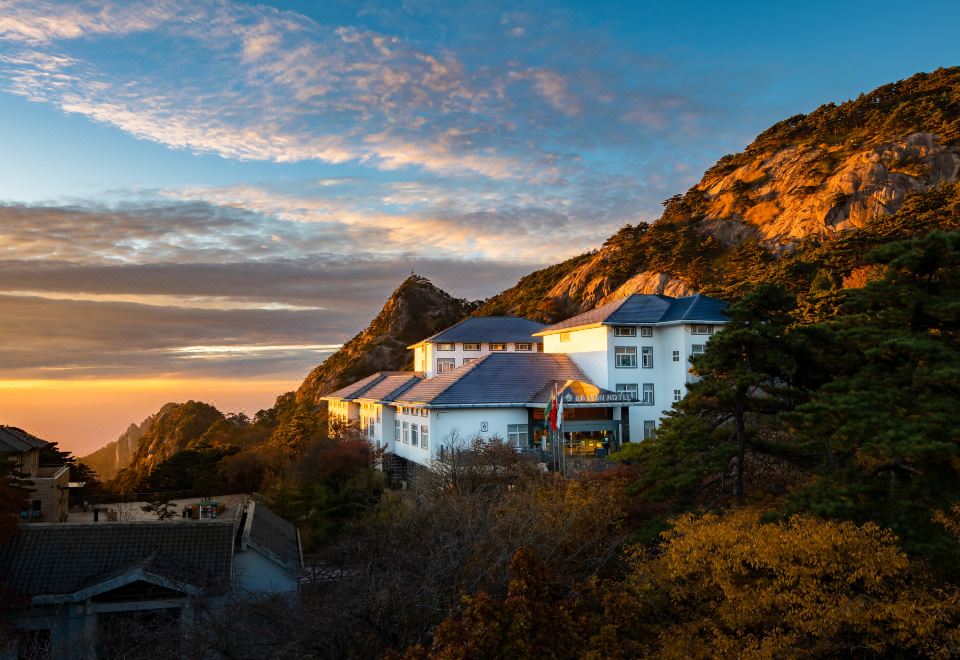
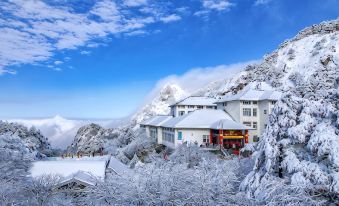
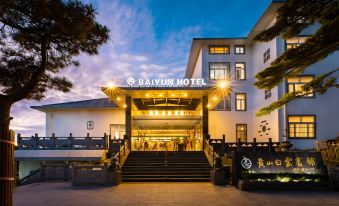
The Baiyun Hotel, where we stayed this time, is an asset of Huangshan Tourism Group, a state-owned enterprise under Huangshan City. It's true that an independent, state-run hotel like this can hardly compare to international chain brands in many aspects. Nevertheless, the hotel will most likely never join any international hotel group because there's simply no need. Its enviable, superb location alone guarantees it a fortune every year. As for anything else, it's completely irrelevant.
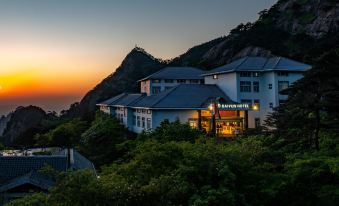
The Baiyun Hotel is ranked 80th in Asia's Top 100 "Scenic View" Hotels, a testament to its undeniable strength. It's worth noting that most hotels on this list are establishments like Four Seasons and St. Regis. Its inclusion reconfirms the irreplaceable beauty of its sunrise and sunset views, a feature unrivaled anywhere else in Huangshan.
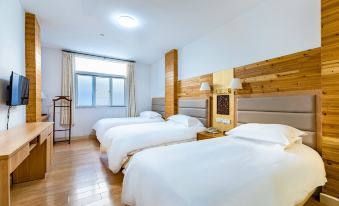
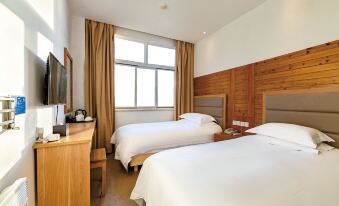
Due to its geographical location, cramped room sizes are almost inevitable. After all, there's limited space on the mountaintop, making expansion difficult. As for the observation deck, it's just a few hundred steps away, which is incredibly convenient for those with limited physical ability, such as the elderly, young, sick, or weak.
Poor sound insulation, simple rooms, high prices, queues for breakfast, and mediocre management are all shortcomings that need improvement. But as I said, for the magnificent scenery (with vast landscapes stretching as far as the eye can see), for spending splendid time with my "lovers" (my wife and two sons), and for a unique summer holiday experience, all the inconveniences become bearable.
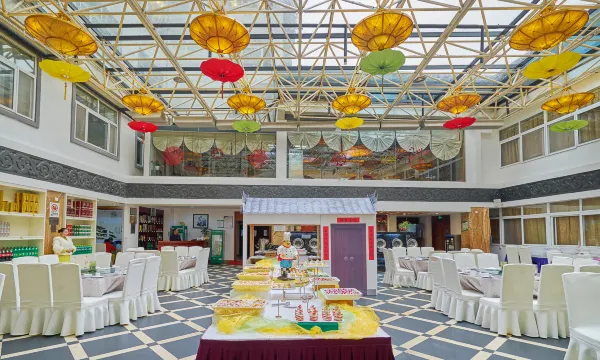
Regarding food, ordering takeout is naturally impossible on Huangshan, making the hotel restaurant the inevitable choice. It was neither good nor bad, neither surprising nor disappointing – just like any other tourist restaurant in a scenic area.
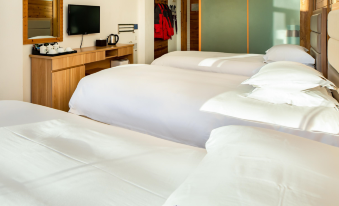
The room provides complimentary rental jackets for watching the sunrise, as the temperature difference between day and night on the mountain is extreme, especially at sunrise. It's essential to prepare for the cold, even in summer.
I've stayed in 1501 hotels and encountered many "Baiyun" hotels, big and small, across various locations like Guangzhou, Chuzhou, Lanzhou, and so on. Of course, these numerous "Baiyun" hotels are merely coincidences in name and have no affiliation whatsoever.
Hotels on Huangshan's peak generally fall into three categories. The first type is boutique guesthouses, all from "Yun Ji." The well-known ones are Shilin Ya She and Shuguang Li, as well as the more niche Sanhua Jing She. The characteristic of these three is their tranquil setting amidst the bustling area, offering both comfortable, exquisite stays and easy access to natural scenery. The second type consists of standard guesthouses, such as Yunlu Beihai, Yupinglou, Paiyun Xinglü, Xihai, Shilin, and Bai'e. The advantage of these is their relatively lower prices and good value for money. The third type is the Baiyun Hotel, where we stayed this time, boasting exclusive access to the best sunrise and sunset viewing spots. For my two sons, who are "traveling according to their textbooks," it was absolutely perfect. Of course, the drawbacks are also super obvious. The hotel will celebrate its 30th birthday next year. Although it had a simple renovation 11 years ago (the family rooms and Mediterranean-style rooms are highlights), the hardware still clearly shows its "old cadre" style and state-run guesthouse aesthetic. Regardless, you can't have your cake and eat it too. When choosing between scenery and a comfortable stay, I believe the vast majority would opt for the former.
Looking at the entire Huangshan prefecture-level city, the undisputed leader in the hotel industry is naturally Banyan Tree. Of course, if you're not staying in Hongcun and only visiting Huangshan itself, then the Baiyun Hotel becomes an excellent, affordable alternative (even though the soft and hard facilities are incomparable, the scenery is truly infinitely beautiful).
Huangshan's 3 districts and 4 counties have their culinary highlights mainly concentrated in Huangshan District, Tunxi District, and Yi County. I highly recommend Zhong Da Chu Stinky Mandarin Fish at Ziyun Pavilion in Gaoxin District (Tunxi). Tourist attractions are primarily in Tunxi District, Huizhou District, Yi County, She County, and Huangshan District. For instance, Xixinan Ancient Village is perfect for stunning photos in traditional costumes. Relatively speaking, the gastronomic and tourism resources of Qimen and Xiuning counties are slightly less impressive.
Kites rise highest against the wind, not with it. Climbing mountains is extremely strenuous physical work. When traveling in Huangshan with family, the advantages of the Baiyun Hotel are self-evident.
Among Anhui's 16 prefecture-level cities, Huangshan consistently ranks last in GDP. The reasons are simple: First, the population is too small, just over a million. Second, similar to Lijiang and Dali, ecological redlines cannot be crossed, making industrial development almost impossible. Third, the actual tourism revenue generated by transient tourism is not particularly substantial. Theoretically, Huangshan accounts for nearly half of Anhui's 18 5A scenic spots: Qiankou Folk Houses Museum, Ancient Huizhou Cultural Tourist Area, Bao Family Garden, Huizhou Ancient City, Chengkan (Aoyu), Xidi Ancient Village, Hongcun, and Huangshan. How to deeply connect these attractions and retain visitors is a profound art.
Original TextTranslation provided by AI