Things to do in Hezuo
Explore top experiences
Top 10 attractions in Hezuo


Ganjia Grassland
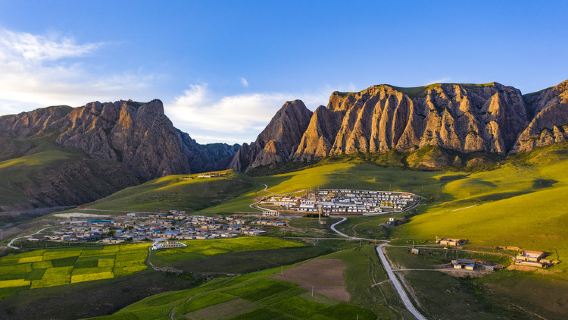
Ganjia Grassland is an open alpine meadow and a traditional pasture where herders have grazed their livestock for generations. In midsummer, the grassland is lush green, with wildflowers spreading along the gentle slopes and herds of cattle and sheep scattered throughout. Compared to Sangke Grassland near the county seat, it receives fewer tourists and retains the more primitive and tranquil appearance of an alpine pasture. The grassland's distinctiveness largely comes from the Baishiya stretching across the end of the pasture — a gray-white cliff stretching over 10 km that stands like a screen above the greenery, with Baishiya Temple located at its foot. The Yangqu River and Yangla River meander across the grassland. The Bajiao Ancient City, built on the terrace where the Yangqu and Yangla rivers meet, is named for its eight corners. Ascend the viewing platform to take in the panoramic view of the ancient city, surrounding highland barley fields, and pastures. The grassland covers a large area with scattered attractions. Baishiya, Bajiao Ancient City, and Zuohai Temple are located in different directions, making it suitable for a self-drive or car charter tour along the route.Xiahe · 57.1 km from Hezuo

Maijishan Cave-Temple Complex
The Maijishan Cave-Temple Complex is carved into the cliff face of an isolated peak resembling a farmer's wheat stack in the Xiaolong Mountains. Alongside the Mogao Caves in Dunhuang, the Yungang Grottoes, and the Longmen Grottoes, it is renowned as one of China's four great cave-temple complexes and serves as the core attraction of the Maijishan scenic area. The caves were first excavated during the Later Qin period of the Sixteen Kingdoms and underwent continuous construction for over 1,600 years through the Northern Wei, Western Wei, Northern Zhou, Sui, Tang, and up to the Ming and Qing dynasties. The site preserves over 200 caves and niches, more than 10,000 clay and stone sculptures, and nearly 1,000 square meters of murals. Featuring predominantly clay sculptures with an unbroken lineage across dynasties, the complex showcases a complete and clear stylistic evolution, earning it the title "Oriental Sculpture Gallery." In 2014, it was inscribed as a UNESCO World Heritage Site as part of the "Silk Roads: the Routes Network of Chang'an-Tianshan Corridor." Maiji Mountain stands alone amidst surrounding peaks, with most of its grottoes carved into sheer cliffs dozens of meters above ground, connected solely by tiered aerial walkways spanning over ten levels. The visit itself becomes a cliffside adventure: at the base, gaze up at the exposed rock face and the colossal cliff-carved Buddha over ten meters tall, then ascend via winding walkways suspended dozens of meters high—both thrilling and offering panoramic views of lush forests. Grottoes along the path vary in size, with smaller ones protected by nets, while larger ones dominate the upper sections. The upper eastern cliff's Sanhua Tower (Upper Seven-Buddha Pavilion) is an unmissable highlight. This seven-bay, eight-pillared hall with a single-eaved hip roof replicates wooden architecture carved directly into the cliff, featuring a grand front corridor and rear chamber. Its ceiling showcases the unique "thin relief" flying apsaras—faces and limbs rendered in shallow sculpture while flowing robes are painted, creating a distinctive fusion of painting and sculpture unparalleled in ancient Chinese murals. As you walk and observe, the stylistic evolution of clay sculptures becomes distinctly visible: the elegant and slender figures of the late Northern Wei, the refined and serene style of the Western Wei, the plump and graceful forms of the Northern Zhou, and the full and rounded shapes of the Sui and Tang dynasties—like flipping through a three-dimensional history of sculpture. On overcast or freshly cleared days after rain, when mist swirls around the peaks and drizzle veils the landscape, the solitary haystack-shaped peaks emerge and fade in the clouds, creating the famous "Maji misty rain" scenery. The plank road is narrow, and visitors may need to queue and proceed slowly when crowded. Travelers with acrophobia should proceed with caution. Flash photography is prohibited in the grotto area, and touching the statues is not allowed. A few classic grottoes are designated as special grottoes and are not included in the regular tour route, such as Cave 133, famous for the "Oriental Smile" novice monk, and Cave 127, known for its large-scale sutra illustration murals. Travelers with a strong interest in statue art can check the special grotto visiting arrangements in advance. Most of the other caves and niches can be viewed in sequence along the plank road.China · Tianshui

Maijishan Scenic Area
The Maijishan Scenic Area is located in the southeast of Tianshui, Gansu Province, within the Xiaolong Mountain forest area of the western Qinling range. A ridge extending from southwest to northeast separates the Wei River, a tributary of the Yellow River, from the Jialing River, a tributary of the Yangtze, placing them to the north and south respectively. The northern mountains boast majestic peaks, while the southern streams are serene and picturesque, blending both temperaments within the same landscape. The entire attraction comprises five major sections: the Maijishan Cave-Temple Complex, Xianren Cliff, Shimen Mountain, Quxi, and Jieting Hot Springs, with over 180 attractions scattered across more than 200 square km of forested terrain. Ancient Qinzhou scenes like "Maiji mist and rain," "immortals offering lanterns," "night moon at Shimen," and "pine waves in pure land" all originate from these mountains. The core of the attraction is the Maijishan Cave-Temple Complex, renowned alongside the Mogao Caves in Dunhuang, the Yungang Grottoes in Datong, and the Longmen Grottoes in Luoyang as one of China's four great cave-temple complexes. Maiji Mountain is an isolated peak in the Xiaolong range, named for its resemblance to a farmer's wheat stack. Its sheer red cliffs—over 100 m high on the eastern, western, and southern sides—are densely honeycombed with caves, connected by tiered aerial walkways spiraling upward to the Upper Seven-Buddha Pavilion, colloquially called "Sanhua Tower," where railings frame panoramic views of forested peaks. First excavated during the Later Qin period of the Sixteen Kingdoms, the complex saw continuous construction for over 1,600 years through the Northern Wei, Western Wei, Northern Zhou, Sui, Tang, and up to the Ming and Qing dynasties. With over 200 surviving caves and 10,000 clay and stone sculptures, it's hailed as the "Oriental Sculpture Gallery." Particularly lifelike are the life-sized round sculptures, including the smiling novice monk in Cave 133, celebrated as the "Oriental Smile." When rain clears during summer and fall, mist coils around the cliffs, veiling the grottoes in ethereal beauty—a spectacle enshrined as "Maiji mist and rain" among the Eight Views of Qinzhou. The other areas each have their own highlights: Xianren Cliff, located over 10 km from the grottoes, consists of three cliffs, five peaks, and six temples. The halls beneath the cliffs preserve nearly 200 statues dating back to the Northern Wei dynasty, and with the lake reflecting the red cliffs, the old scene of "immortals offering lanterns" has been passed down to this day. Shimen Mountain features a granite peak forest landscape and is known as "Little Huangshan." Juxian Bridge spans the north and south peaks, and on the night of the Mid-Autumn Festival, the bright moon hangs right over the bridge, creating the "night moon at Shimen" scene. Quxi is hidden deep in the Xiaolong Mountain forest, where a stream winds through nine bends, featuring small bridges and flowing water—a secluded spot full of wild charm. The hot spring water in Jieting Ancient Town maintains a temperature of about 40 degrees year-round. The ancient town is said to be related to the Three Kingdoms allusion of "losing Jieting" and also preserves traces of Du Fu's stay in Qinzhou, making it a perfect place to soak and relax after touring the mountains and waters. The major areas are spaced 10 to over 20 km apart, so it's recommended to plan your itinerary priorities in advance. If time is limited, prioritize the Maijishan grottoes. The grotto walkways are suspended with steep and narrow steps, so travelers with acrophobia or limited physical strength should proceed within their capabilities. The walkways become slippery after rain, so take your time ascending—it's also a perfect opportunity to enjoy the mountain mist.China · Tianshui

Ganjia Secret Realm
The "Gangjia Secret Realm" is located in Gangjia Town, Xiahe County, Gannan Tibetan Autonomous Prefecture, with a total area of 131.23 square kilometers. The altitude difference between the north and south of the Attraction is 1,300 meters. The unique geological structure contains a variety of geological resources such as cliffs, grasslands, plateau lakes, stone forests, canyons, prehistoric caves, and rivers. The Bajiao Ancient City, Zuohai Temple, Baishiya Temple, and the Denisovan Site Cave have become the imprints of the Attraction profound historical and cultural heritage. Academic masters and eminent monks such as Guru Padmasambhava, Tsongkhapa, Gongtang Cang, and Gendun Gumpel have successively studied, practiced, and preached in the Gangjia area.Xiahe · 58.2 km from Hezuo

THE YELLOW RIVER TOWER
THE YELLOW RIVER TOWER is a landmark antique-style pavilion built by Lanzhou for the Yellow River. The main tower stands approx. 93 m tall with 16 floors, located at a major bend of the Yellow River in Lanzhou. It integrates Yellow River culture exhibitions, elevated viewing, and live performances. The core experience here is admiring the river from the tower. The 16th-floor "Lanzhou in the clouds" observation deck offers a panoramic view of the S-shaped river bend skirting the city and urban landscapes on both banks. At dusk when the sunset glow blankets the river, many travelers specifically choose this time to ascend the tower. Each floor houses thematically diverse exhibits: the 11th-floor Lanzhou city memory exhibition resembles a 3D photo album, narrating urban stories of the Yellow River flowing through the city; the 13th-floor features a premium Yellow River stone exhibition displaying uniquely shaped rocks polished by millennia of river erosion; the 15th-floor Lanzhou memories·light and shadow museum immersively showcases the four seasons of the "Golden City" through projections, also making it photogenic; the 14th-floor Yellow River study allows visitors to enjoy tea and books while overlooking the river, and families with children can explore the 8th-floor exhibition themed on ancient animal fossils. After nightfall, the live performance "Ode to the Yellow River·Great Lanzhou" uses the entire tower as its backdrop, projecting the Yellow River's flow and Lanzhou's urban memories onto the night-lit facade through chapters like "Origin of the great river," "Golden great city," "Folk great charm," and "Orchid great state." The neon-outlined tower reflection dancing with its watery counterpart becomes the nightlife highlight. We recommend arranging your itinerary with daytime tower visits, sunset viewing at dusk, and evening performances to fully experience THE YELLOW RIVER TOWER's essence in one trip.China · Lanzhou

The First Bend of The Yellow River
The Yellow River converges with the White River in Tangke Town, Zoige County, Sichuan, forming the magnificent First Bend of The Yellow River. Here, you can admire the peculiar and spectacular natural view, making it a favorite spot for photographers. To witness the First Bend of The Yellow River, you can climb the steps or take the elevator to reach the viewing platform. The scenery from the platform will make you forget all your worries, and it's also an ideal location to watch the sunset. The winding Yellow River, bathed in the glow of the setting sun, appears exceptionally enchanting, as if "the sunset and a lone wild duck fly together, while the autumn water blends with the vast sky in one hue."China · Zoige

Huahu Eco-Tourism Area
The Zoige Flower Lake is located in the Re'er Dam Grassland at north of the Zoige County. The shore is densely reeded and the Flower Lake is named after a small white flower in the lake. In addition, here is the place to watch the black-necked cranes, which are under special state protection. Huahu Lake is tremendous, and the submerged is an incomprehensible marsh. Under the daylight, the water surface reflects distinctive splendor and is loaded with hearts. The lake is encompassed by huge rich reeds, which are influencing with the breeze, mirroring the quietness and changes of the lake.China · Zoige

Guan'E Gou Scenic Area
Guan'E Gou Scenic Area is located in the suburbs of Tanchang County, Longnan, Gansu Province, at the intersection of the eastern edge of the Qinghai-Tibet Plateau and the Qinling and Min Mountain ranges. It consists of three main sections: Guanzhu Gou, E'man Gou, and Leigu Mountain. Guanzhu Gou is a canyon over 30 km long, with steep cliffs on both sides and numerous waterfalls. Its emerald-green lakes often feature ancient submerged trees, creating scenery reminiscent of Jiuzhaigou, earning it the nickname "Little Jiuzhaigou" among many travelers and photography enthusiasts. E'man Gou is known for its alpine lake, Zedang Lake, and its forest-meadow landscapes. The summit of Leigu Mountain, over 4,000 m high, is snow-capped year-round, providing a majestic snowy backdrop for the scenic area. The names Guanzhu Gou and E'man Gou originate from a local legend about a couple named Guanzhu and E'man, a story later adapted into the Long opera "The love song of Guanzhu and E'man." The standard tour starts from Guanzhu valley. The outer scenic area has a long stretch of road connecting lakes like Yinping lake, Princess lake and Pearl lake, passing through the ancient Tibetan village of Luren with preserved folk customs, as well as attractions such as Luren covered bridge and Tongtian gorge. Walking the entire route is quite strenuous, so most travelers take the sightseeing bus directly to the mid-section near Tongtian gate. The highlight stretch runs from Tongtian gate to Guane heavenly waterfall, with plank trails extending along the canyon where waterfalls like Dragon's saliva falls, Nine-fold falls and Tiger's mouth falls appear in succession. Five waterfalls cluster in Wupu gorge, while the iconic Guane heavenly waterfall at the end drops dozens of meters with abundant flow. Most visitors return the same way, but fit hikers can continue into primitive forests and alpine meadows, ascending Leigu mountain or even crossing to Emen valley to combine both sections into one long route. Guangou valley is pleasantly cool in summer, making it a renowned summer retreat in the Longnan area. In spring, mountain azaleas and wildflowers bloom; in fall, the hills are covered with red leaves; in winter, frozen waterfalls and lakes create a unique icefall snowscape. Visitors are advised to choose routes according to their physical ability.China · Tanchang

LianBaoYeZe Scenic Spot
LianBaoYeZe Scenic Spot is located at the junction of Sichuan, Gansu, and Qinghai provinces, forming part of the southern branch of the Bayan Har Mountains. Spanning over 500 sq km and situated 39 km from Ngawa County, it stands as the foremost sacred mountain in Amdo Tibetan region, often hailed as the "Oriental Fantasy World—Source of Shu Mountains and Kunlun Celestial Ladder." This provincial-level ecotourism demonstration zone features spectacular peaks, unique rock formations, glacial relics, and snow-capped mountain lakes. It's a premier destination for sightseeing, photography, adventure, scientific research, mountaineering, and specialized activities like exploring glacial traces, traversing stone castles, connecting with sacred peaks and lakes, listening to Gesar epic legends, and experiencing drone-assisted tours. In 2022, it was officially designated as a national 4A-level tourist attraction.China · Aba County

mei ren da cao yuan - 2 hao guan jing ping tai
Hezuo · 35.5 km from downtown
Experiences you can't miss in Hezuo
Featured Outdoor experiences in Hezuo
View all Outdoor experiences
5.0/5
· 2 reviewsFree cancellation
Instant confirmation
From€53.33

Instant confirmation
From€146.11

From€201.10
Free cancellation
Instant confirmation
From€66.73
Free cancellation
Instant confirmation
From€83.80
Free cancellation
Book now for tomorrow
From€227.00
More things to do
Free things to do in Hezuo


What travelers say about Hezuo

晚霞风车August 24, 2023
5.0
Gangjia Grassland is located in Gangjia Township, Xiahe, Gannan Tibetan Autonomous Prefecture, Gansu Province, 33 kilometers north of Xiahe County, and is directly accessible by road. Gangjia Grassland is a meadow grassland, vast and boundless, with an average altitude of more than 3,000 meters. It is one of the main animal husbandry bases in Gannan Tibetan Autonomous Prefecture. There is a reception desk at the Muyun Tent Camp, which prepares fresh milk tea, tsampa, Tibetan buns, hand-pulled mutton and other Tibetan specialties for tourists. It also prepares grassland tourism programs such as horses, yaks, shooting bonfire parties, etc. for tourists. Visitors can fully experience the mysterious and simple Tibetan customs here.
Ganjia Grassland

小小白235October 25, 2026
4.0
We happened to be there during the Maijishan Rain and Mist, and it was very impressive when we arrived at the foot of the mountain. The grottoes and statues were also very unique. We visited Cave 133, and although it was a bit pricey, our whole family felt it was worth it. Before coming, we saw some negative reviews online, so our expectations were probably low. But we were pleasantly surprised when we arrived. I didn't give it five stars because the new visitor center is not very convenient to get to. It's hard to get a taxi, and visitors without cars can only leave by public transport.
Maijishan Cave-Temple Complex

M40***13September 16, 2026
5.0
The environment is clean and elegant, the hot spring water is clear and comfortable, the temperature is just right, and you can relax and de-stress after soaking. The service is warm and thoughtful, the price is very reasonable, and the experience is superb.
Maijishan Scenic Area

M41***91October 3, 2026
4.0
As the first stop in Gannan from Linxia, it's a pretty good tourist attraction, with all three viewing platforms worth taking photos at. However, even during the off-season holidays, the shuttle buses are hard to find, so I can only imagine how ridiculous the queues will be during the summer peak season.
Ganjia Secret Realm

士多啤梨味&October 12, 2026
4.0
The scenic area seemed reasonably priced, and the scenery was very beautiful. However, the facilities within the area weren't particularly interesting. It's best to come here at sunset to watch the Yellow River. Overall, the experience was still worthwhile.
THE YELLOW RIVER TOWER

Mandy-lyOctober 4, 2026
4.0
Online ticketing is very convenient for the attractions along the Sichuan-Gannan Grand Loop! After taking the escalator up to the mountaintop for the view, I recommend walking down the wooden boardwalk for the rest of the journey. However, the parking lot for the escalator is quite far from the entrance! There's no shuttle bus either! Ultimately, we had to split up: one person went down the stairs to get the car, and the other walked down the boardwalk. The experience was just so-so!
The First Bend of The Yellow River

陈天1995October 11, 2026
4.0
The scenery is truly beautiful. The weather was great the day I went, so the scenery was absolutely gorgeous. The lake, the flower-filled lake, and the ecological environment are simply amazing. There's a commercial street right outside with all sorts of food options, which is very convenient.
Huahu Eco-Tourism Area

Anonymous userOctober 25, 2026
4.0
I visited Guange Valley during the National Day holiday, and it wasn't too crowded. It's known as "Little Jiuzhaigou," but it's several levels below Jiuzhaigou. Guange Valley is more fun to visit than E'man Valley. E'man Valley is poorly designed; the shuttle bus doesn't go to the top, so you have to walk 10 kilometers one way, making it 20 kilometers round trip, which leaves most tourists disappointed.
Guan'E Gou Scenic Area

治愈熊October 23, 2026
5.0
Welcome to Lianbaoyeze in Aba Prefecture! In Tibetan, it means "Dignified Jade Peak," and it's commonly known as "Stone Mountain." While other parts of western Sichuan take a gentler approach, it's rugged, majestic, and magical, like stepping onto the set of *The Lord of the Rings*. The core of the experience: Experience the stone world from a different perspective—effortlessly witness its breathtaking beauty, explore hidden gems, and make sure your stomach and camera are never empty.
🏔️ Stone Mountain with a "Magical Filter": Millions of years of glacial erosion and frost weathering have sculpted a granite peak forest, with an average altitude of over 4000 meters and a maximum of 5141 meters. Strange peaks and rocks stand in rows, some resembling meditating Buddhas, others like high-altitude guardians—a natural stone sanctuary. Glacial lakes bring the stone world to life: The star attraction, Zhagar Tso, the largest glacial lake in the scenic area, sits at an altitude of approximately 4200 meters. Its waters are an incredibly blue, surrounded by stone peaks on three sides. On a windless morning, the reflections are absolutely stunning, enough to make any camera applaud. There's also the legendary Zhumu Tso, said to be the dressing lake of King Gesar's queen, and Baixiang Hai, named for the fragrance of high-altitude cypress trees.
📜 Sacred Mountains with Stories
Lianbaoye is one of the ten sacred mountains in the Tibetan region, said to be the site of King Gesar's ancient battlefields. You might encounter pilgrims circumambulating the mountain along the boardwalk; the Tibetan Year of the Monkey is the mountain god's "birth year," a cycle of twelve years. Mani stones, prayer flags, and "goat horn flowers" on the rock walls add warmth to the austere landscape.
🥾 How to Experience: First, take a bird's-eye view, then stroll slowly along the lake. The Zhagar Tso loop is easy to navigate, with a gentle wooden boardwalk and gravel path, taking about 40 minutes to 1 hour for a complete loop. If you have extra energy, head to the viewing platform on the east side of the lake for a panoramic view, then take the path on the west side to find unnamed lakes and mani stones—fewer people and calmer. For a bird's-eye view, head to the 4520-meter viewing platform: Take the shuttle bus from the Heyuan Service Station or Panyangping (approximately 15 RMB per person) for a 360° panoramic view of thousands of peaks and lakes, and the winding road, with the "stone castle" stretching to the horizon. Efficient combination: ascend to the 4520-meter platform for the entire panorama, then descend to Zhagar Tso for a level view.
📸 Best Photo Spots
· Prayer flags on the west side of Zhagar Tso Lake: Low-angle shot, capturing the stone pillars, prayer flags, and lake surface in the same frame.
· Before 9 AM: Soft light, the lake water is at its most vibrant blue-green.
· Luoxia Lake: Sunset spot, with the sunset reflection and the white pagoda and grassy area as a foreground.
· S-curve of the mountain road: Great for highway shots.
· Small stream to the right rear of the Panyangping parking lot: Less crowded, easier, family-friendly.
• Outfit: Dark earth tones like black, khaki, and deep red create a striking contrast with the gray-black stone peaks; a bright-colored windbreaker with a 4520 jacket adds a touch of wasteland style.
🍲 Food: Feed yourself in the county town before heading into the mountains. Restaurants are limited in the scenic area, so Aba County town serves as a culinary buffer. Eat well before setting off and bring your own food. Inside the scenic area, there's the Meet Zhumu Restaurant (next to Lanzhuocuo): yak hand-pulled meat with Tibetan chili sauce, Tibetan yogurt to cut the richness, and barley cakes for a satisfying lunch; the coffee shop next to the viewing platform offers yak yogurt coffee while gazing at the snow-capped mountains. In the county town, Tibetan cuisine is the main attraction: yak hot pot costs approximately 80-150 yuan per person; hand-pulled mutton is slowly boiled in water with only salt and pepper, dipped in chive blossom sauce or salt and pepper; yak butter tea is salty and warming, try sweet tea if you don't like it; tsampa is a high-altitude energy source. For black barley, try "Qulawojia" milk tea and barley crisps as souvenirs; Tibetan blood sausage and bracken pork are mostly found in Tibetan-style restaurants; and the "Monk's Buns" on the street, with their thin-skinned beef filling, are incredibly comforting for just over ten yuan per person.
LianBaoYeZe Scenic Spot


