China High Speed Train Map: Plan Your Route City by City
Contents
- China High Speed Train Travel Map
- Where You Can Go by China High Speed Train
- Which Railway Station Should You Choose?
- Classic China High Speed Rail Routes
- 7-Day China High Speed Rail Itinerary
- 14-Day China High Speed Rail Itinerary
- How to Book China High Speed Train Tickets
Show more
China's high-speed rail network passed 50,000 km in 2025 and now reaches almost every city a first-time visitor wants to see, from Beijing and Shanghai to Xi'an, Chengdu and Guilin. The catch is the map itself: hundreds of stations, four line colours and a dozen corridors crossing each other, with new sections opening every year.
This page is about using that map. It explains what the colours and line types mean, shows which city pairs already have direct trains, tells you how to pick the right station in a city that has four of them, and gives you two ready-made itineraries - 7 days and 14 days - that use high-speed rail only.
The short version: choose two or three bases and connect them. Beijing to Shanghai is 4h18, Shanghai to Hangzhou is under 45 minutes and Xi'an is 4h10 from Beijing, so most first trips are a variation on that spine.
China's high-speed lines are usually drawn as coloured routes across the country. The map below is the standard English-language version. Red lines are the newest trunk routes at 300-350 km/h, yellow lines run at 200-299 km/h, blue lines are upgraded conventional track that high-speed trains also use, and grey lines are classic railways with no high-speed service. Each dot is a station, labelled with its city name.
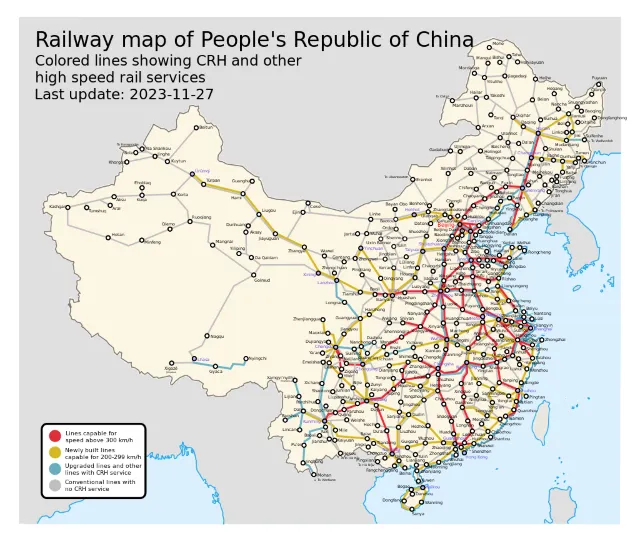
China's high-speed rail map: red lines run at 300-350 km/h, yellow at 200-299 km/h. Map: cnrail.geogv.org - open the live China railway map for the newest lines and a full-resolution download.
What has changed lately: on 28 September 2026 China opened four new sections - Xiong'an to Shangqiu between Hebei and Henan, Xi'an to Ankang in Shaanxi, Yichang to Xingshan in Hubei and Harbin to Yichun in Heilongjiang. The network now runs to more than 50,000 km of high-speed line out of 165,000 km of railway in total, and the plan is to reach 70,000 km by 2035 on the "Eight Verticals and Eight Horizontals" corridors - the thick red and yellow lines that form the grid on the map.
How to read it when you plan:
Almost every major city is on the network: all provincial capitals, plus the big visitor cities such as Xi'an, Hangzhou, Suzhou, Chengdu, Chongqing, Guilin, Zhangjiajie, Huangshan, Xiamen, Qingdao and Harbin. Independent travel by rail is straightforward - stations have English signage and announcements, and tickets are sold in English through Trip.com or the official 12306 site.
| Route | Fastest | Trains a day | Why it works |
| Beijing - Shanghai | 4h18 | about 54 | Forbidden City to the Bund at 350 km/h |
| Beijing - Xi'an | 4h10 | about 41 | Great Wall to Terracotta Army |
| Shanghai - Hangzhou | 34-45 min | about 340 | West Lake as a day trip |
| Shanghai - Suzhou | 25 min | about 150 | Gardens and canals, no hotel change |
| Chengdu - Chongqing | 1h02 | about 153 | Pandas for lunch, hotpot for dinner |
| Beijing - Tianjin | 33 min | about 299 | The easiest first bullet train ride |
| Guangzhou - Hong Kong | 47 min | about 55 | Cross-border, two checks at West Kowloon |
| Shanghai - Guangzhou | 6h14 | about 24 | Long, but still a day train |
Fastest departures and train counts checked on Trip.com in October 2026. Schedules change with the season, so confirm times for your dates before booking.
In practice the eastern half of the country behaves like one large metro area. You can sleep in Shanghai and reach Hangzhou, Suzhou or Nanjing before lunch, then come back the same evening. The west is thinner: Lanzhou, Xining and Urumqi are connected, but the distances are long - Beijing to Urumqi is more than ten hours even on the fastest train, which is why most itineraries stay east of Xi'an.
Two practical points about tickets. Sales usually open about 15 days before departure, and popular routes on public holidays - Spring Festival, Golden Week in early October and the May Day break - sell out within hours. Outside those windows, seats are normally available a few days ahead, and early-morning departures are the easiest to get.

Beijing to Shanghai is the busiest route on the map: roughly 54 departures a day between Beijing South and Shanghai Hongqiao, and the fastest takes 4h18. Check live times and fares before you lock your dates.
This is the mistake that costs people their train. Chinese cities often have three or four high-speed stations, they are far apart, and your ticket is tied to one exact station. Beijing has Beijing South, Beijing West, Beijing Chaoyang and Beijing North. Shanghai has Shanghai Hongqiao, Shanghai Station and Shanghai South. Guangzhou has Guangzhou South, Guangzhou East and Guangzhou North. "Beijing" is not a station name, and "Shanghai" is a different station from "Shanghai Hongqiao".
| City | Stations you will see | Which one you usually want |
| Beijing | Beijing South, Beijing West, Beijing Chaoyang | South for Shanghai and Tianjin, West for Xi'an and Chengdu |
| Shanghai | Shanghai Hongqiao, Shanghai Station | Hongqiao for almost all high-speed trains |
| Xi'an | Xi'an North, Xi'an Station | Xi'an North for every G train |
| Hangzhou | Hangzhou East, Hangzhou West, Hangzhou | East for Shanghai and most long-distance trains |
| Guangzhou | Guangzhou South, Guangzhou East | South for high-speed services |
| Chengdu | Chengdu East, Chengdu South | East for Chongqing and Xi'an |
| Chongqing | Chongqing North, Chongqing West | Both are used - check your ticket |
| Hong Kong | West Kowloon | The only cross-border station |
Five habits that save you a missed train:
Keep the booking confirmation handy - the full station name, the train number and the carriage are all on it.
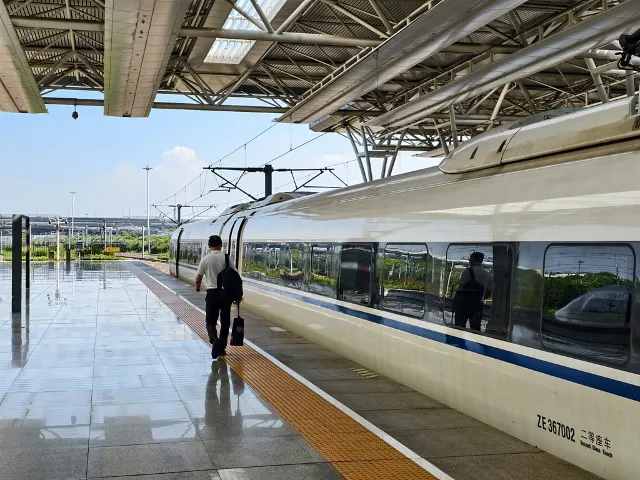
High-speed platforms are marked by carriage, so find your carriage number before the train arrives.
Getting to the station is the other half of the job. Chinese map apps such as Amap and Baidu Maps are the most accurate for station entrances, exits and metro lines, but they are Chinese-only. If you would rather keep using Google Maps, install a travel eSIM before you fly - data from a travel eSIM is routed outside the mainland, so Google Maps, WhatsApp and Gmail keep working. Our China SIM card and eSIM comparison explains the options, and Google Maps in China covers what does and does not work. For metro lines, taxi apps and station layouts in general, see the China transport guide.
Once you know where the stations are, the routes almost plan themselves. We have already ranked the seven best high-speed routes in China by scenery, frequency and value in our bullet train guide. The two itineraries below turn the strongest parts of that network into complete trips you can book as they are.
The classic first trip: Beijing, Xi'an and Shanghai, with one short hop in the Yangtze Delta at the end. Three bases, three train rides, no domestic flights.
| Day | Base | What you do | Train |
| 1-2 | Beijing | Forbidden City, hutongs, Temple of Heaven | - |
| 3 | Beijing | Great Wall at Mutianyu, evening train west | Beijing West - Xi'an North, 4h10 |
| 4 | Xi'an | City wall by bike, Muslim Quarter | - |
| 5 | Xi'an | Terracotta Army in the morning, Big Wild Goose Pagoda | - |
| 6 | Shanghai | Morning train, Bund and French Concession in the afternoon | Xi'an North - Shanghai Hongqiao, about 6h |
| 7 | Suzhou or Hangzhou | Day trip to canals or West Lake, back to Shanghai for the evening | Shanghai Hongqiao - Suzhou, 25 min, or Hangzhou East, 45 min |
Why it works: the two long legs are both on 350 km/h trunk lines, so you lose only one morning to travel. Book the Beijing-Xi'an train for late afternoon so Day 3 still includes the Great Wall, and take an early train out of Xi'an on Day 6. If you have an extra day, add it to Shanghai rather than squeezing in a fourth city - the delta day trips are easier from there. Our 7-day China itineraries cover three other versions of this route.
Two weeks lets you add the middle kingdom: Luoyang's Longmen Grottoes, Nanjing, the canal towns of Suzhou and a slow finish around West Lake. Every leg below is a direct high-speed train of 3h40 or less.
| Day | Base | What you do | Train |
| 1-3 | Beijing | Forbidden City, hutongs, Great Wall, Summer Palace | - |
| 4-5 | Xi'an | Terracotta Army, city wall, Muslim Quarter | Beijing West - Xi'an North, 4h10 |
| 6 | Luoyang | Longmen Grottoes and the old town | Xi'an North - Luoyang Longmen, 1h20 |
| 7-8 | Nanjing | Ming city wall, Sun Yat-sen Mausoleum, Confucius Temple | Luoyang Longmen - Nanjing South, about 3h30 |
| 9-10 | Suzhou | Classical gardens, Pingjiang Road, canal boat | Nanjing South - Suzhou, about 1h10 |
| 11-12 | Shanghai | Bund, Yu Garden, French Concession, museums | Suzhou - Shanghai, 25 min |
| 13-14 | Hangzhou | West Lake, Lingyin Temple, Longjing tea hills | Shanghai Hongqiao - Hangzhou East, 45 min |
Why it works: it moves east gradually, so each train gets shorter as the trip goes on, and the last week is a gentle loop around the Yangtze Delta. Luoyang is the one stop people skip and then regret - the grottoes are a 20-minute taxi from Luoyang Longmen station, so you can see them between two trains if you are short on time. Swap Suzhou for Huangshan if you want mountains instead of gardens; the Huangshan North line is on the same corridor.
There are two realistic ways to book, and they suit different travellers.
Whichever you use, book the long legs first - Beijing-Shanghai and Beijing-Xi'an are the ones that sell out - and keep the confirmation with the station name visible. Our step-by-step guides cover buying train tickets in China as a foreigner and booking on 12306.
One last thing about the map: print it, or keep it on your phone, but plan around the corridors rather than the cities. The lines that run north-south and east-west are the ones with the most departures, the shortest waits and the cheapest seats - and they are the reason a rail-only trip across China is now easier than most people expect.
Popular recommendations
Bullet Train China 2026: The 7 Best High-Speed Rail Routes
 OneVoyager

7 Days in China: 4 Best Itinerary Options for Every Traveler (2026 Guide)
OneVoyager
China SIM Cards 2026: Best Data SIMs, eSIMs and Pocket WiFi for Short Trips, Longer Stays and Travel in China
OneVoyager
How to Buy Train Tickets in China as a Foreigner in 2026
 LocalGuides