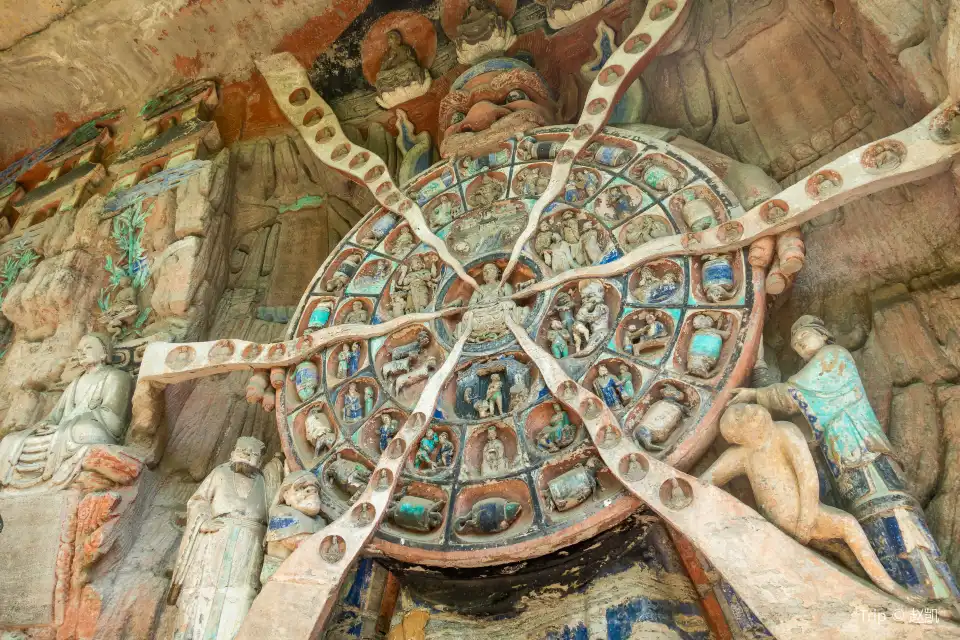
Dazu Rock Carvings(Big foot)
大足石刻 based on 257 reviews
 No. 6 of Global Traveller-Picked Attractions in Chongqing
Opening hours of Dazu Rock Carvings
Dazu Rock Carvings Highlights: Must-See Features and Attractions
Dazu Rock Carvings is the collective name for the cliff carvings (grottoes) in Dazu District, Chongqing, primarily featuring Buddhist themes. It includes Baodingshan Scenic Area, Beishan Rock Carvings, Nanshan Rock Carvings, Shimenshan Rock Carvings, Shizhuanshan, and other sites, where well-preserved rock carving art from the Tang and Song dynasties can be appreciated. To date, 75 sites of rock carvings have been designated as cultural heritage protection units, with over 50,000 statues. The carvings at these attractions were first created in the early Tang dynasty, continued through the late Tang and Five Dynasties, flourished during the Northern and Southern Song dynasties, and extended into the Ming and Qing dynasties, spanning over a thousand years. They are a monument in the history of Chinese grotto art and a magnificent chapter in world grotto art from the late 9th to the mid-13th century.
Rooted in the fertile soil of the long-standing Ba-Shu culture, the attraction builds on and integrates the essence of earlier grotto art, innovating and pursuing exhaustive transformation to open up new horizons in grotto art. With distinctive national, secular, and life-oriented characteristics, it has become a model of grotto art with Chinese style.
It is a representative work of late Chinese grotto art, and together with the Dunhuang, Yungang, and Longmen grottoes, it forms a complete history of Chinese grotto art. The grottoes showcase, from different perspectives, the significant developments and changes in Chinese grotto art styles and folk religious beliefs between the 9th century and the mid-13th century, making important contributions to the innovation and development of Chinese grotto art, and possessing irreplaceable historical, artistic, scientific, and appreciative value compared with grottoes of earlier dynasties. On December 1, 1999, it was inscribed on the UNESCO World Heritage List as a cultural heritage site.

Baodingshan attraction andBeishan Rock CarvingsRelatively concentrated
Among the stone carving clusters, the more concentrated ones are the Baodingshan attraction and Beishan Stone Carvings. They sell tickets separately, and combo tickets are also available. The two are over ten km apart. The other three attractions in the stone carving cluster—Nanshan, Shimenshan, and Shizhuanshan—officially opened in July 2024.
Dazu Rock Carvings
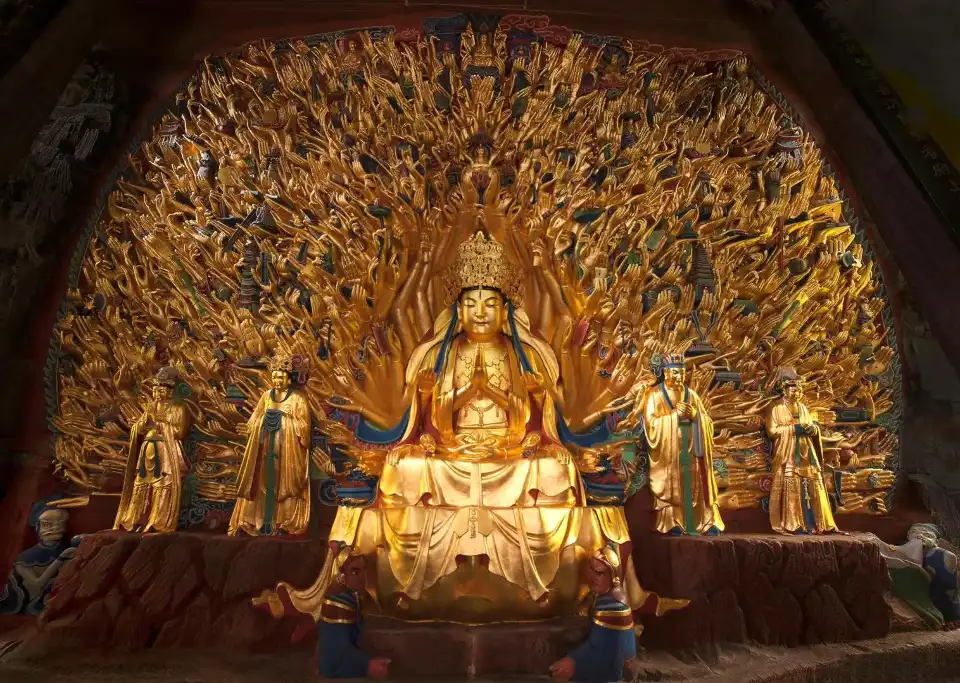
Baodingshan Rock Carvings are located in the Baodingshan Scenic Area 15 km northeast of the urban area of Dazu. Centered on the Greater and Lesser Buddha Bays, they were carved under the supervision of the monk Zhao Zhifeng during the Chunxi to Chunyou reign periods of the Southern Song Dynasty (1174–1252). The Greater Buddha Bay of the Dazu Rock Carvings Scenic Area is a U-shaped mountain bay, with a cliff face of carvings about 500 m long and 8–25 m high. The carvings are cut on the east, south, and north cliff faces and are numbered consecutively as Nos. 1–31.

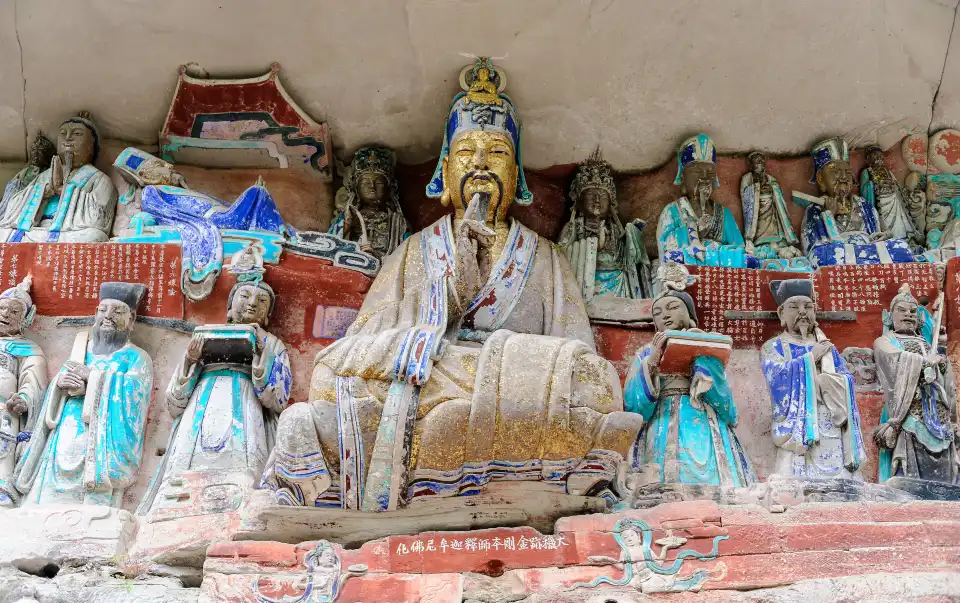
The sculptures in the Baodingshan Grottoes exhibit several characteristics that distinguish them from earlier Chinese grottoes: First, the Baodingshan Grottoes are a rare large-scale Buddhist Esoteric sect grotto site in China, extending the history of Chinese Esoteric Buddhism by nearly four hundred years. Second, the expressive forms of the Baodingshan sculptures are unique in grotto art. In the Dafowan area of the Dazu Rock Carvings scenic site, the themes of thousands of sculptures do not repeat, and the niches and caves are both internally connected in doctrine and formally interlinked, forming an organic whole that resembles a magnificent historical scroll painting. All sculptures are accompanied by both images and texts, and the inscribed scriptures mostly differ from those in the Tripitaka; many are extra-canonical Buddhist stone inscription documents not included in previous editions of the Tripitaka, holding significant academic value for the study of Buddhist texts. Third, the sculptures emphasize philosophical exposition, integrating the basic doctrines of Buddhism with Confucian ethics, the mind-nature theory of Neo-Confucianism, and Daoist teachings, broadly incorporating and assimilating multiple traditions, and displaying the characteristics of Buddhist thought in Song dynasty China. Fourth, from content to form, the Baodingshan sculptures are a model of the nationalization and secularization of Chinese grotto art. The reverence for Confucian filial piety and the depiction of worldly urban life make it an art treasury with strong traditional Chinese cultural characteristics, marking the completion of the Sinicization process of grotto art that originated in India. Fifth, the Baodingshan sculptures are a culminating work of grotto art, with creative developments in many aspects. They take the ability to inspire awe in people as their creative principle, thereby arousing devotees' pious faith in the Buddhist Dharma. They also integrate scientific principles into artistic modeling; the sculptures, decorations, layout, drainage, lighting, support, and perspective all pay great attention to formal beauty and artistic conception.

In addition, there are still 16 steles, 44 inscriptions, travel notes, and poems, and 49 records of repairs and adornments in the Baodingshan Grottoes sculptures. Among them, the stele "Biography of Liu Benzun of the Tang Dynasty," carved between 1174 and 1252 AD, and the "Record of reopening the Baoding stele" and other [texts] are of significant academic value for the study of the history of the Baodingshan Grottoes and even the history of Chinese Esoteric Buddhism.
Beishan Rock Carvings
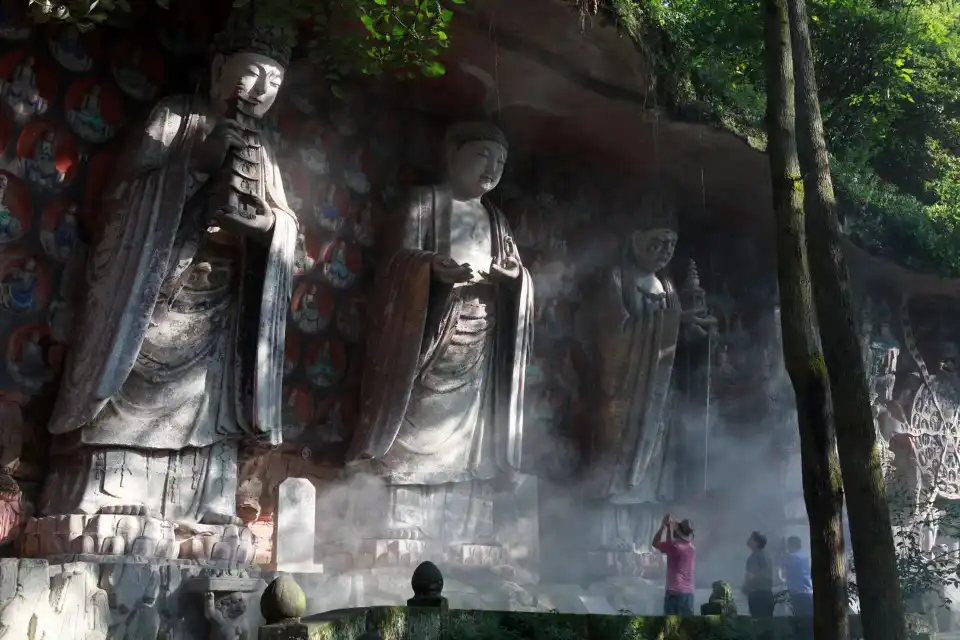
Beishan Rock Carvings are located on the summit of Beishan (commonly known as Fo Wan) 1.5 km north of the main urban area of Dazu District. They were first carved in the first year of Jingfu of the Tang Dynasty (892) by Wei Junjing, then prefectural governor of Changzhou and commander of the four prefectures of Chang, Pu, Yu, and He. Subsequent construction by local officials, gentry, commoners, and monks and nuns continued until the final year of Shaoxing of the Southern Song Dynasty (1162), when the present scale was reached.
The sculptures in the Beishan Grottoes were built against the rock, with the cliff face of the sculptures approximately 300 m long and 7–10 m high, shaped like a crescent moon. The niches and caves are as densely packed as honeycombs and are divided into the southern and northern sections, numbered consecutively as 290, including 264 niches and caves with sculptures, nearly ten thousand statues, 1 incised-line diagram, and 8 sutra pillars. The Beishan Grottoes sculptures were mainly carved with funds donated by laypeople praying to the Buddha, with rich themes, predominantly Esoteric Buddhist sculptures, accounting for more than approximately one-half of the total.
The late Tang dynasty sculptures in the Beishan Grottoes feature 12 types of themes, with Guanyin and the combined niches of Guanyin and Ksitigarbha, as well as Amitabha accompanied by Guanyin and Ksitigarbha, being the most common. The late Tang sculptures are dignified and full-bodied, with a robust temperament, fine and dense drapery lines, and thin garments clinging to the body, bearing the legacy of the High Tang style.

The Five Dynasties sculptures account for more than one third of the Beishan Grottoes, featuring 18 themes, including new content such as the Bhaisajyaguru Sutra transformation and the Dharani Sutra transformation, making it a region with a large number of sculptures from this period in China. The Five Dynasties sculptures are small and exquisite, with varied postures, free and natural expressions, and increasingly ornate clothing and adornments, presenting a transitional style from the Tang to the Song Dynasty.
The Song dynasty sculptures in the Beishan Grottoes feature 21 types of themes, with Guanyin being especially prominent, earning it the title of "China's exhibition hall of Guanyin sculptures." The Song dynasty sculptures have distinct character personalities, elegant postures, well-proportioned figures, and brightly colored attire, possessing a rich decorative beauty.
Seven steles and inscribed tablets are extant at the Beishan Grottoes. Among them, the "Stele of Wei Junjing," carved in 895 AD, holds significant value for filling gaps in Tang dynasty history; the "Spirit Way Stele of Lord Zhao Yijian," carved between 1163 and 1189 AD, was written by Cai Jing, one of the four great calligraphers of the Song dynasty, and is a treasure of calligraphic art; and the twenty-two-chapter "Stele of the Ancient Text Classic of Filial Piety" has been called by historians "the only carving of its kind in the world."
The grottoes are renowned worldwide for their exquisite elegance, distinctive characteristics of the era, fine carving, superb craftsmanship, and excellent preservation. They also integrate works from the late Tang, Five Dynasties, and Northern and Southern Song dynasties, showcasing the different styles and evolutionary development of grotto art across various periods from the late Tang to the Song dynasty, and are hailed as a "museum of Tang and Song stone carving art."

Other visitors' reviews of Dazu Rock Carvings
Show More ReviewsThe Dazu Rock Carvings are quite spectacular. I walked around taking pictures and asking Doubao questions, which gave me a clearer understanding of what I saw along the way. The ancient Chinese craftsmen were truly amazing!