Tokyo Transportation Guide
-
Airport Transfer
-
Subway
-

Car
-

-

-

Pass
Popular Tokyo Transportation Pass
See all attractions
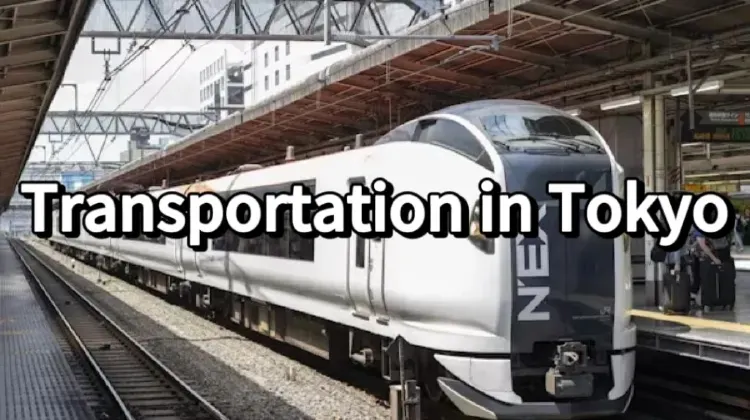
Tokyo's transportation system is superbly designed to connect its various urban centers, almost like several cities linked together. You can quickly move from one area to another, such as from Shibuya to Shinjuku, by hopping on the JR Yamanote Line, known as the "Loop Line." Most of Tokyo's key areas are on this line, with Roppongi and Asakusa being just a few stops away via subway.
For a smooth travel experience within Tokyo, using a prepaid Suica or Pasmo card is the best option. These cards can be purchased online and picked up at the airport. While taxis provide excellent service, they are quite expensive. Buses might not be the easiest option for those not familiar with the area, making the train and subway systems the most efficient means to explore the city.
In this article, we'll show you how to get around Tokyo easily and cheaply, even if it's your first time. Keep reading for more useful tips!
Trains are on time & clean which makes traveling in Tokyo easy, source from Japan Guide.com
Tokyo train system is the most important part of the city's transport. It helps millions of people get to work, school, and places of interest quickly and efficiently every day. The network includes many lines managed by various companies, including Japan Rail (JR), Tokyo Metro, and Toei Subway. This system is very useful for tourists too, as it connects nearly all parts of the city and nearby areas.
Tokyo’s train system is an extensive network connecting urban and suburban areas, operated by companies including Japan Rail (JR), Tokyo Metro, and Toei Subway, providing comprehensive coverage throughout the city and beyond (source: Go Tokyo).
Service | Operator | Description | |
Train | Japan Rail (JR) | JR East | Operates a large number of train lines including the popular Yamanote Line and the fast Shinkansen or bullet trains. Covers both local areas in Tokyo and longer distances to other cities. |
Subway | Tokyo Metro | Tokyo Metro Corporation | Manages nine lines that reach many well-known areas like Shibuya and Ginza. Useful for tourists visiting major sights. |
Toei Subway | Tokyo Metropolitan Bureau of Transportation | Runs four lines that help connect with other major train and subway networks, making it easier to reach various parts of the city. |
In central Tokyo, the Yamanote Line, operated by JR East, is especially useful. This loop line connects Tokyo's multiple city centers, serving major hubs such as Tokyo, Ueno, Ikebukuro, Shinjuku, Shibuya, and Shinagawa stations. This line is often the easiest way to get around the city center. Trains come every few minutes, so waiting times are short. This line is great for tourists because it stops at many places they are likely to visit. Here’s a closer look at the major JR lines that are vital for traveling within central Tokyo:
Line | Operator | Key Stations |
Yamanote Line | JR East | Shinjuku, Shibuya, Harajuku, Tokyo Station |
Keihin-Tohoku Line | Ueno, Akihabara, Tokyo, Shinagawa, Yokohama | |
Chuo/Sobu Line (Local) | Mitaka, Shinjuku, Akihabara, Chiba | |
Chuo Line (Rapid) | Tokyo Station, Shinjuku, Mitaka, Tachikawa, Otsuki | |
Saikyo Line | Ikebukuro, Shibuya, Shinjuku, Osaki | |
Shinkansen | Tokyo, Shinagawa, Ueno |
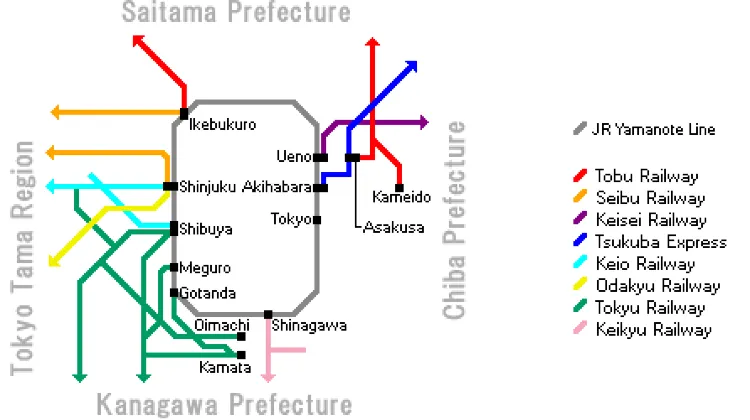
For trips outside the main city, several train lines connect Tokyo to its suburbs and other nearby prefectures. These lines start from central stations and extend outwards, providing access to less urban areas and attractions outside the crowded city center. Each railway company offers its own one-day or two-day passes for unlimited travel.
The Hakone Freepass offers 2‑ or 3‑day unlimited travel on eight transport types, including the Hakone Tozan Train, Ropeway, buses, and a round-trip on the Odakyu Line. It also provides discounts at popular attractions like museums, parks, and hot springs, making sightseeing around Hakone easy and cost-effective (source: Odakyu Railway).
Line | Operator | Coverage Area |
Tokyu Railway | Tokyu Corporation | Serves areas in southwestern Tokyo and goes as far as Kanagawa. Good for reaching the suburbs and coastal regions. |
Tobu Railway | Tobu Railway Co. | Useful for traveling to Saitama and Tochigi, providing access to scenic areas and historic sites. |
Seibu Railway | Seibu Railway Co. | Covers western parts of Tokyo and parts of Saitama, ideal for day trips into the countryside. |
Keio Railway | Keio Corporation | Connects central Tokyo with the western suburbs, useful for accessing hiking spots and natural parks. |
Odakyu Railway | Odakyu Electric Railway | Goes to Kanagawa and the popular tourist area of Hakone, known for hot springs and views of Mount Fuji. |
Keisei Railway | Keisei Electric Railway | The best way to get to Narita Airport, with frequent services directly from central Tokyo. |
Keikyu Railway | Keikyu Corporation | Connects Tokyo with Kanagawa and provides easy access to Haneda Airport, making it a good choice for international travelers. |
Tsukuba Express | Metropolitan Intercity Railway Company | Links central Tokyo with Ibaraki, offering a quick route to the science city of Tsukuba. |
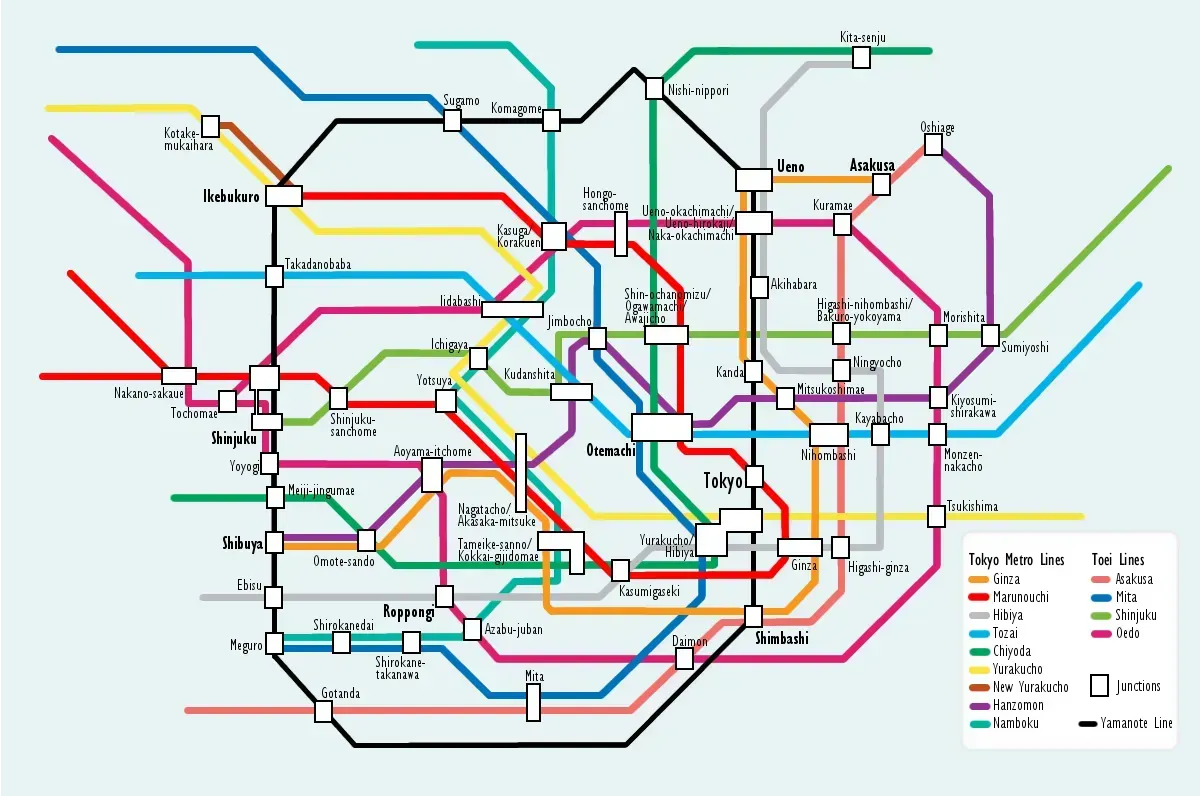
Tokyo Metro Map (Source: wikipedia)
Tokyo's subway network consists of 13 lines that are operated by two entities: Tokyo Metro, which runs nine lines, and the Tokyo Metropolitan Bureau of Transportation, also known as Toei, which manages four lines. These lines densely cover central Tokyo, especially within the Yamanote circle and around areas like Ginza and east of the loop line.
The subway map has different colors for each line, making it easy to follow. Both Tokyo Metro and Toei provide signs in multiple languages at stations and on trains, helping travelers find their way. Despite being separate companies, Tokyo Metro and Toei coordinate their services, allowing passengers to transfer between their lines more easily.
Operator | Line Name | Line Number | Color |
Tokyo Metro | Hibiya Line | Line 2 | Silver |
Ginza Line | Line 3 | Orange | |
Marunouchi Line | Line 4 | Red | |
Tozai Line | Line 5 | Light Blue | |
Namboku Line | Line 7 | Jade Blue | |
Yurakucho Line | Line 8 | Gold | |
Chiyoda Line | Line 9 | Green | |
Hanzomon Line | Line 11 | Purple | |
Fukutoshin Line | Line 13 | Brown | |
Tokyo Metropolitan Transportation Bureau | Asakusa Line | Line 1 | Pink |
Mita Line | Line 6 | Blue | |
Shinjuku Line | Line 10 | Yellow-Green | |
Oedo Line | Line 12 | Purple |
👉 Click to view & download a high-resolution Tokyo Metro Map.
It's also important to note that some subway lines extend beyond their usual routes at terminal stations, where they continue on the tracks of other suburban train lines. For instance, the Chiyoda Subway Line connects directly with the suburban Odakyu Line at Yoyogi-Uehara, and trains on the Fukutoshin Subway Line extend onto the Tokyu Toyoko Line tracks at Shibuya.
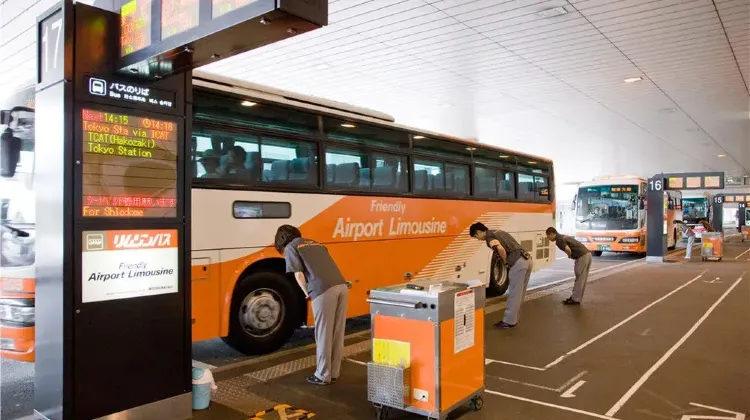
Buses can be especially useful if you find yourself outside the main parts of the city
In Tokyo, while the subway and train systems cover much of the city, buses offer a viable transportation alternative, particularly for reaching lesser-known areas or when trains are too crowded. Although buses in Tokyo may not run as frequently as trains and can take longer to travel from place to place, they are well-equipped with conveniences like free WiFi on some routes.
Service | Description | General Fare | Operating Hours | Notable Routes |
Toei Bus | Connects main city areas, useful with other public transport. | Adults 210 yen, Children 110 yen | Check website for schedule | Various city routes |
SKY BUS TOKYO / SKY Duck | Open-top buses touring major sights. | Varies by course | 9:00–18:00 | Tokyo Tower, Ginza, Rainbow Bridge courses |
Hato Bus | Tour bus service with various themed tours. | Adults 2,000-2,200 yen, Children 1,000-1,100 yen | Multiple departures from 9:30-16:00 | Panorama Drive (Rainbow Bridge & Ginza) |
Skytree Shuttle® | Sightseeing shuttle connecting major attractions. | Adults 230 yen, Children 120 yen (Ueno‒Asakusa Line) | Check website for schedule | Ueno, Asakusa, TOKYO SKYTREE TOWN |
Free Shuttle Bus | Free bus service running between key districts. | Free | [Weekdays] 8:00 - 20:00, [Weekends] 10:00 - 20:00 | Marunouchi, Nihonbashi areas |
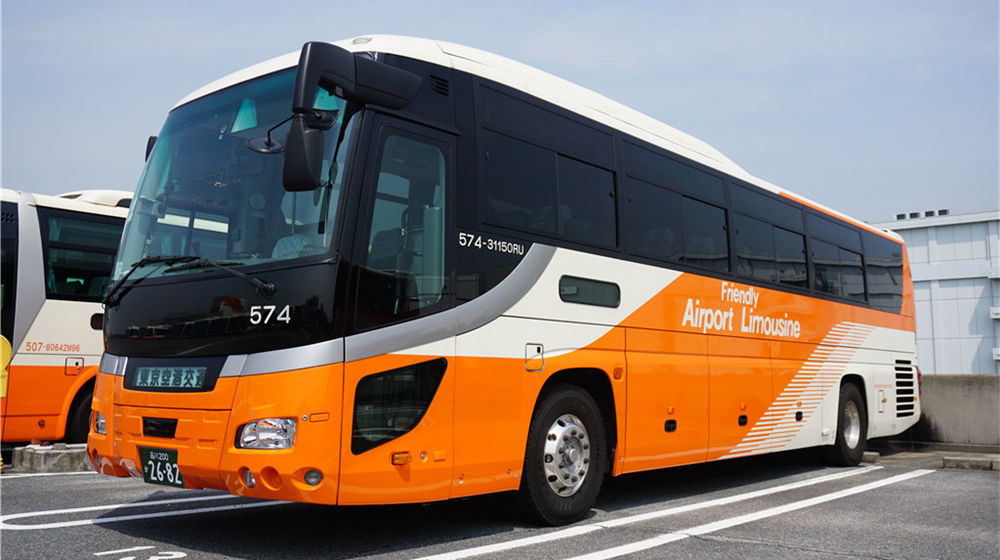
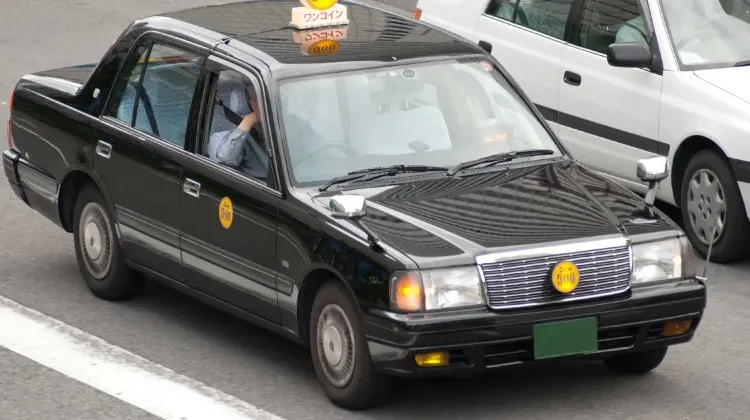
Taking a taxi in Tokyo can be quite expensive
You don't always have to hail a taxi on the street. Many hotels, hostels, and businesses will call one for you. If they don't speak English, you can ask by saying, "takushii o yonde kudasai" (please call me a taxi). This service may include a small fee, around $2.71, known as a "pick-up fee."If you're outside, the easiest way to find a taxi is to go to a taxi stand, commonly found near stations and popular tourist spots. In central Tokyo, you can usually flag down a taxi in a matter of seconds by standing on a busy street. Alternatively, you can use a taxi booking app.
To see if a taxi is available, look for a red sign on the dashboard displaying 空車 (“kuusha” meaning "empty car"). A green sign showing 賃走 (“chinso”) means the taxi is occupied. The left door of the taxi is operated remotely by the driver, so you don't need to open it yourself.
The initial charge for a taxi starts at approximately $3.32 for the first 1.096 km. After that initial distance, the fare increases by about $0.66 for every 255 meters, or during waiting times. Below is an overview of some standard fares:
Destination | Distance | Daytime Fare (USD) | Nighttime Fare (USD) |
Shinjuku Station to Yoyogi Station | About 2 km | ~$5.30 | ~$5.96 |
Shinjuku Station to Harajuku Station | About 2.7 km | ~$7.28 | ~$8.61 |
Haneda Airport to Shibuya Station | About 17.5 km | ~$45.70 | ~$54.96 |
【Additional Charges】
Discover Tokyo in your own car with Trip.com Tokyo Car Rentals! Enjoy hassle-free pick-up/drop-off, a wide selection of well-maintained vehicles, and 24/7 support for a seamless experience. Whether you're exploring vibrant neighborhoods, day-tripping to Mount Fuji, or navigating beyond the subway lines, renting with Trip.com ensures you travel easily. Book now and unlock the full potential of your Tokyo adventure!
Don’t just take our word —see what other travelers say about their Trip.com Jeju car rental experience! Real reviews from customers who’ve explored Jeju Island with Trip.com car rental before:





Tokyo is a major international city with a highly developed public transport system, including subways, trains, and buses that cover all areas within Tokyo. Therefore, renting a car is not necessary for tourists who are only traveling within these areas.
However, if you plan to visit places outside of Tokyo or if you are traveling with a group that includes children or elderly people, renting a car might be a better choice.
Car rentals provide more freedom and comfort, especially if you need to travel between multiple locations or want a more flexible and relaxing travel experience. Rent car on Trip.com to get 8% Off!
Japan Car Rental Types | Capacity | Estimated Price |
Small Cars | 4 Passengers | From US$33.70 per day |
SUVs | 5-7 Passengers | From US$34.08 per day |
Vans/Minivans | 7-8 Passengers | From US$38.62 per day |
To travel easily in Tokyo, having a reliable and fast internet connection is crucial, and an eSIM can be incredibly useful for this purpose. An eSIM, or "embedded" electronic SIM, is presented in the form of a QR code. Unlike traditional physical SIM cards, which require insertion into a phone's SIM card slot, an eSIM can be activated immediately by simply scanning a QR code. This allows you to connect to the local network instantly.
Using an eSIM is the latest method for staying online while traveling in Japan. You don't need to buy a physical Japanese SIM card or queue up to rent a WiFi device. Just purchase a Japanese eSIM plan through an app, and you can use it right away to stay connected with the world!
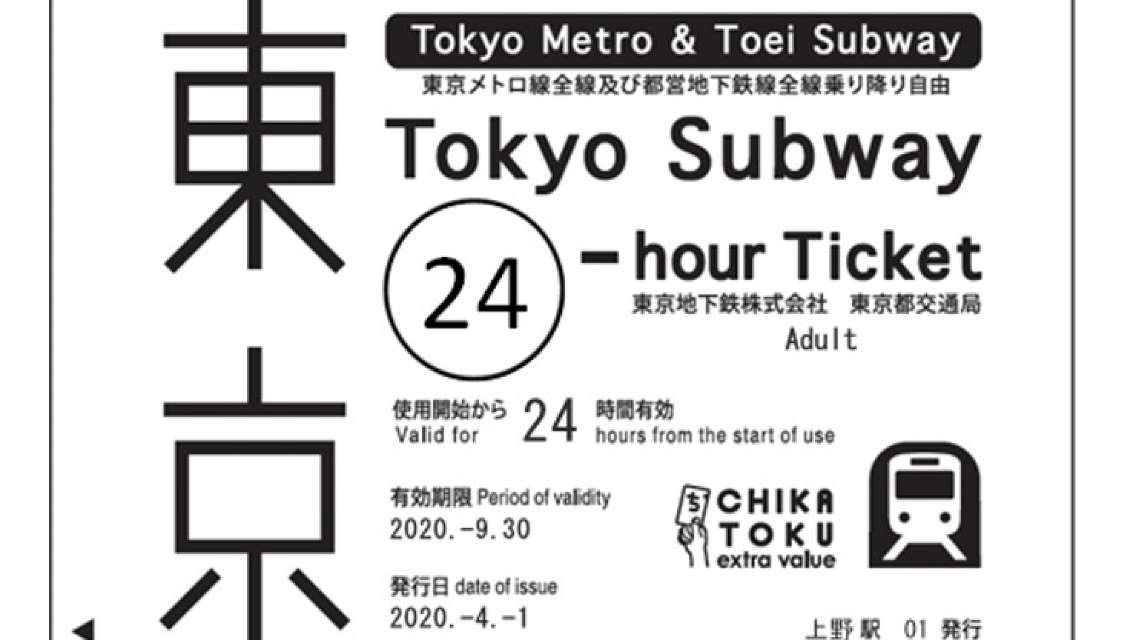
For tourists focused on heavy subway use to hit numerous attractions across the city, the Tokyo Metro 1-3 Days Pass offers a cost-effective solution. Available in 24-hour, 48-hour, and 72-hour options, this pass allows unlimited travel on all Tokyo Metro and Toei Subway lines.
This is ideal for visiting well-known districts such as Ueno, Asakusa, Shibuya, Shinjuku, and Ginza. Passes can be bought at Tokyo Metro ticket counters, select subway stations, Bic Camera stores, and tourist centers—just remember to bring your passport. Additionally, booking your pass online through platforms like Trip.com can often yield a discount, such as a 3% off promotion available for certain booking dates.
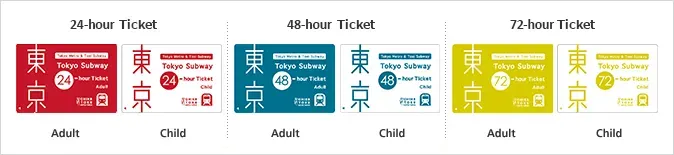
Booking your pass online through platforms like Trip.com, source from Tokyometro Official site
Here's a table with the latest 3% Off prices and discounts for the Tokyo Subway tickets:
Ticket Type | Age Group | Original Price (USD) | Trip.com Discount | Discounted Price (USD) |
Tokyo Subway One-Day / 24-hour | Adult |
| -0.16 | 4.98 |
Child |
| -0.08 | 2.49 | |
Tokyo Subway Two-Day / 48-hour | Adult |
| -0.23 | 7.35 |
Child |
| -0.12 | 3.61 | |
Tokyo Subway Three-Day / 72-hour | Adult |
| -0.29 | 9.34 |
Child |
| -0.15 | 4.67 |
*Adult: Age 12+ , Child: Age 6 to 11
For most visitors and residents, prepaid IC cards like Suica and Pasmo are highly recommended. These cards don't offer a fare discount over single tickets; however, they greatly simplify the process of getting around. A quick tap on the card reader is all you need to access nearly any train or bus in Greater Tokyo and other major cities across Japan.
Besides transportation, these cards can be used for small purchases in convenience stores, vending machines, and many restaurants, making them a versatile tool in everyday urban life. If you plan to travel across various parts of the city without sticking to a strict route, an IC card is invaluable.
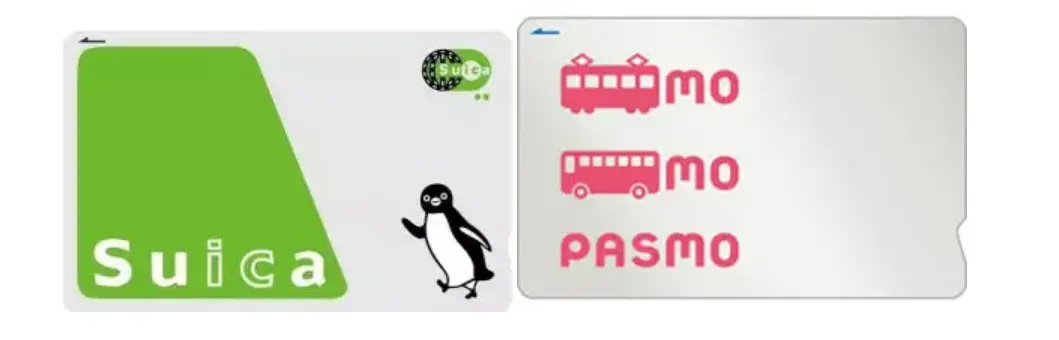
These cards can be used for small purchases
For those looking to extend their exploration beyond central Tokyo to surrounding regions, the JR TOKYO Wide Pass is an excellent choice. This pass provides three consecutive days of unlimited travel on JR trains, including selected shinkansen bullet trains. It covers exciting destinations like Nikko, the Fuji Five Lakes area, Mount Fuji, and hot spring resorts such as Karuizawa and Kusatsu. Priced at US$108.62, it’s especially useful for visitors planning day trips to these scenic areas from Tokyo. The pass can be purchased online, with links available for easy booking.
Validity period | Coverage Areas | Price | Booking link |
3 consecutive days | In and Around Tokyo | US$108.62 |
Hakone is one of Japan's primary hot spring (onsen) areas that are close to Tokyo and still remain the rich nature without artificial development. The Hakone Freepass is a discounted ticket offering coverage of all the popular sightseeing destinations in Hakone.
Hakone Freepass included a round-trip ticket on the Odakyu Line and able to get on-and-off freely within the designated area, also the Hakone Freepass included some discounts at the specific sightseeing location.
The validity of this pass comes with a choice of 2 day and 3 days. The pass provides access to 8 different transportation systems in the area, such as the Hakone Tozan Line, the Hakone Ropeway, the Hakone Sightseeing Cruise and etc
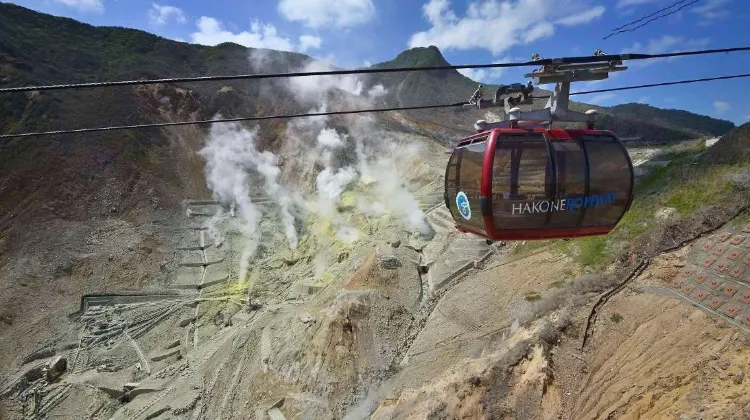
Explore Hakone freedomly throughout your journey
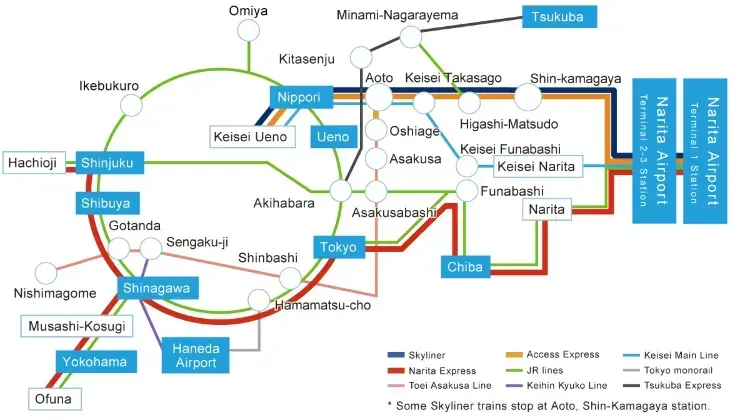
How to Get from Narita or Haneda Airport to Tokyo?
Transport | Expenditure (JPY) | Travel Time | Frequency | Advice |
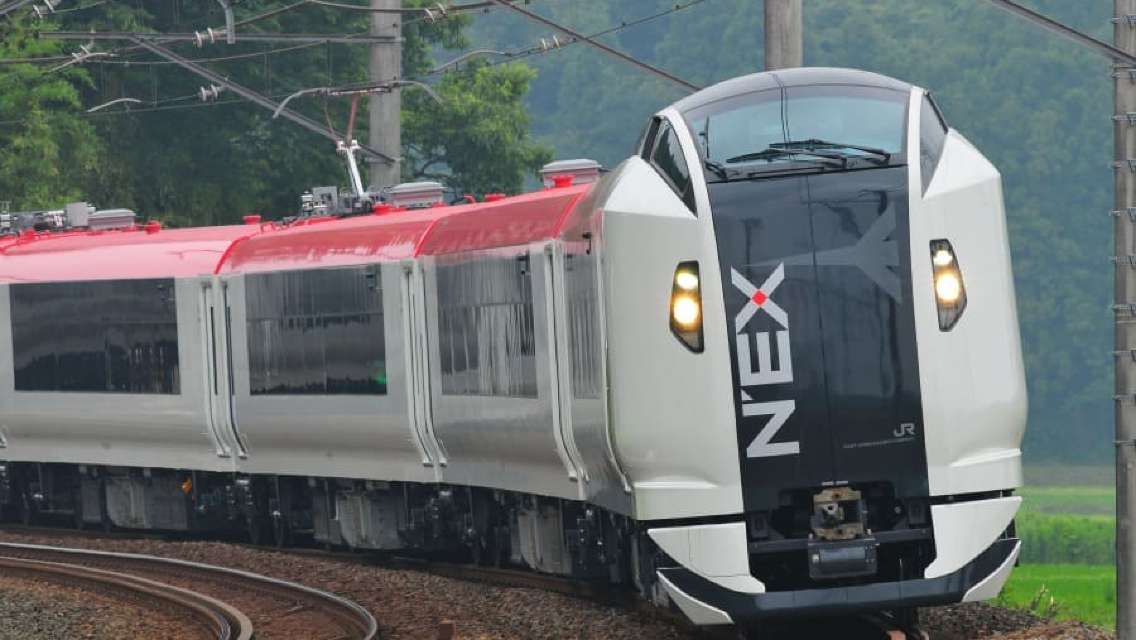
~$19.65 | ~53 mins to Tokyo Station | Every 30 mins | Best for those close to JR stations, seeking quick access to Tokyo with the flexibility of the JR Rail Pass. | |
~$14.42 | ~41 mins to Ueno Station | Every 15-20 mins | Ideal for quick, direct journeys to Ueno/Nippori, offering speed and comfort for travelers on a tight schedule. | |
~$8.05 | ~95 mins to Tokyo Station | Every 15-20 mins | Transfer at Nippori Station for onward travel on JR lines. Buy at the airport. | |
~$9.01 | ~90-120 mins to Tokyo Station | Hourly | Suitable for direct hotel connections, favored by those prioritizing convenience over cost and staying near bus stops. | |
From $135 | ~60 mins to Tokyo Station | On-demand | Preferred for a private, direct experience, especially for those with more luggage or less concern for expense. | |
From $168.96 | ~90 mins to Tokyo Station | On-demand | Price may vary considerably depending on traffic and time of day. |
Transport Option | Approx. Cost | Travel Time | Frequency | Tips |
Tokyo Monorail | Around 500 JPY | 15-20 mins to Hamamatsucho Station | Every 3-5 mins | You can use the JR Pass on Tokyo Monorail |
Keikyu Line | Around 400-500 JPY | 15-30 mins to Shinagawa Station | Every 5-10 mins | Connects to the Asakusa Line, convenient to Asakusa or Ginza |
Around 930-2,200 JPY | 30-90 mins | Every 15-30 mins | A comfortable option takes you directly to major hotels or train stations. Good choice if you have a lot of luggage. | |
Taxi | Around 5,000-10,000 JPY | 30-60 mins | Available 24/7 | Most expensive option but offer door-to-door service |
Pre-booked Taxi | Around 5,000-10,000 JP | 30-60 mins | Available 24/7 | |
5,000 JPY per day | / | N/A | Renting a car might be useful if you plan to travel outside Tokyo |
How to Use Public Transportation in Japan | |
Taking the Train | Purchase tickets at the station's vending machines. Insert your paper ticket into the ticket gate machine; it will be returned as you enter. Keep it with you, as you need to insert it again at your destination, where it will be collected. Alternatively, use an IC card for entry and exit. |
Taking the Bus | Check bus schedules via mobile apps or at bus stops, displaying times for weekdays and weekends/holidays in a 24-hour format. For buses with a fixed fare, pay upon boarding or exiting by inserting cash into the fare box or tapping your IC card. For distance-based fares, take a numbered ticket when boarding and pay the corresponding amount shown above the driver when exiting; use your IC card to tap on entry and exit. |
General Tips | Queue and board trains at marked spots on platforms. Do not rush onto the train when doors open. Avoid eating, drinking, or making phone calls on trains. If carrying a large backpack, hold it in front or keep it between your legs to minimize inconvenience to others. Note the last train times between 23:30 and 00:30, especially when out late. First trains start around 5:00 AM. Designated seats are available for the elderly, pregnant women, disabled passengers, or those in need. Most trains have women-only carriages during peak hours, which are also accessible to young children, passengers with mobility issues, and their caregivers. |
Tokyo's train maps include services from Japan Railway Group (JR), Tokyo Metro, Toei, and various private railways, offering a complete view of transit options in the city. JR lines are marked in black with destinations noted in small red letters. The JR Yamanote Line, crucial for reaching popular sightseeing spots, is typically highlighted in a prominent black oval on maps.
For those who find the comprehensive train maps too intricate, focusing on maps that only detail central Tokyo might be less confusing. Maps that highlight both JR and subway lines are particularly useful for tourists who plan to use multiple forms of transit.
To effectively use Tokyo's train maps, start by identifying the station and line you need. The name of the station and the lines passing through can be checked using tools like Google Maps. Remember, if the line is marked by a single letter (like 'G' for the Ginza Line), it belongs to the subway; two letters indicate JR lines.
Finding the correct platform in Tokyo's vast train stations can also be a challenge. Each line is usually represented by a specific color and number, making it easier to navigate once inside the station. For instance, the JR Yamanote Line is typically denoted by a light green color. Platforms for a single train line might be split into two, each going in opposite directions, so checking the platform number and the direction is crucial.
In Tokyo, the busiest times on trains are during the morning and evening rush hours. If you want to avoid the crowds, it's best to steer clear of these peak times:
Avoiding these hours will make your travel more comfortable. If you must travel during these times, prepare for a densely packed experience. Additionally, late-night trains, especially on weekends, can also be quite busy as people return home from outings. If you prefer a quieter ride, mid-morning, early afternoon, and late evening after the rush are typically less congested.
Planning your journey can also involve online resources, which can show detailed routes from your departure point to your destination. Websites like Google Maps, japantravel.navitime.com, and others are invaluable for planning and can show you which platforms to use and when to transfer lines. Check more useful Japan travel APPs below 👇
Best Japan Transport Apps | |
NAVITIME Transit | Designed to help users find the most efficient routes for their journeys, such as trains, subways, buses, and flights. |
Google Map | Provides detailed information about geographical regions and sites around the world, including in Japan. |
Japan Travel by NAVITIME | A comprehensive travel app designed to assist travelers in navigating Japan with ease. |
Suica App | Allows users to manage their Suica card directly from their mobile device |
Japan Taxi/GO | A popular mobile app in Japan that allows users to easily hail and pay for taxi rides from their smartphones. |

GO is the No.1 taxi app, serving 45 of 47 prefectures in Japan(e.g. Hokkaido, Tokyo, Kyoto, Osaka, Fukuoka and Okinawa). It is a popular mobile application in Japan that allows users to easily hail and pay for taxi rides from their smartphones. Go has been designed to improve the convenience of using taxis for both residents and visitors in Japan.

Japan Travel is a comprehensive travel app designed to assist travelers in navigating Japan with ease. It is developed by NAVITIME JAPAN, a company known for providing detailed navigation services. The app is tailored for international tourists and offers a range of features, including route search, offline maps, and travel guides.

The Suica app, also known as "Mobile Suica," brings the convenience of the physical Suica card to smartphones. It allows users to manage their Suica card directly from their mobile device. The app is available for both iOS (through Apple Wallet) and Android (via the Mobile Suica app) platforms.
Check More Japan Transport APPs and Japan Travel APPs below:
If you're planning a trip to Japan, Trip.com is an excellent place to find deals on flights and hotels. You can find great prices on popular flights and hotels.
If you're interested, please click on the image below for more details! 👇

 113885 booked
![Tokyo Metro 24/48/72-hour travel pass [Physical ticket/e-ticket/Skyliner Tokyo Airport Express/Tokyo Limousine Bus discount package available]](https://ak-d.tripcdn.com/images/0354t12000pj5wys8B52D_C_568_320.png)
![Skyliner Keisei railway ticket (Tokyo airport express: Narita International Airport-Ueno/Nippori) [optional+Tokyo subway discount package]](https://ak-d.tripcdn.com/images//0580f12000qjpzexo5F36_C_568_320.jpg)