Can Foreign Tourists Fly a Drone in China? Registration, Airspace and the 2026 Rules

Yes, a foreign tourist can fly a drone in China only if it is registered in your name and the airspace and site allow it. Since January 1st, 2024, every civil drone needs real-name registration under China's Interim Regulations on the Flight Management of Unmanned Aircraft and flying an unregistered drone attracts a fine. Micro drones may fly up to 50 m true height, and light drones up to 120 m, in permitted airspace with no prior approval, outside airports and other controlled zones. Flying in a controlled zone needs approval in advance. However, Beijing is off limits for drones (see City Rules below), and most big scenic areas check bags at entry. Spare batteries go in your cabin bag. First, test whether the registration platform accepts your passport.
Plan Your China Trip
Flights to Shanghai
Hotels in Shanghai
China eSIMs
See all flights

 NO.1









What does Chinese law require of a drone owner?

According to Article 10 of the Chinese Interim Regulations on the Flight Management of Unmanned Aircraft, issued in 2023 by the State Council and the Central Military Commission and in force since 1 January 2024, every owner of a civil drone must register it under their real name. There is no exception for tourists or for light weight drones. Even tiny drones under 250 g must be registered. Article 9 also says every drone must carry a unique product identity code from the maker. You'll find it on the drone or the box, and you need it to register.
You register the drone through the Civil Aviation Administration of China (CAAC) platform (known as the UOM platform), even if your drone fits in a jacket pocket. For a hobby flight with a micro or light drone, that registration is the main paperwork. You don't need a pilot licence or mandatory insurance.
The three layers that decide if you can fly
There are three (3) layers that decide whether you can fly a drone in China. Passing one layer does not mean you pass the next.
Layer | What it decides | Who runs it | What to do | Cost |
National regulation | It decides who must register, which airspace is open and the fines | The State Council, CAAC, air traffic management | Read the rules below | Free |
Registration and activation | It checks if the drone is legally yours and allowed to power up | CAAC, through its UOM platform | Register the drone, put the QR code on it, and turn it on in the app before you fly | It is Free |
City and site rules | It checks if you can fly at this exact place today | City government, scenic-area operator and the police | Check the city notice and ask the site | Free to check |
Checking costs nothing, but at big scenic areas the answer is usually no.
Here is what each weight class needs:
Class of Drones | Main limits (from the regulation) | Registration | Pilot licence in open airspace | Mandatory insurance for hobby flights |
Micro | Under 250 g empty, max 50 m height, max 40 km/h | Yes | No | No |
Light | Up to 4 kg empty, 7 kg take-off, max 100 km/h | Yes | No | No |
Small | Up to 15 kg empty, 25 kg take-off | Yes | Yes | Yes |
Article 12 of the Interim Regulations on the Flight Management of Unmanned Aircraft makes liability insurance compulsory for any commercial flight and for small or bigger drones even when you fly for fun. If a brand pays you to film, treat it as commercial and ask the local civil aviation office before you take the job. A flight that crosses the border needs nationality registration too, and skipping it carries a fine of 10,000 to 100,000 yuan.
What breaking the rules costs
Situation | Penalty | Who enforces |
Flying an unregistered drone (Article 47, Chapter V, Legal Liability) | You will get an order to correct it, a fine up to 200 yuan and in serious cases you can be fined 2,000 to 20,000 yuan | Police |
Micro, light or small drone in controlled airspace without approval (Article 51) | You will get an order to stop flying, a fine up to 500 yuan and in serious cases, the drone will be confiscated with a 1,000 to 10,000 yuan fine | Police |
No liability insurance where it is required | Up to 2,000 to 20,000 yuan in fine | Civil aviation authority |
Breaking airspace rules in a more serious way (Public Security Administration Punishments Law, Article 46, in force 1 January 2026) | 5 to 10 days of administrative detention | Police |
Can a foreign visitor register a drone in China?
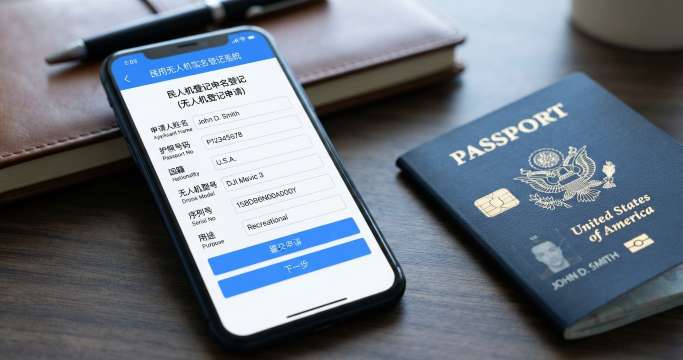
Please note: we have not tested the registration ourselves. The passport option and the need for a Chinese phone number come from reports by foreign visitors who registered in 2025 and 2026, not from our own attempt. Treat them as likely, and confirm on the platform before you travel.
Registration Step by Step
1. Get a Phone number that receives SMS in China: A local SIM bought with your passport at a China Mobile, China Unicom or China Telecom store is the usual route.
2. Create a UOM account: Choose passport (护照) as the ID type and type your name in the exact order printed on the passport page to create your UOM account on the CAAC platform or its app.
3. Add the drone: Choose real-name registration, then pick the maker and model of the drone. Enter the serial number or the product identity code from the box, and upload the photos it asks for.
4. Get your QR code: The system gives a registration code that starts with ‘UAS’. Print the code and stick it somewhere visible on the drone.
5. Activate before the first flight: Under national standard GB 46761-2025, in force since 1 May 2026, a drone must stay unable to fly until it is activated. Activation through the maker's app or the UOM platform is required, and an unactivated drone may not take off. The rule covers newly produced drones from 1 May 2026, and drones already sold and in use from 1 May 2027.
6. Keep proof on you: Carry your passport and a screenshot of the drone registration page whenever you fly.
Remember, registration is free. If a website asks you to pay for "official" registration, it isn't the CAAC.
What to do if the Platform Refuses your Document
What happens | Likely reason | What to do |
The SMS code never came in | You used a foreign number that can’t accept an SMS code in China | Get a local Chinese SIM with your passport and try again |
Your name is rejected | It is likely that your surname and given name are written in the wrong order | Copy the name on your passport page exactly |
Your drone model isn't in the list, or it won't activate | Drones already in use have until 1 May 2027 under the transition period, but an older model may still fail to activate | Ask the maker if a firmware update exists. If not, leave the drone at home |
The passport option fails at the identity check | Possibly platform rules or a glitch | Contact UOM support. Until it goes through, don't fly the drone |
If you can't finish registration, ensure to keep the drone in your bag without flying it.
Stay connected in China with cheap eSIM data plans
See all attractions



Where can you legally fly?
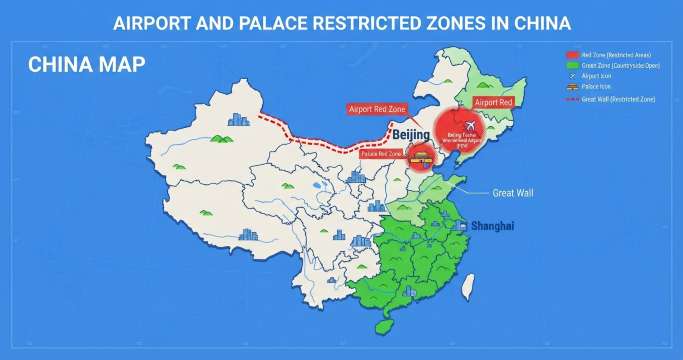
Controlled Airspace under Article 19
Below are the areas that count as “controlled airspace”. So, don’t try to fly your drone there without approval:
• All airspace above 120 m true height
• Airports and a set zone around them
• Border areas and military zones
• Power plants, substations, fuel stations, water works, transport hubs, ports, motorways and electrified railways
• Important revolutionary memorial sites and important immovable cultural relics, with their surroundings
• Any extra area the national air traffic leadership adds
In addition, city governments publish the exact boundaries, so the above list is just a starting point. However, the map in your registration app is the place to check.
City Rules worth knowing in 2026
City | Rule now | What it means for you |
Beijing | The whole Beijing city is in controlled airspace. Since May 1st, 2026, drone sales have been banned in Beijing. Therefore, bringing a drone into the city is prohibited and this includes tourists. "Carrying into Beijing" covers arriving by air, rail or road, and it also covers transit or passing through the city. From November 15th, 2026 owning or storing a drone inside Beijing is banned too. Illegal flights can be fined up to 10,000 yuan with confiscation | As a foreign tourist, don't bring a drone on a Beijing trip. A stopover or transit through Beijing still counts, so plan the route so the drone never enters the city |
Shanghai | Shanghai first published its permitted-airspace map on 24 December 2025. The current edition (沪府发〔2026〕12号, printed 29 July 2026) covers 57% of the city's land area below 120 m true height. Outside those zones, even flying a drone below 120 m is controlled | Check the published zones before you plan a shot. Most of the downtown skyline is off limits. Before every flight, check the airspace map in the UOM app or the Suishenban (随申办) app. If the spot is controlled airspace, file the flight application by noon on the previous day, then confirm take-off and landing in the app |
Other cities | Many publish notices with no-fly areas and event closures | Search the city name plus 无人机 禁飞 (drone no-fly) and check the app map on the day |
Your Pre-flight Checklist
• ☐ I know the class of my drone (micro or light)
• ☐ I have done registration, have the QR code on the drone, and have activated it
• ☐ The map on the UOM app shows this place falls within the permitted airspace
• ☐ I am far enough from any airport and its vicinity
• ☐ My drone height will not exceed the limit for its class: 50m for a micro drone, or 120m for a light drone, above the ground underneath
• ☐ The owner/operator of the site has allowed it, or this is public land with no ban signposted
• ☐ I will not be flying over crowds, events, or people’s residences
• ☐ My batteries are in good condition and within my drone's specs
• ☐ Passport and registration screenshot are in my pocket
Top Hotels in Shanghai and Chengdu
Hotels in Shanghai
Hotels in Chengdu
See All Hotels







The Site Rule: Why the Answer is Often No
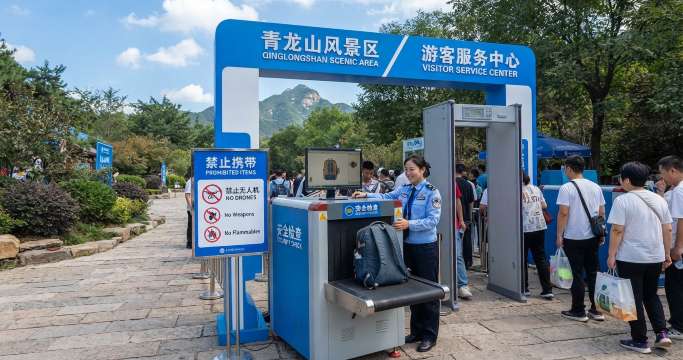
Thus, before going to China, send a message to the visitor centre of the site and seek clarification. You may use this short Chinese phrase: 请问景区内可以飞无人机吗?It means "Can I fly a drone inside the scenic area?” Save the screenshot of the reply.
How to recognize the "no-flight zone" for drones
• Signs: Search for signs such as 禁止无人机 (no drones) or the cross-out of a drone logo at the gate and on viewing platforms.
• Terms of ticket: Look at the visiting rules on the booking website. It typically mentions drones alongside pets and alcohol.
• Security along the wall or trail: if you still take off, be ready for security to order you to land. They can fine you and confiscate the drone.
• Bags scanning: Large sites check bags at the entrance and any drone there is kept until your exit or denied entry.
Two sites and their own drone rules
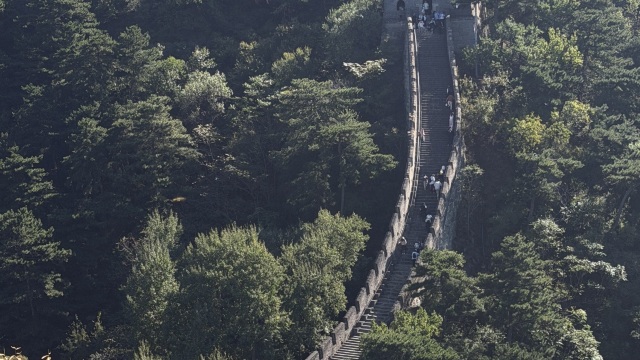
Great Wall (Badaling and Mutianyu): The two most visited Great Wall sections are both inside Beijing, so the city ban described above applies before you reach the gate. Read the visitor rules on the ticket page too, and ask the scenic area in writing if you are unsure.
Chengkan Scenic Area (呈坎), Huangshan: The scenic area's management announced in 2025 that its whole area, including the core, buffer and open zones, is a no-drone zone. Flying is only allowed with written approval for news, filming or safety patrols, and staff work with law enforcement to stop unapproved flights.
4.8/5
10649 reviews
5/5
Everything is great, very fast and I didn't have to stand in line thanks to Trip.

5/5
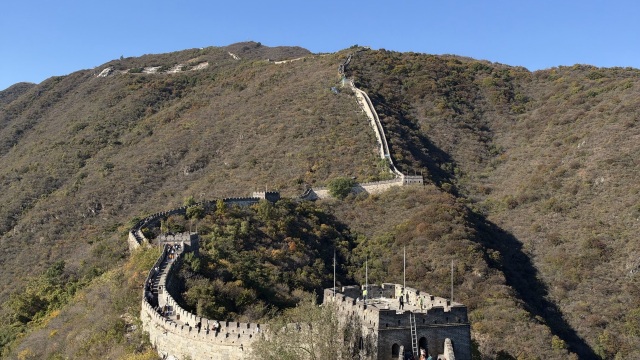
The great wall is one of the most beautiful places in China. The vastness of this historic place makes you feel so small. If try to imagine how many people have walked across those paved in over 2000 years! What a majestic place.


5/5
I really liked this service; the guide spoke excellent English and explained the sections of the wall and the differences between them. We chose the route with the enclosed lift; we were told that there would be fewer people and Chinese tourists on this route (Tower 14) than on the toboggan route (Tower 6). There were plenty of people, but we didn't go to the other section. The photo shows the wall near Tower 21 (the maximum route is 23), which shows the people who made it. There are more people further down the route.


5/5
We enjoyed the trip. We took a chairlift up to the wall and then back down on a sled. We had enough time to walk around, take in the beautiful scenery, and not get tired. We also had a great guide, Boris, a pleasant guy who speaks good Russian, and it was interesting to talk with him.
5/5
It was foggy, but still definitely worth a visit.

Getting the drone and its batteries there
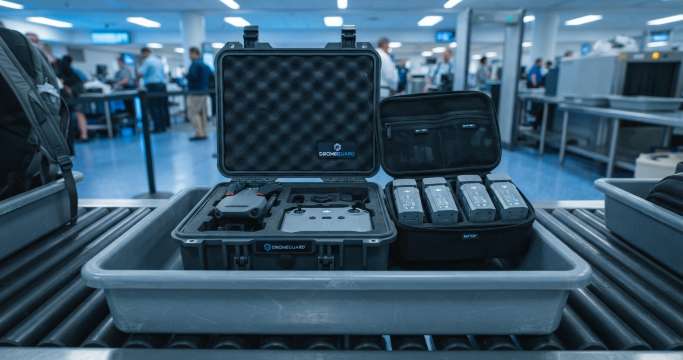
Battery packing rules (CAAC, for flights in and around China)
Item | Cabin bag | Checked bag | Notes |
Battery fitted in the drone, up to 100 Wh | Yes | Ask your airline | Most travellers keep the whole drone in the cabin |
A spare battery up to 100 Wh | Yes | No | Tape the contacts or use a battery pouch |
A spare battery between 100-160 Wh | You will need airline approval for maximum of 2 spares | No | Request approval when you book, not at the gate |
Any battery over 160 Wh | No | No | Leave it at home |
Power bank | Yes | No | Chinese domestic flights only accept power banks with the 3C mark (since 28 June 2025) |
Shipping and buying in China
Courier companies in China will not accept loose lithium batteries. Therefore, you are advised to carry your drone and extra batteries from home. Additionally, buying a drone in China does not exempt you from filling all the paperwork. You must register and activate your drone using your passport before unlocking it and, therefore, you will still have the SMS problem as with a drone you bring from home.
Moving around with a hard case
It is recommended that you place your drone in a hard case and keep it in your hand luggage. A hard case and a suitcase together can be too much for a small taxi, so book a car that shows its luggage space, especially for airport runs.
Common mistakes and failure cases
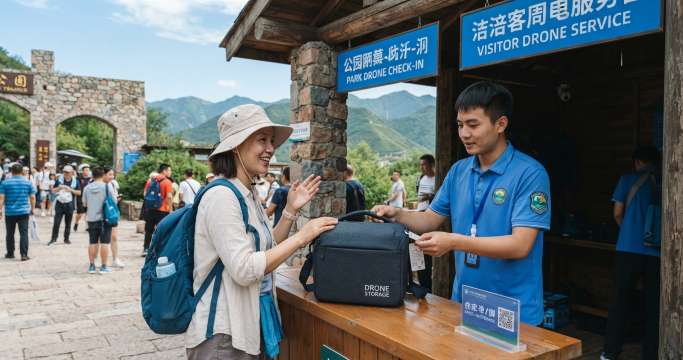
Most of the drone problems faced by tourists in China arise before their very first drone flight. It is unfortunate when a traveler carries his drone, arrives at his destination and realizes that his drone registration requires a local phone number, he is flying in a city where there is no drone use, or his drone battery violates the packing regulations. Below are some of the common mistakes that foreigners make with their drones in China and how to solve them:
Mistake | Why it happens | What can follow | How to recover |
Treating open airspace as “permission site” | The national map looks green | Ordered to land, drone held and possible fine | Ask the operator first and keep the answer in writing |
Spare batteries in checked luggage | Packed with the charger in the big bag | Bag pulled at screening and batteries removed | Move every spare to the cabin bag before check-in |
Taking paid work without insurance | When a hobby trip turns into a client shoot | You will be fined 2,000 to 20,000 yuan | Treat paid filming as commercial and ask the authority before you agree to it |
Turned away at the entrance | The ban was in the ticket which you never read | Drone stored at the gate or you will be refused entry | Leave the drone at the hotel on site days |
Platform won't accept your passport or number | No Chinese mobile number, or the ID check fails | No legal way to fly | Get a local SIM and retry. If it still fails, don't fly |
Older drone won't activate | Model lacks the activation function that GB 46761-2025 requires (drones already in use must comply from 1 May 2027) | An unactivated drone may not take off | Check with the maker before the trip |
Planning to post batteries home | Bag is over the limit on the way back | Courier refuses the parcel | Fly home with batteries in the cabin, within the Wh limits |
FAQs about China drone rules
-
Why am I not allowed to fly a drone even though it is registered?
-
Is flying drones in China illegal?
-
Which drone can fly without a license?
-
What are the requirements for drone registration in China?
-
Can you fly a sub-250g drone anywhere?
-
Can I fly a drone at the Great Wall?
-
Can I bring my drone into China on a plane?
-
What happens if I fly without registering?
Disclaimer: This article has been provided by an individual contributor or third party platform. If there is any discrepancy regarding the copyright, please contact us directly and we will delete the content immediately.
Trending Searches
-
Air Travel Guide
-
Latest Flight Deals
-
Popular Flight & Hotel Packages
-
Getting Around
-
eSIM/SIM card
- Tokyo Flight and Hotel
- Koh Samui Flight and Hotel
- Osaka Flight and Hotel
- Langkawi Flight and Hotel
- Antalya Flight and Hotel
- Shanghai Flight and Hotel
- Da Nang Flight and Hotel
- Cox'S Bazar Flight and Hotel
- Phuket Flight and Hotel
- Dubai Flight and Hotel
- Puerto Princesa Flight and Hotel
- Sanya Flight and Hotel
- Singapore Flight and Hotel
- Hong Kong Flight and Hotel
- Bangkok Flight and Hotel
- AREX Timetable
- Shanghai Pudong Airport Transfer
- Child Car Seats in China
- China domestic flight vs train with kids
- Chengdu Layover
- Hongqiao Railway Station to Pudong Airport
- Wellness & Spa in Kuala Lumpur
- Ha Long City Day Tours
- Macau Sports & Adventure
- Iceland Activities
- Uji Activities
- Hurghada Spa & Massage
- Iceland Cultural Experience
- My Tho Day Tours
- Nikko Day Tours
- Philippines Day Tours
- Hebei Day Tours