China High-Speed Train: First Class vs Second Class vs Business Class


China High Speed Train first class uses a 2+2 seat layout (no middle seats) vs second class's 3+2, offers ~5cm wider seats, footrests, armrest-integrated tray tables, free snacks/water, quieter cabin, and 20-50% higher price.
to Shanghai
to Beijing
to Guangzhou
See all flights


🔥[Discount] Trip.com China Train Promo Codes
China High Speed Train: 1st Class vs 2nd Class vs Business Class
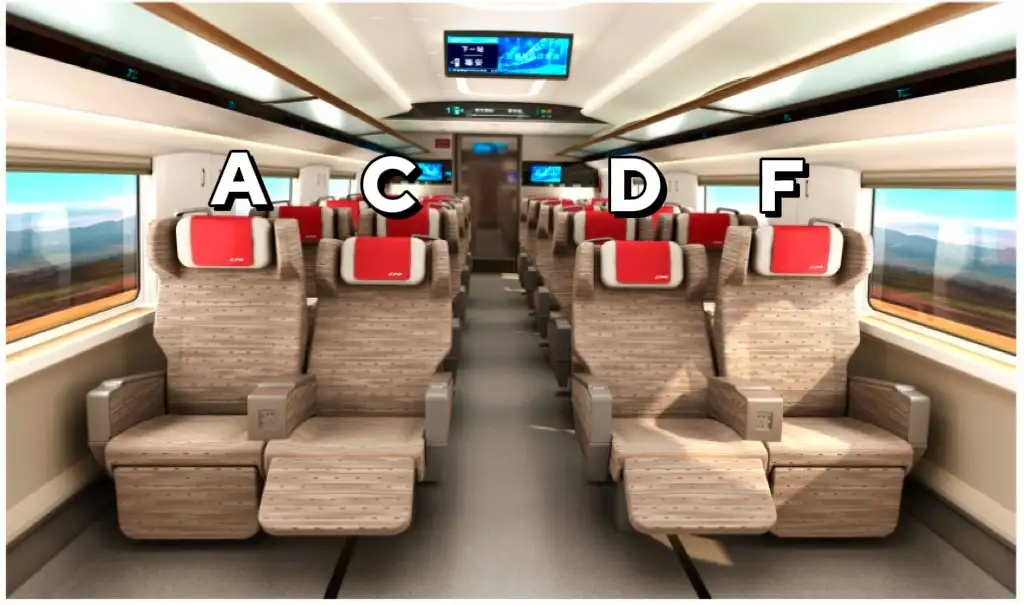
1st Class
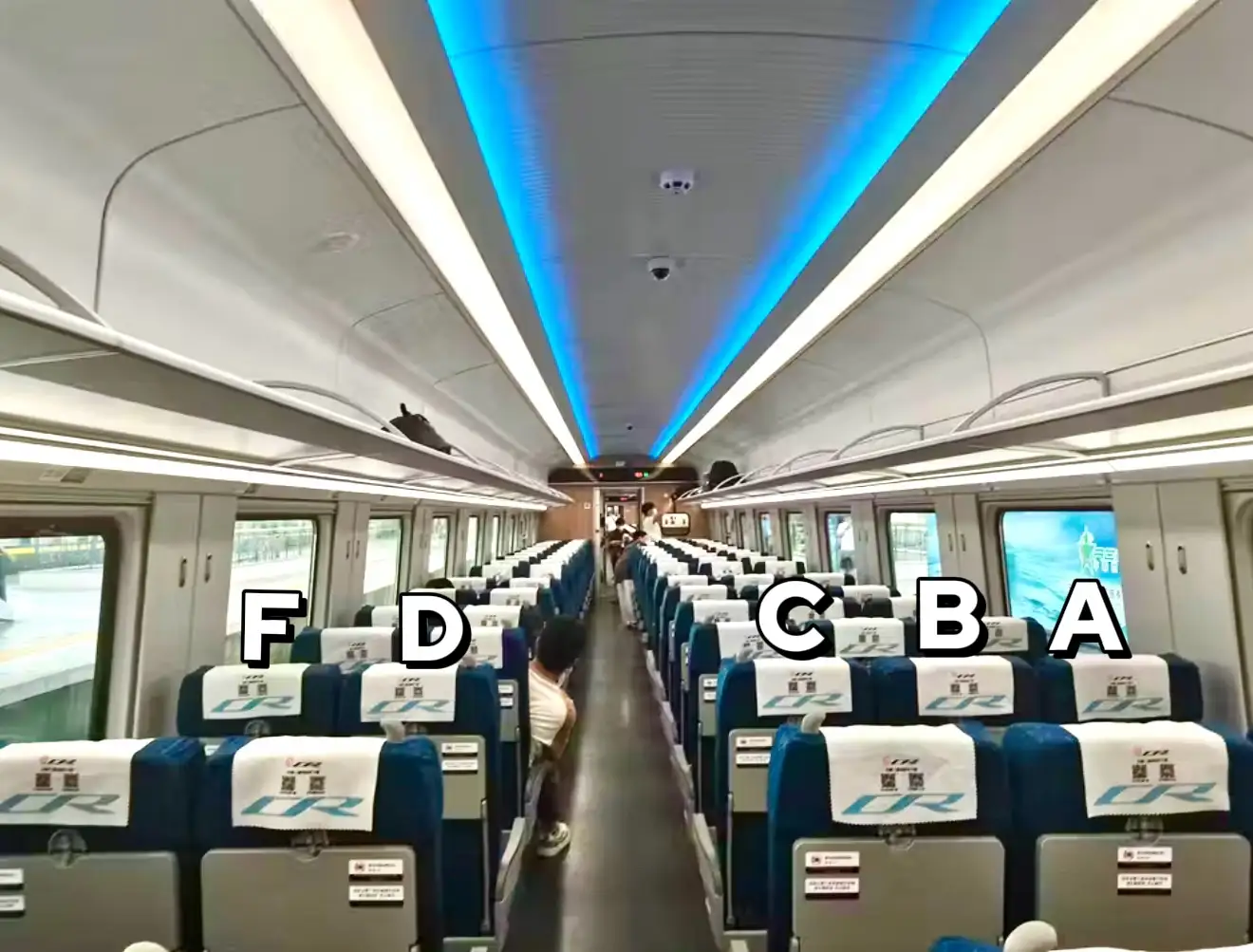
2nd Class
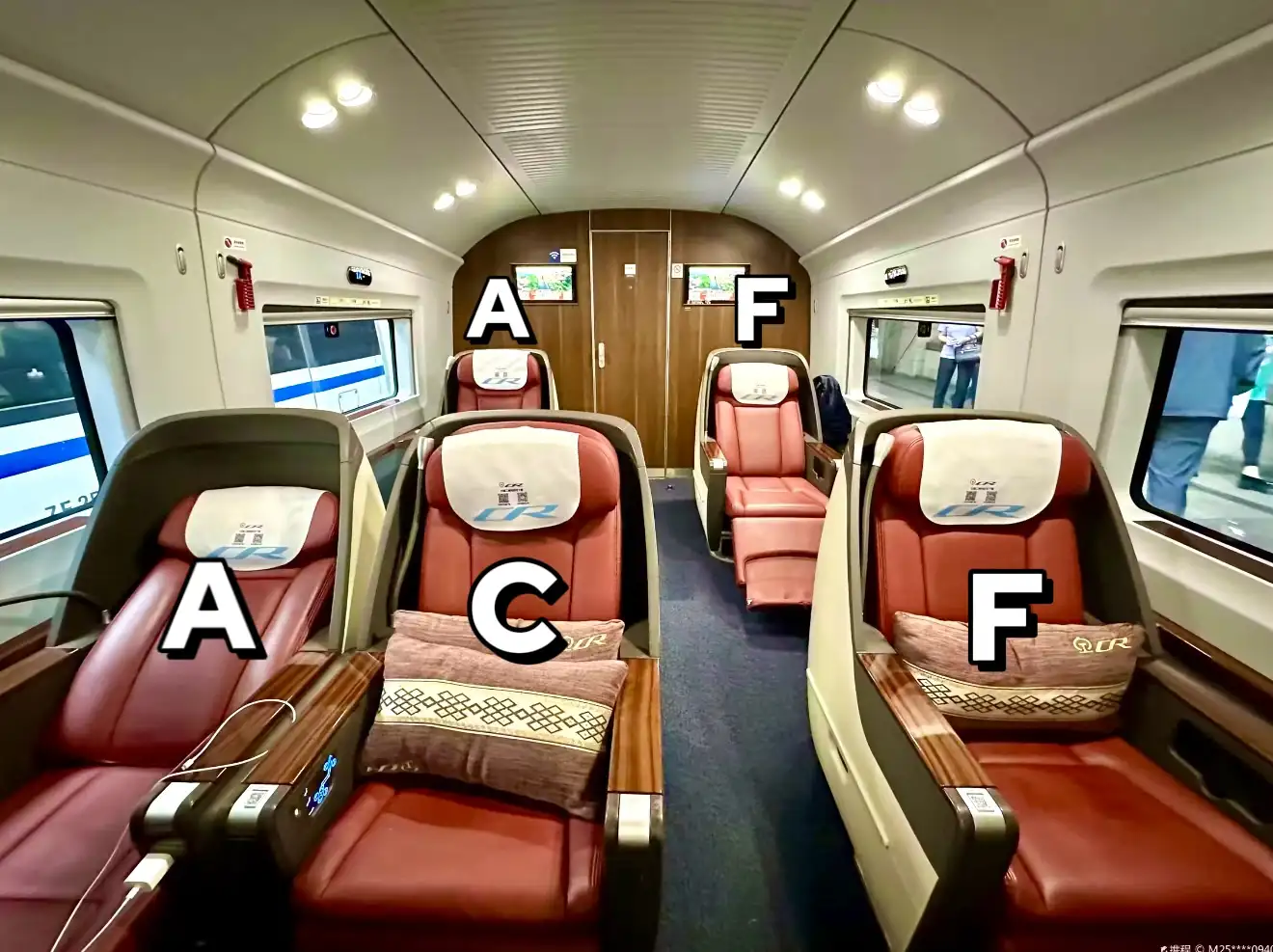
Business Class
For trips under 2 hours, Second Class is fine; for 3+ hours, First Class is the sweet spot; Business Class is worth it for special occasions or when you want genuine rest.
On China's high-speed rail (G/D/C trains), Second Class uses a 3+2 layout (5 seats/row) with ~42cm wide seats—functional but cramped on long rides. First Class offers 2+2 seating, ~47cm wide seats, footrests, and free snacks, costing 20-50% more. Business Class is a completely different product: lie-flat seats, VIP lounge access, hot meals, and platform escort service—priced 3-5x Second Class.
Feature | Second Class | First Class | Business Class |
|---|---|---|---|
Seat Layout | 3+2 (A-B-C / D-F) | 2+2 (A-C / D-F) | 2+1 or 1+1 |
Seat Width | ~42-45 cm | ~47-48 cm | ~70 cm+ (individual pods) |
Legroom | Standard (~37cm row spacing) | Generous (~40-50cm) | Extensive + full recline |
Recline Angle | 5-24 degrees | 5-32 degrees | Full lie-flat (0-180°) |
Footrest | No | Yes | Yes (premium) |
Pillow/Blanket | No | Small pillow | Yes |
Tray Table | Seatback-mounted | Armrest-integrated | Personal table |
Power Outlets | Shared between rows | Both sides of row | Individual |
Free Food | No | Snack box + water | Hot meal + drinks + lounge |
VIP Lounge | No | No | Yes (with snacks/drinks) |
Boarding | Standard | Standard | Priority + escort |
Typical Price | Base fare | +20-50% | +300-500% |
Best For | Short trips (<2h), budget | 2-5 hour journeys | 4+ hours, luxury experience |
China's G and D trains have run on floating fares since 2020. Every train carries a published ceiling price (公布票价) and an actual selling price (执行票价) that gets discounted up or down by season, date, time of day, and how fast the train runs. There is no single fixed number — the same Second Class seat on Beijing–Shanghai can go for ¥553 on a slow Tuesday departure and ¥673 on a Friday-night flagship.
What stays steady is the gap between classes. First Class runs about 1.6x Second Class, and Business about 3.5x Second Class (on Beijing–Shanghai those ratios are set at 1.6x and 3.5x).
Route | Second Class | First Class | Business Class |
|---|---|---|---|
Beijing–Shanghai (北京南–上海虹桥) | ¥553–673 | ¥969–1,076 | ¥1,998–2,354 |
Beijing–Guangzhou (北京西–广州南) | ¥878–1,036 | ¥1,405–1,658 | ¥3,050–3,617 |
These are real selling prices pulled from 12306/Trip.com in October 2026. The Beijing–Shanghai row works out to roughly US$78–94 for Second Class and US$280–330 for Business.
Two 2026 updates worth knowing:
- Beijing–Shanghai raised its published ceiling 20% on May 26, 2026. The Second Class cap for Shanghai Hongqiao–Beijing South rose to ¥794, and the Business cap to about ¥2,780. The catch is that actual selling prices didn't move at rollout, so most tickets still sell inside the ranges above. Treat "¥800 Second Class" headlines as the top of the ceiling, not what you'll normally pay.
- Some Fuxing smart EMUs now carry a "优选一等座" (Preferred First Class) tier between First and Business — it shows up around ¥1,471 on Beijing–Shanghai and ¥1,932–2,046 on Beijing–Guangzhou.
Seat Map Layouts by China Train Type
Train Type | Speed | Business | First | Second | Sleepers |
|---|---|---|---|---|---|
G-Train | 300-350 km/h | Yes (2+1) | Yes (2+2) | Yes (3+2) | No |
D-Train | 200-250 km/h | Yes | Yes | Yes | Soft/Hard Sleeper |
C-Train | 200 km/h | Yes | Yes | Yes | No |
Z-Train | 160 km/h | No | No | Soft/Hard Seat | Soft/Hard/Deluxe Sleeper |
T-Train | 140 km/h | No | No | Soft/Hard Seat | Soft/Hard Sleeper |
Seat Numbering Logic (consistent across all high-speed trains):
- A & F: Always window seats
- B: Always middle seat (Second Class only)
- C & D: Always aisle seats
Picking your seats on China High Speed Train
Yes, you can pick your seat. When you book a G, D, or C train on the 12306 app or website (or through Trip.com), the "选座服务" step lets you state a preference for window, aisle, or middle. Treat it as a request rather than a guarantee — if the train has no matching seat left, the system assigns one at random. You can also choose at a station ticket window or an agent.
The letters never change: A and F are window on every class, C and D are aisle, and B is the middle (Second Class only). There is no E seat — high-speed rows copied the airline convention (A/F window, C/D aisle), and since a row maxes out at five seats, E gets dropped.
A few habits that help:
- Book everyone under one account and the system leans toward giving you adjacent seats.
- Want the window (scenery, or you get motion-sick)? Ask for A or F.
- Expect bathroom or stretch breaks? C or D keeps you from climbing over people.
- F is the internet's favorite — a window seat on the two-seat side, so you get the view without the middle-seat squeeze.
One thing that trips people up: there is no "change seat" button after you've bought. 12306 has no online seat-swap feature, and third-party apps promising "online seat change" are quietly running a ticket re-endorsement (改签) — which can burn your one allowed change. If you really want to move seats, do it through an official 改签 while seats are available.
China High-Speed Train: First Class Seats & Amenities

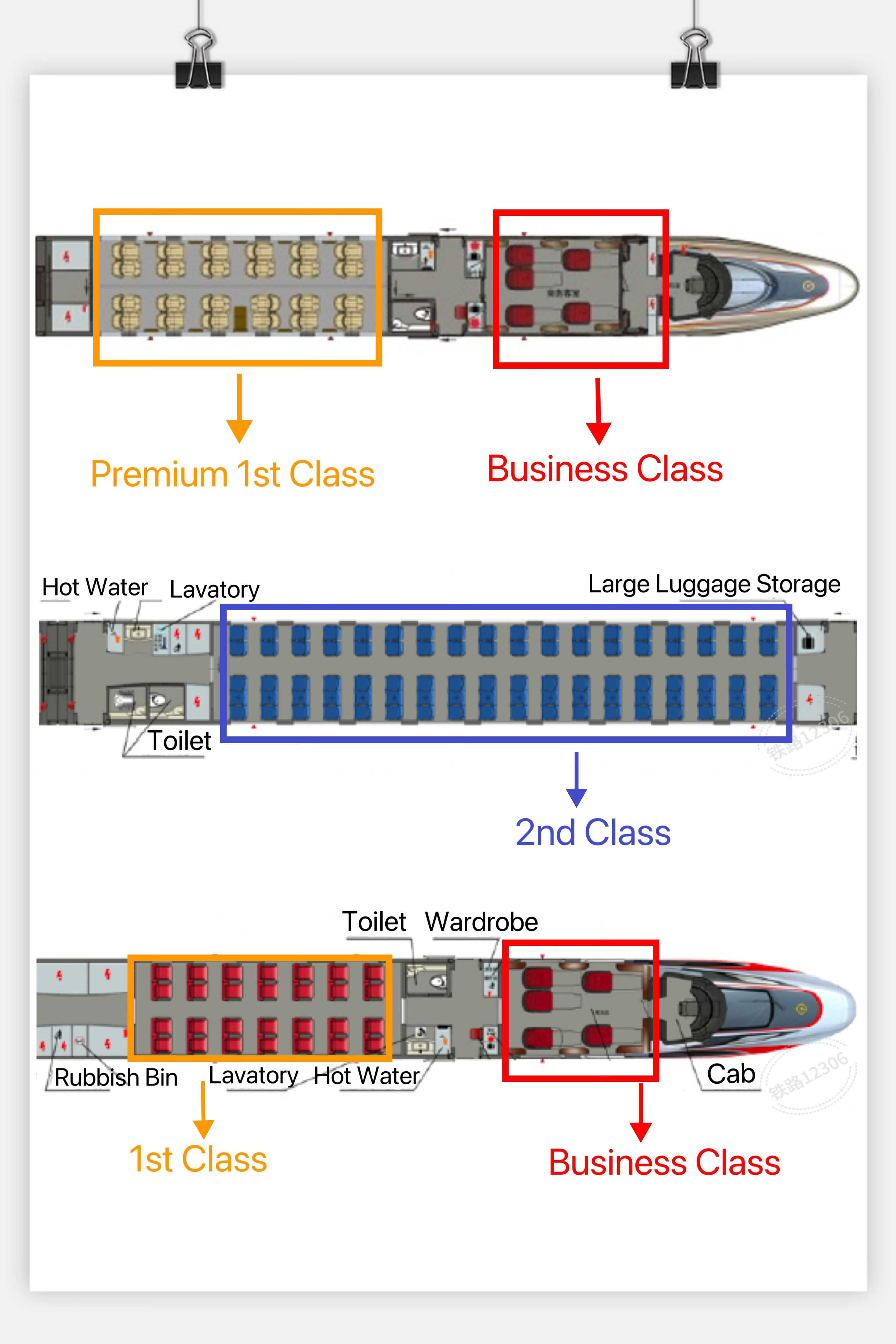
First Class and Premium First Class, Image credit: Railway 12306
First Class Seating & Layout
First Class carriages use a 2+2 configuration (seats A/C on one side, D/F on the other). This eliminates the dreaded middle seat entirely. Seat width is approximately 47-48cm—about 5cm wider than Second Class—with noticeably more legroom between rows (40-50cm vs 37cm).
First Class Amenities
- Footrest: Every seat has a fold-down footrest
- Pillow: Small headrest pillow attached to seat
- Tray Table: Located inside the armrest (not the seatback in front), which means you can use it even when facing backward or in face-to-face seating arrangements
- Recline: Seats recline to approximately 32 degrees (vs 24 degrees in Second Class)
- Power: Charging outlets on both sides of each row
- Freebies: Attendants distribute snack boxes (typically crackers, dried beef, peas, cherry tomatoes) and bottled water—Second Class passengers don't get this
First Class Environment
First Class carriages accommodate roughly 28 passengers per 8-car train section vs 70+ in Second Class. This means:
- Quieter atmosphere
- Less crowded aisles and toilets
- More attentive service from attendants
- Attendants will announce upcoming stations
The Reality Check
As you noted, the difference between First and Second isn't dramatic—it's incremental. The seats aren't that much bigger, and you're still on the same train. The value proposition depends entirely on journey length and your sensitivity to noise/crowding. For a 1-hour ride, the upgrade is hard to justify. For 4+ hours, the extra space and quieter cabin become meaningful.
See all attractions
 187575 booked


China High-Speed Train: Second Class Seats & Amenities

China Bullet Train 2nd Class, Image credit: Railway 12306
Second Class Seating & Layout
The 3+2 configuration (A-B-C / D-F) means there's a middle seat (B) on one side. Seat width is ~42-45cm—comparable to economy airline seats but with better legroom than most budget carriers. Row spacing is tighter than First Class but still functional.
Second Class Amenities
- Tray Table: Fold-down table attached to the seatback in front of you (useless if the person in front reclines fully, or if you're facing backward in face-to-face seating)
- Power: Outlets shared between rows (typically one per two seats)
- Recline: 5-24 degrees backward
- No free food or drinks
The Experience
Second Class is where most Chinese travelers sit. It's louder, more crowded, and often filled with families, phone conversations without earphones, and instant noodle aromas. For short trips, this is perfectly acceptable. For journeys over 3 hours, the lack of space and higher noise level can become draining—exactly as you experienced.
China High-Speed Train: Business Class Seats & Amenities

If you're going to splurge, this is where the money goes. Business Class on G-trains is a different category entirely:
Business Class Pre-Boarding Experience
- Access to VIP lounges at major stations with free snacks, drinks, WiFi, and comfortable seating
- Attendant escorts you to the train and helps with boarding
Business Class Onboard Experience
- Seats: Individual leather pods arranged 2+1 or 1+1 across the car width
- Lie-flat capability: Seats recline to fully flat beds at the touch of a button—genuine sleeping capability
- Meals: Hot meal served at your seat (not just snacks), plus complimentary tea, juice, and other beverages
- Service: Dedicated attendant, priority for everything
- Privacy: Carpeted cabin, significantly fewer passengers (typically 10-28 per carriage depending on configuration)
- Arrival Experience: Platform greeting and luggage assistance at some stations
The Verdict At 3-5x the Second Class price, Business Class isn't for everyday travel. But for journeys over 4 hours, overnight-equivalent trips, or special occasions, it delivers genuine luxury that rivals airline first-class—at a fraction of the cost (often around $280–330 for major routes like Beijing-Shanghai).
Other China Train Seat Types & Sleeper Options

HSR First Class Sleeper (WY/WR), image source: Railway 12306
Premium/Sightseeing Seats
Originally designed with glass bulkheads to view the track ahead, these are now mostly frosted or solid. Some trains have these behind the driving cab with 5 business-class style seats or mixed configurations.
Sleeper Trains (D-series overnight)
For true long-distance travel (8+ hours), consider D-series sleeper trains:
- Soft Sleeper: 4 bunks per enclosed compartment (upper/lower), available on D and Z trains
- Deluxe Soft Sleeper: 2 bunks per compartment with private toilet (Z trains only)
- First Class Sleeper: On Fuxing trains, 11 cabins with 2 double-deck berths each, emergency call devices
- Second Class Sleeper: 11 compartments with triple-deck bunks, USB ports, reading lamps
New Type Sleeper (CRH2E)
Bunks arranged longitudinally along the train walls (like capsules), each with individual desk, lamp, curtain, and power outlet. Currently only on specific routes like Beijing-Shenzhen (D901/D902).
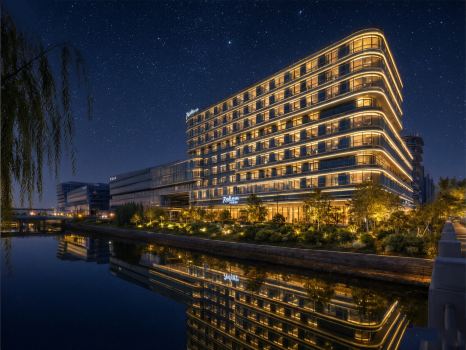
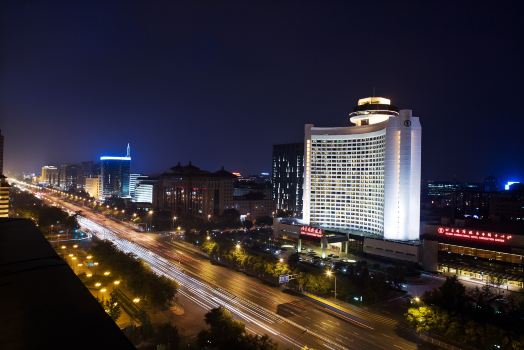
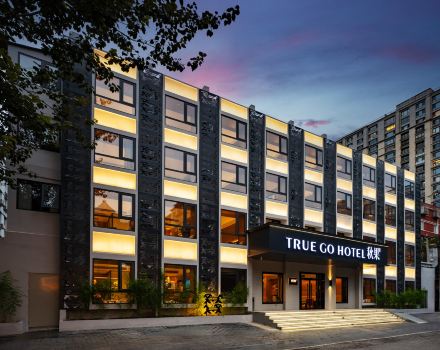
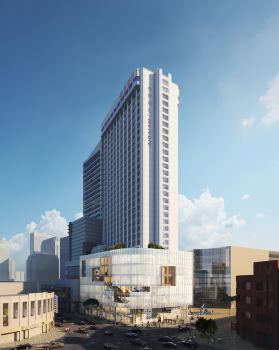
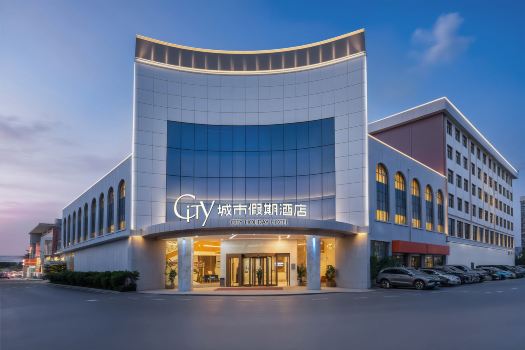
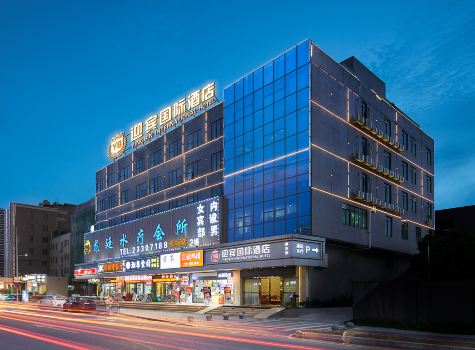
[10% Off] China Hotel Recommendations
Top Shanghai Hotels
Top Beijing Hotels
Top Guangzhou Hotels
See All Hotels

Changing Your China High Speed Train Tickets
You get one change per ticket, as long as the train you want has seats.
It's free when:
- You change more than 48 hours before departure (to anything in the presale window).
- You change within 48 hours to an earlier train (a date before your ticket's date).
- You change after departure to another train the same day, before 24:00.
You pay when you switch to a later date:
When you change | Fee |
|---|---|
24–48 hours before departure | 5% of the lower of the two fares |
Under 24 hours before departure | 15% of the lower fare |
After departure, to next day or later | 40% of the lower fare |
- If the new ticket costs more, you pay the difference. If it costs less, the difference comes back to you minus a refund fee on that difference. A ticket changed after departure can't be refunded.
- Changing your arrival station (变更到站) is stricter: you must do it more than 48 hours before departure, and once you do, that's your one change — no further re-endorsement.
- Where: 12306 app/site, station windows, or self-service machines that support it. Tickets paid in cash can only be changed at a station window.
- (For the flip side: refunds are free more than 8 days out, then 5% within 8 days–48 hours, 10% within 24–48 hours, and 20% under 24 hours.)
Luggages on China High Speed Trains
Free carry-on, per person:
- Adult: 20 kg
- Child (with or without a ticket): 10 kg
- Diplomat: 35 kg
Keep each piece at 20 kg or under. On high-speed trains (G/D/C), each piece's length + width + height must add up to 130 cm or less; regular trains allow 160 cm. Foldable wheelchairs and foldable baby strollers ride free and don't count toward the allowance.
There's no checked-bag fee like a budget airline. If you can carry it and it fits the overhead rack or the big-bag racks by the doors, you're generally fine. What actually gets stopped at security: oversized pieces, hoverboards and scooters that aren't hard-cased, live animals (guide dogs and sealed-box seafood are the exceptions), and the usual flammable items.
Things with hard limits:
- Alcohol: sealed, 24–70% strength, up to 3,000 ml total.
- Power banks: a single unit must be 100 Wh or less.
- Lighters: up to 2 ordinary lighters (and 2 small boxes of matches).
Over the limit? You can check (托运) up to 50 kg per ticket at a China Railway Express (中铁快运) counter, each piece under 50 kg and 200 cm total. One exception to know: Guangzhou–Shenzhen–Hong Kong cross-border trains have no checked luggage at all, so the 20 kg / 130 cm carry-on limit is the whole story.
FAQs about first class and second class on China bullet train
-
What is the difference between first class and second class on China bullet train?
-
Is first class worth it on China high speed rail?
-
Do you get free food with a first class train ticket in China?
-
What is the difference between China G trains and D trains?
-
Can you sleep in Business Class on China high-speed rail?
-
Do China high-speed trains have WiFi?
-
Are there power outlets on all China bullet trains?
Disclaimer: This article has been provided by an individual contributor or third party platform. If there is any discrepancy regarding the copyright, please contact us directly and we will delete the content immediately.
Trending Searches
-
More about China Trains
- China High Speed Train Seat Map
- 1st class vs 2nd class on China high speed trains
- Shenzhen to Hong Kong
- Trip.com Train Discount Codes
- China Train Luggage
- How to Take a Train in China
- China Train Seats Together
- China Train Types
- China Train App
- China Sleeper Train
- What To Do If China Train Tickets Are Sold Out
- China Train Classes
- Trains to Lecce
- Trains to Windsor & Eton Central
- Universal Studios Beijing
- flight deals to Spain
- The best boutique and shophouse hotels in Shanghai
- Beijing to Guangzhou trains
- Trains to Skewen
- Knutsford to Altrincham trains