China high-speed train is the fastest, most punctual, and most comfortable way to travel between cities. “Gaotie” trains reach up to 350 km/h, making long trips quick and smooth. Cabins are clean and quiet, with clear English signs for easy boarding.
China train offers classes from Second Class to Business Class. Tickets are simple to get—online with a passport, e-ticket, or paper ticket at the station. This guide helps travelers understand train types, booking steps, and tickets in one place, making China train travel clear and stress-free.
🔥Exclusive China Train Coupon: Get 3% OFF Now!
Book your China train tickets as a new user on Trip.com and enjoy a special 3% Off 🎁! Use our exclusive coupon to save big on your first train journey!!!👀
✨Popular China Bullet Train Routes✨
- DepartureShanghai Hongqiao
- ArrivalHangzhou East
- Duration~45m
- Price (2nd Class)From $8.00
- DepartureShanghai Hongqiao
- ArrivalBeijing South
- Duration~6h
- Price (2nd Class)From $79.40
- DepartureShanghai Hongqiao
- ArrivalShenzhen North
- Duration~7h
- Price (2nd Class)From $81.46
What Is China Train?

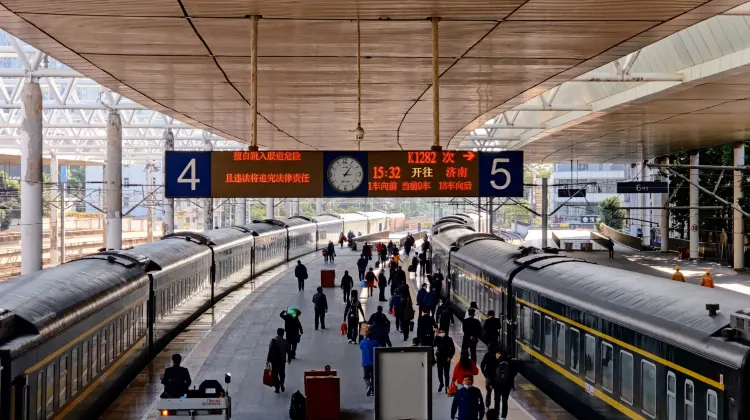
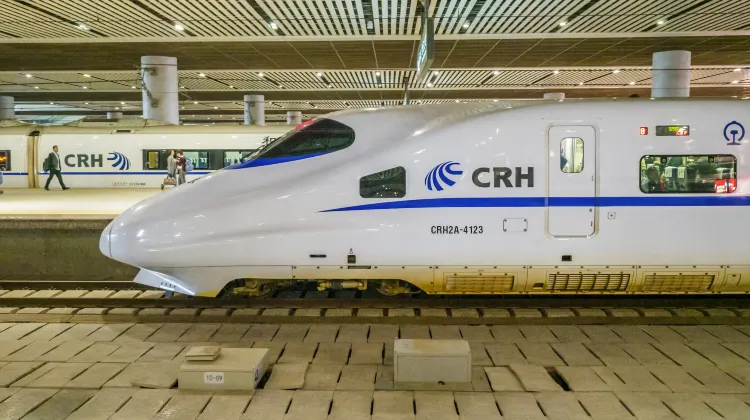
Source from Unsplash | A China high-speed train waiting to depart.
The network length of China’s high‑speed rail (HSR) exceeded 48,000 km by the end of 2024, with a target of around 60,000 km by 2030 (from Wikipedia). It's the most heavily used china train system, accommodating speeds between 200 and 450 km/h and making up two-thirds of the world's total high-speed railway. Owned and operated by the China Railway Corporation under the brand China Railway High-speed (CRH), it provides fast, efficient, and wide-reaching train service.
The network includes high-speed (G, D, C series) and normal trains, each designed for specific travel needs and budgets. High-speed trains are known for their rapid service and advanced amenities, while normal trains are preferred for their cost-effectiveness and access to more regions.
- G-series High-Speed Trains (250-400 km/h) : Connects over 113 major cities across China, with fewer stops to ensure quicker travel times. Facilities: Air-conditioning, dining cars, western toilets, large luggage racks, power outlets, visual entertainment systems, and available Wi-Fi.
- D-series High-Speed Trains (200-250 km/h) : Links large and smaller cities, also operates overnight services, which are unique among high-speed trains. Facilities: Similar to G-series, including air-conditioning, dining options, and modern toilets.
- Normal Trains (Below 160 km/h): Commonly used for travel to smaller cities and rural areas, offering a budget-friendly option. Facilities: Basic, with options like hard seats, hard sleepers, and soft sleepers; some trains have air-conditioning.
Now that you have a general idea of what China's trains are like, let's know more about the specific types of each China train.
Different China Train Types
China High Speed Trains, marked with the letters G and D followed by numbers, are fast, clean, and well-equipped. They offer a variety of seats from second-class to luxury soft sleepers, including first-class and business class seats. Normal Trains, labeled with letters like Z, T, K, Y, and S plus numbers, or just numbers, are more budget-friendly and offer simpler amenities.
Category | Train Type | Description | Average Speed |
High Speed Trains | G-Class | Operates on long routes between major cities, offering the fastest service among all train types. | 300 km/h |
D-Class (EMU) | Serves both long and middle distances. Some operate overnight. | 250 km/h | |
C-Class (Intercity EMU) | Focuses on short distances between neighboring cities. | 200 km/h | |
Normal Trains | Z-Class (Direct Express) | Travels directly to destinations with minimal stops, usually only at major stations. | 160 km/h |
T-Class (Express) | Has limited stops, primarily at large stations, designed for somewhat faster travel. | 140 km/h | |
K-Class (Fast) | Makes stops at medium and large stations, offering a balance between speed and access. | 120 km/h | |
Ordinary Fast | Identified by four digits starting with 1, 2, 4, or 5; makes frequent stops. | 120 km/h | |
Ordinary | Identified by four digits beginning with 6, 7, 8, or 9; stops at almost every station. | 100 km/h |
✅If you're curious about how to stay connected in China, check out the following packages!
How to Buy China Train Tickets for Foreigners?
Click to book cheap China train Online🤞
How to Buy China Train Tickets Online?
To buy train tickets in China online, start by visiting Trip.com. This website offers services in English and various other languages, making it accessible for international travelers. You can pay with international credit cards. First, select your journey details—date, time, and destination. Then, enter the names and passport numbers for each traveler. Once booking opens (15 days in advance), Trip.com will process your purchase immediately. After booking, you don't need a physical ticket; just scan your passport at the station gate to board the train.
How to Buy China Train Tickets at the Station?
- Arrive Early: Stations can be busy, especially during peak travel times. Arriving early helps you avoid long lines.
- Bring Your Passport: You must have your passport with you, as it's required both to buy a ticket and to board the train.
- Check Seat Availability: Look for the big electronic boards displaying seat availability for trains. This will show you if seats are available for your intended travel date and help you decide whether to queue.
- Find the Right Ticket Window: All windows sell tickets for various routes, but it’s easiest to buy tickets for trains that start from the station you are at.
- Use English-Speaking Windows: Some major stations, like those in Beijing and Shanghai, have dedicated windows for English speakers. If these are not available, having a written note with your travel details can help.
- Get a Confirmation Slip: Although travel is now ticketless, the ticket office will give you a confirmation slip with your journey details. Remember, this slip is not your ticket but serves as a confirmation of your booking.
How Fast Is China High Speed Train?

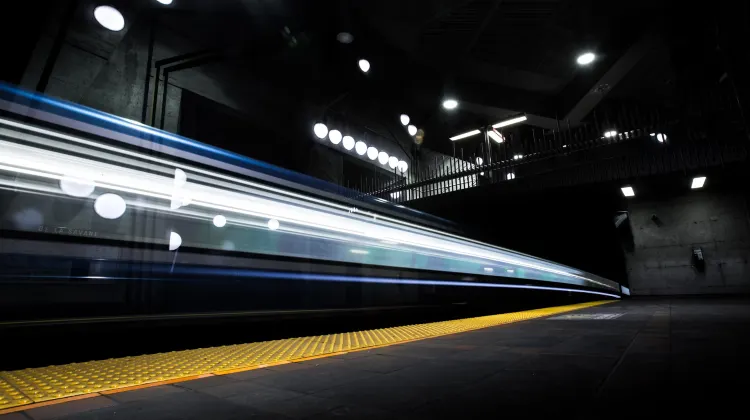
Source from Unsplash | A China high-speed train zipping by the platform.
China's high-speed rail is impressive not only for its extensive network but also for the speeds it achieves, which are among the highest in the world. The Shanghai maglev, recognized as the fastest train in China, reaches a top speed of 431 km/h, though it is limited to a 30 km track. Despite this limitation, it stands out for its peak operational speed.
International Rail Journey (Aug 2025) reports that China State Railway Group Co., Ltd. is preparing for 400 km/h commercial operation on key HSR lines.
On the other hand, traditional high-speed services like those on the Wuhan-Guangzhou route once averaged 312.5 km/h, making them the fastest in terms of average trip speed. However, after a policy change in 2011 aimed at reducing energy consumption and operating costs, speeds were capped at 300 km/h. Since then, the Beijing-Shanghai route has seen speeds restored to 350 km/h in 2017, pushing the boundaries of speed once again with average trip speeds of around 291.9 km/h.
China Train Speed Record
China's quest for speed on rails is not limited to operational trains but extends to test runs that have set remarkable records. For instance, a CRH380BL train hit 487.3 km/h during a test on the Beijing-Shanghai line, marking it as the fastest non-maglev train speed achieved in the country.
Below is a table about some key speed records set by various trains in China over the years:
Date | Train Type | Track Used | Top Speed Achieved |
2002-09-10 | DJF2 EMU | Qinshen PDL | 292.8 km/h |
2002-11-27 | DJJ2 EMU | Qinshen PDL | 321.5 km/h |
2008-04-24 | CRH2C EMU | Jingjin ICL | 370 km/h |
2008-06-24 | CRH3C EMU | Jingjin ICL | 394.3 km/h |
2009-12-09 | CRH3C EMU | Wuguang PDL | 394.2 km/h |
2010-12-03 | CRH380AL EMU | Jinghu HSR | 486.1 km/h |
2011-01-09 | CRH380BL EMU | Jinghu HSR | 487.3 km/h |
Source from Wikipedia
China Train Schedule
- G trains (High-Speed Train) are the fastest trains in China's rail network, with a maximum speed of 380-400km/h.
- D trains (Bullet Train), with a maximum speed of 250km/h, are also high-speed trains but operate at slightly lower speeds than G trains.
Check China train schedule below to have a better understanding of how fast is China high-speed trains 👇
Route | Train Type | Travel Time | Distance | Price |
G | About 45mins | 173km | From US$10.08 | |
D | About 1h | From US$6.49 | ||
G | About 30-40mins | 131km | From US$10.29 | |
D | About 1h 15mins | From US$11.46 | ||
G | About 4h 18mins | 1318km | From US$68.73 | |
D | About 12h | From US$40.44 |
How to Take a Train in China?

Source from Unsplash | People are preparing to board the train.
Taking a train in China involves a few simple steps to help you get from the station to your seat. First, make sure you arrive at the right station well in advance, about 1 to 1.5 hours before your train leaves. Many cities have multiple stations, so it's important to check which one you need.
When you get to the station, go through a quick ID and ticket check and a security screening at the entrance. Then, find the right waiting room to sit and wait until it's time to board. When your train is ready, head to the gate and then to the platform to board your train. Find your seat, settle your luggage, and relax for your journey. Once you arrive, just follow the signs to exit the station.
Step | Description |
1 | Arrive early (1-1.5 hours ahead) at the correct station. Make sure you're at the right one, as many cities have more than one. |
2 | Go through the ID check, ticket check, and security screening at the station entrance. |
3 | Find the designated waiting room and wait for the boarding announcement. |
4 | Proceed to the boarding gate and then to the platform to board the train. |
5 | Settle in your seat, store your luggage, and relax as you travel to your destination. Upon arrival, follow the signs to exit the station. |
Explore Beijing for Free During Your Layover!
Starting December 27, 2024, transit passengers with an 8+ hour layover at Beijing Capital Airport can enjoy the Beijing Express Half-Day FREE Layover Tour. Choose from two exciting routes daily and make the most of your stopover!
Tips for Bullet Train China

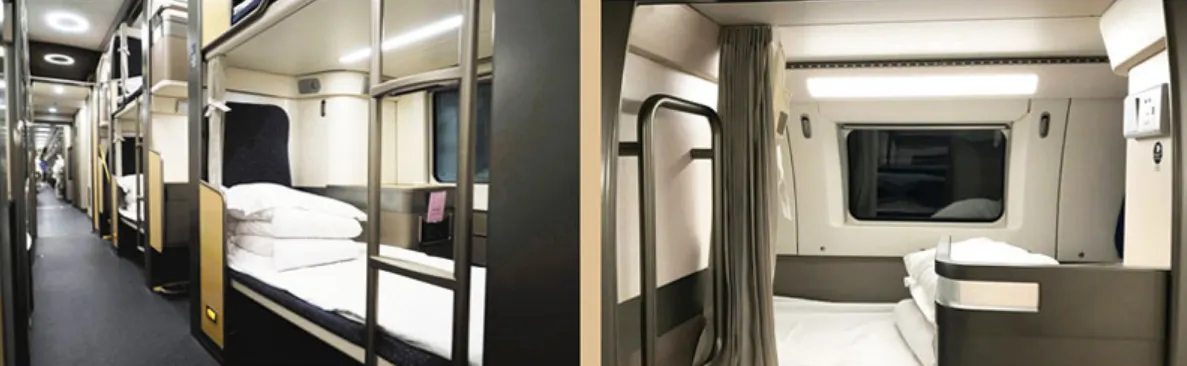
Source from China Discovery | Warm and cozy sleeping compartment of China high-speed rail.
Benefits of 3 Types Sleeper Compartments
1. New Sleepers (Dong Wo动卧)
- Description: Modern sleeper design with two layers of berths parallel to the carriage. Each berth has its own window, offering privacy with a curtain and a suite of convenient features.
- Facilities: Electrical outlets, tray table, hooks, adjustable backrest, overhead and reading lights, storage for books, bedding, personal air-conditioning, and snacks.
- Advantages: Offers a private, quiet environment ideal for business or leisure, enhancing overnight travel by saving time and money.
2. Soft Sleepers Compartment (Ruan Wo软卧)33322
- Description: Features four berths per compartment with perpendicular arrangement to the carriage. Compartment doors slide to ensure quiet.
- Facilities: Television, electrical sockets, slippers, bedding, and a service call button.123
- Advantages: Suitable for groups traveling together, offering a comfortable and enjoyable onboard experience.
3. Deluxe Soft Sleeper Compartment (Gao Ji Ruan Wo高级动卧)
- Description: Luxurious option with two berths per compartment, more akin to a private hotel room on wheels.22
- Facilities: Soft sofa, wardrobe, LCD TV, air conditioner, mirror, slippers, earplugs, and a shared lounge area at the end of the aisle.
- Advantages: Provides a very private and quiet environment, ideal for couples or small family groups, with high-quality amenities.
Tips for High-Speed Train Sleepers
【Comparison of Sleeper Services】
Feature | High-Speed Train Sleepers (D) | Standard Train Sleepers (K, T, Z) |
Berth Layout | 2 berths per side | 3 berths per side |
Comfort Level | 4.5 stars | 3-3.5 stars |
Environment | Clean, quiet, private | Dirtier, noisier |
Smoking Policy | Banned on board | Limited to certain areas |
Toilet Facilities | Western and Chinese styles | Mostly Chinese style |
Other Amenities | Well-equipped with mirrors, water dispensers, and TVs in each compartment | Basic, with fewer amenities |
12306 vs. Trip.com
When booking train tickets in China, travelers can choose between 12306, the official site of China Railway Corporation, and Trip.com, a reliable international travel agency. While 12306 allows users to book directly, it often experiences technical issues and offers support only in Chinese during limited hours. Conversely, Trip.com provides a user-friendly interface, multilingual 24/7 customer support, and accepts various payment methods, making it cheaper and more accessible for international travelers.
| Feature | 12306 | Trip.com |
| Booking Source | Official China Railway website | Best International travel agency |
| Additional Fees | No extra fees | Possible extra fees |
| Service Hours | 5 AM to 1 AM (11:30 PM on Thursdays) | 24/7 |
| Website Reliability | Occasional errors and crashes | Stable and user-friendly |
| Customer Service | Chinese only, limited hours | Multilingual, available 24/7 |
| Payment Options | Limited to local methods | International credit cards, AliPay, WeChat Pay |
| Additional Services | None | Hotels, flights, tours |
FAQs about China Train
How early should I arrive at the station?
Arrive at least 30–60 minutes before departure for security checks and boarding.Can I bring luggage on China trains?
Yes, each passenger can carry small hand luggage plus larger bags within the train’s limits.How do I buy tickets for China trains?
You can book online with a passport, use e-tickets, or pick up paper tickets at the station.What types of seats are available on China high-speed trains?
There are Second Class, First Class, and Business Class seats, plus sleeper compartments on some overnight trains.Are China high-speed trains punctual?
Yes, China high-speed trains are known for being very punctual, usually departing and arriving on time.

3555 booked