The Complete 2026 Kenya eVisa and eTA Guide

Contents
- WHAT IS THE KENYA EVISA?
- WHO NEEDS A KENYA EVISA?
- TYPES OF KENYA EVISA AVAILABLE IN 2026
- Tourist eTA
- Business eTA
- Transit eTA
- East African Tourist Visa — Multi-Country Option
- REQUIRED DOCUMENTS FOR KENYA VISA ONLINE
- STEP-BY-STEP KENYA ETA APPLICATION PROCESS
- EXPERT TIPS FOR A SUCCESSFUL APPLICATION
- WHAT TO EXPECT ON ARRIVAL IN KENYA
- Extending Your Stay
- Ready for your East African journey?
Show more
In early 2024, the Kenyan government formally transitioned from the traditional visa framework to a streamlined Electronic Travel Authorization (eTA) system.
This digital framework entirely replaced the old paper visas and the previous iteration of the Kenya eVisa.
Its primary function is to screen travelers before they board flights, fortifying border security while reducing processing delays at immigration checkpoints.
The application is entirely online, eliminating the need to mail passports to consulates or wait in line at embassies.
Once approved, the document links directly to your passport number.
While the terminology shifted from visa to eTA, the fundamental requirement remains the same: foreign nationals must obtain digital pre-approval to cross Kenyan borders.
The short answer is almost everyone.
Kenya implemented a universal eTA requirement for international visitors, effectively ending visa-on-arrival programs.
Whether you are visiting Nairobi for a quick business meeting or embarking on an extended safari in the Great Rift Valley, you must secure digital clearance.
Exceptions to this rule are exceptionally narrow.
Citizens of the East African Community (EAC)—including Burundi, the Democratic Republic of Congo, Rwanda, South Sudan, Tanzania, and Uganda—enjoy exemption from the eTA requirement for stays up to 180 days.
Important update — May 2025: Kenya expanded eTA exemptions to include most African nationals. Citizens of all African Union member states are now exempt, with the exception of Libya and Somalia, which still require an eTA for security reasons.
All other foreign nationals, regardless of age, must apply for the electronic authorization prior to departure.
This mandate applies to infants and children traveling with their parents.
The government issues specific authorizations based on the intended nature of your visit.
Selecting the correct category prevents delays at immigration and ensures you do not violate the terms of your stay.
The tourist authorization covers standard leisure travel — wildlife safaris, coastal holidays, and visiting family or friends residing in Kenya.
The document remains valid for 90 days from the date of issue and grants a single entry into the country.
United States citizens have access to a distinct five-year multiple-entry tourist authorization, provided they meet specific passport criteria.
Corporate travelers attending conferences, engaging in trade negotiations, or exploring investment opportunities require the business eTA.
Like the tourist category, this single-entry authorization lasts 90 days.
It strictly prohibits formal employment or long-term salaried work within the country.
A five-year multiple-entry version is available exclusively to U.S. passport holders conducting regular business in the region.
Travelers catching connecting flights through Nairobi or Mombasa to third-country destinations must hold a transit eTA if they intend to leave the airport.
This single-entry permit allows a brief layover period.
If your itinerary involves remaining entirely within the international transit lounge without passing through passport control, you typically do not need to meet this requirement.
Travelers planning to visit Kenya, Uganda, and Rwanda on a single trip can apply for the East African Tourist Visa (EATV) instead.
The EATV costs $100 USD, covers all three countries, and grants a non-extendable multiple-entry stay of 90 days.
It must be first used to enter the country that issued it.
This is particularly practical for safari itineraries that cross borders between the Maasai Mara and Rwanda’s Volcanoes National Park.
Gathering your materials before initiating the application eliminates the primary cause of processing delays.
Every uploaded document must be legible, uncropped, and free of glare.
· Valid Passport: Must contain at least one blank page and remain valid for a minimum of six months beyond your intended date of arrival.
· Biographical Passport Page: A clear, color scan of the page displaying your photo, personal details, and passport signature.
· Recent Digital Photograph: A clear photo of the applicant’s face against a plain background. Selfies are acceptable if the lighting is even and the face is unobstructed.
· Confirmed Return Flight Ticket: A digital copy of your airline itinerary showing your departure from Kenya.
· Proof of Accommodation: Hotel booking confirmations covering the duration of your stay. If staying with a resident, provide their formal invitation letter and a copy of their Kenyan national ID or passport.
· Onward Flight Ticket (Transit Only): Proof of a booked flight departing Kenya for a third country.
· Company Invitation Letter (Business Only): A formal document on corporate letterhead detailing the purpose and duration of the business visit.
· Parental Consent Letter (Minors Only): A signed authorization form if a child travels unaccompanied or with only one parent.
Yellow fever certificate: Required if you are arriving from a country classified as a yellow fever endemic zone. Proof of vaccination (the yellow card) must be presented to the immigration officer on arrival. Kenya’s official list of endemic countries includes much of sub-Saharan Africa and parts of South America.

Navigating the application requires attention to detail.
A methodical approach ensures you do not omit crucial information that could trigger a rejection.
Using a dedicated service such as the Kenya eVisa platform by e-Visa Express can simplify data entry and reduce the risk of errors.
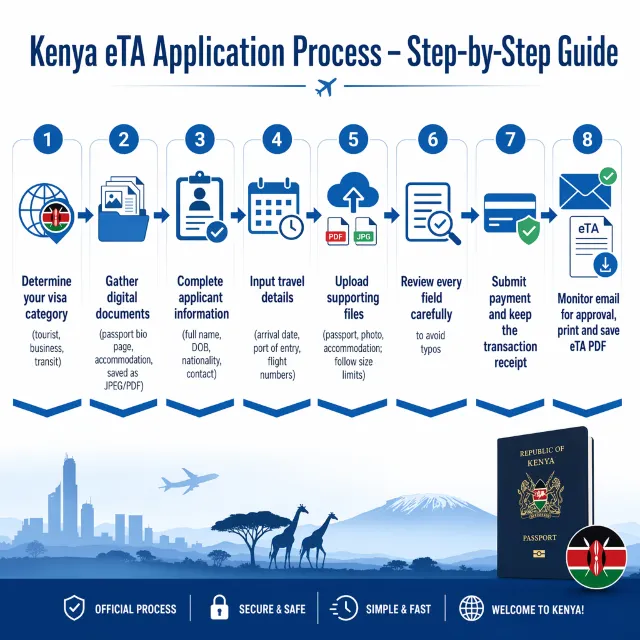
Securing your Kenya Electronic Travel Authorization relies on precision.
Immigration officials process thousands of requests daily and reject applications containing conflicting or incomplete data.
· Match your names exactly: Include all middle names as listed on your passport bio page. Omitting a middle name causes immediate border complications.
· Book hotels before applying: The system requires concrete proof of accommodation. You cannot submit an application with an unconfirmed or tentative itinerary.
· Check photo lighting: Ensure your uploaded photograph has no heavy shadows across your face and no glare from eyeglasses.
· Apply 14 days in advance: Standard processing takes 48–72 hours, but system load during peak safari season can significantly extend this.
· Carry printed copies: Digital devices fail or run out of battery on long flights. A printed PDF handed to an immigration officer accelerates your entry.
· Verify your validity window: The 90-day validity begins on the date of issue, not the date you enter Kenya. Do not apply months before your trip.
· Re-entry after EAC travel: Your eTA remains valid for re-entry if you make a brief departure to an EAC partner state (Rwanda, Uganda, Tanzania, etc.). Exiting to any country outside the EAC block requires a new eTA.
Touching down in Nairobi or Mombasa initiates the final phase of your entry process.
The eTA grants permission to travel to a Kenyan port of entry — it does not guarantee your admission.
The final decision rests with the immigration officer at the desk.
Join the line designated for eTA and foreign passport holders.
Have your physical passport, printed electronic authorization, return flight confirmation, and hotel bookings easily accessible.
The officer will scan the QR code on your document and cross-reference your passport data.
They may ask brief questions about your itinerary — answer clearly and concisely.
If you recently transited through a yellow fever endemic zone, have your vaccination certificate ready.
Once cleared, your passport will be stamped with your permitted duration of stay.
If you wish to remain in Kenya beyond the duration stamped in your passport, you may apply for an extension before it expires.
Extensions are handled in person at Nyayo House Immigration Offices in Nairobi.
A first extension of up to 90 days can be granted at the discretion of the Director of Immigration.
A further 90-day extension may also be applied for, subject to approval.
Ensuring your travel documents are in order lets you focus entirely on your itinerary.
Simplify your border preparations and secure your required Kenya eVisa through a streamlined portal that minimizes errors and expedites approval.
Popular recommendations

2026 Guide to Shanghai Pudong Airport: Transit Visa & PVG Airport Shuttle
 TripBlog
Everything you need to know before going to Los Angeles zoo
TripBlog
Top 10 Things to see and do In the Bund, Shanghai
TripBlog
Latest Trip.com Promo Codes, Flight Discounts & Hotel Savings (Weekly Update)
 Trip.com Official