Pantheon Paris: Facts, History and Tips 2025

Contents
- A. Pantheon Paris opening hours and days
- B. Ticket price
- C. Access and transportation
- D. Time needed to view the entire structure
- E. Tours in Pantheon
- F. School groups and extra-curricular tours
- G. Audio tours
- History of Pantheon Paris
- Beautiful Architecture, Aesthetic and the Church
- 1. Dome
- 2. The Façade
- 3. Art Naves
- 4. The Crypt
- 5. Attend Mass
Show more
Pantheon Paris is a majestic archeological site situated in the Latin Quarter in Paris, France. It is the most ancient structure (125 AD) of Rome, and one of the city's most magnificent spectacles and this grandeur is visible from every corner of Paris.
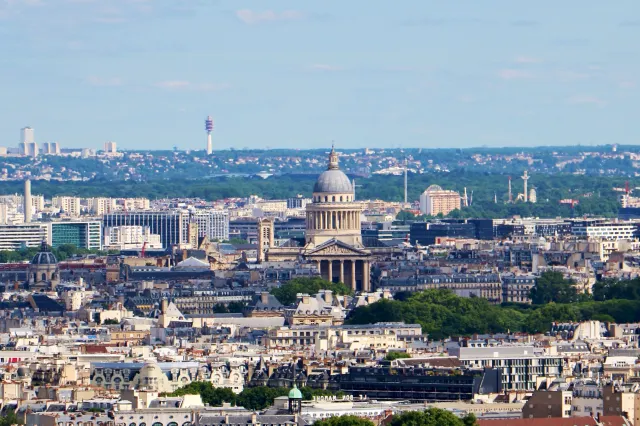
Panthéon Paris meant the “Temple of all the Gods” and was initially built as a church dedicated to St. Genevieve. The primary purpose of constructing this building was to keep the reliquary Chasse containing the remains of the most honored saint of those times. But unfortunately, it changed to a secular mausoleum and now houses the remains of prominent French citizens.
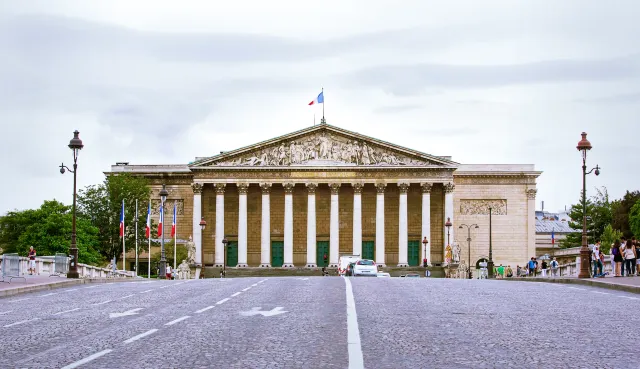
This place is not to miss attraction for history enthusiasts as it presents the marvelous architecture of neo-classicism. The façade, the most significant part of the building's construction, the beauty of the architecture, leaves the visitors in awe. Besides, an alluring dome conquers the building which was made taking inspiration from great Bramante's Tempietto. This heritage is in the heart of ancient Rome and invites thousands of visitors to enjoy the alluring display of classical architecture.
- Open every day of the week
- From April 1 to September 30 – 10 am to 6.30 pm
- From October 1 to March 31 – 10 am to 6 pm
- The Pantheon Paris remains closed on some national holidays (January 1, May 11 and December 25, On June 17th morning) or if any mass is taking place.
There is a small entry fee for getting inside the Pantheon Paris, but it's free for the Paris Insiders Pass holders.
- Full Price: 9€
- Reduced Price (Under 26 YO for not a national of a Member State of the European Union): 7€
- Group Price from 20 people: 7€
- Free every 1st Sunday of the month from Nov. to Mar.
There are several modes to reach this heritage site, but the most popular and convenient one is by walk. Pantheon Paris is a walk away from anywhere in the quarter. Getting here through the east gate of the Luxembourg Gardens lets the visitor experience the panoramic views of Paris from the highest point of the arrondissement.
- By Metro: The nearest Metro station is Cardinal Lemoine on line 10, which connects to the east of the Pantheon Paris and also RER B which stops at Luxembourg.
- By Bus: Two bus stops are near Piazza Navona which is only about 5 minutes from this Pantheon Paris. Bus lines available on this route are 21, 27, 38, 82, 84, 85, and 89.
- By Car: Boulevard Saint-Michel and Rue Soufflot
The average time needed to admire the beauty of this classic structure varies from person to person, but the one with the likes of heritage can look around in an hour or so. The best time to visit the place is evening, as you can very well explore the architectural grandeur and easily go to the nearby restaurant later.
There are several individuals, group or school tours as well as self-guided, guided, or audio guided tours available to explore this majestic Pantheon Paris.
- Self-guided tours: Self-guided tours require a maximum of one hour, and a visitor's guide is there to help the visitors. It is available in several languages including French, English, German, Spanish, Italian, Russian, Polish, Portuguese and Chinese. No booking is required for self-guided tours.
- Guided tours: It is of 45 minutes duration and is subject to availability. These are available every day in the afternoon and cover a comprehensive tour on the Pantheon Paris and its history. For these guided tours also there is no requirement of pre-booking.
- Tour-lectures: These lectures are available in French, English, and Spanish and need at least one and a half hours to cover all the details. The different tour lectures are:
- "Aux grands hommes, la Patrie reconnaissante" ("To the great men, the grateful homeland"): alternate Wednesday at 2.30 p.m.
- The "Les Peintures Murales" (Murals) series: any Thursday of the month at 10.30 a.m.
- "Le Paris des Dômes" (Paris Domes): alternate Monday between April and October
The ticket price for these tours is fixed at a flat rate of €15 per person.
Several school groups and theme tours are also available for the students of 6/5th grade, middle, high school or universities. Also, these tours offer various services for differently-abled people.
At the entrance, the visitors can purchase an audio guide by paying 3€ and explore the beauty by themselves. This audio-guided tour is of one and half hours duration and is available in French, English, Spanish, Italian, German, Polish, Chinese, Korean, Japanese, Brazilian and Russian.
The Pantheon Paris is situated on the highest point on the Left Bank and has a remarkable history associated with it. The site where this structure is constructed has initially been a site of a church, dedicated to Saint Peter and Paul. But after the death of the patron Saint Genevieve, it became the monastery and had her relics too. The plan for this building came into the mind of Louis XV, the last French King, during the mid-1740s when he was on his death-bed. He then thought of making a beautiful church dedicated to the patron saint of Paris, Saint Genevieve. And for that purpose, he appointed the most famous architect of those times, Soufflot. Soufflot was one of the leading architecture of those times and was master of making masterpieces with a unique blend of a classical style and new perspectives. He planned to create a church that is far ahead of all other churches and buildings of that era. This Pantheon Paris church building was designed on a very vast space and required a massive amount of funds for its construction. The building got its completion after many years of gap and after the death of its founders Louis XV and Soufflot, in 1790, the time when the French Revolution was in its early phase.
Soufflot’s first design of Pantheon Paris was after the works of Bramante and comprised of four naves of equal length, and monumental dome over the crossing in the center forming a Greek cross. The design also had the presence of a classical portico with Corinthian columns and a Peristyle with a triangular pediment on the main façade. But this design didn't work and was modified five times over the following years. The Narthex, a choir, and two towers also got inclusion in the building after changes that were made in the original design of Pantheon Paris and the construction got its completion in 1790.
The construction of this Church of Saint-Genevieve completed in early 1790 during the start of the French Revolution. But, after the demise of the President of the National Constituent Assembly, the Comte de Mirabeau on April 2, 1791, this church got its new name of "the temple of the nation." This building got converted to a mausoleum and was devoted to liberty, on the model of the Pantheon Paris in Rome. After the funeral of Mirabeau that took place in this building, the remains of Voltaire and several other martyrs of Revolution got a peaceful home in this enticing piece of architecture.
After the end of the Revolutionary period, two of the esteemed men's remains were removed from the Pantheon Paris, declaring them the enemies of the Revolution. But in February 1795, a new decrement was announced which did not allow the placing of remains of a person dead for more than ten years. The building went into some renovation to suit the solemnness of the mausoleum. New murals and statues also replaced all the figures and friezes which got destroyed during the French Revolution period. For that the architectural changes like making interior darker by frosting the glass of the upper windows and bricking up all the lower windows. The new architecture removed all the ornament presents on the facade along with the bells and lanterns. And all these changes were done to make the building look like a mausoleum rather than a church.
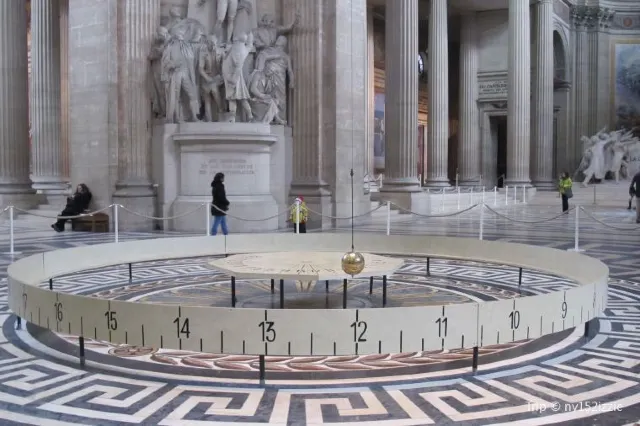
Since then, the Pantheon Paris has seen various changes, renovations, and conversions. The interiors of buildings kept on changing with new emperors, and the transformation of the Temple to church and back to Temple also happened during 1806-1830. During this period, the crypt was marked closed for the general visitors. In 1948, after the arrival of the elected government, the Pantheon Paris got a new name of "The Temple of Humanity" and underwent some new renovations, including sixty new murals. In 1951, it got a new addition in the form of The Foucault Pendulum which represented the rotation of earth but got removed after complaints from the church. After the death of Victor Hugo in 1885, the Pantheon Paris got back to its original status of "The Temple of Great Men." And since then have seen the addition of remains of several renowned personalities. The new addition to the Pantheon Paris include André Malraux, the writer plus the cultural minister who was brought here in 1996, and the most recent one is Simone Veil, the lawyer, and the politician who got the honor of being here in 2018.
The excellence of this building lies in its architecture, and the glorious art showcased all over the structure. The main attractions of this Pantheon Paris include the magnanimous Dome, a rich façade, the astonishing Narthex and Naves and the mesmerizing crypt. All of these masterpieces delight visitors with superb architecture, designs, art pieces, and displays.
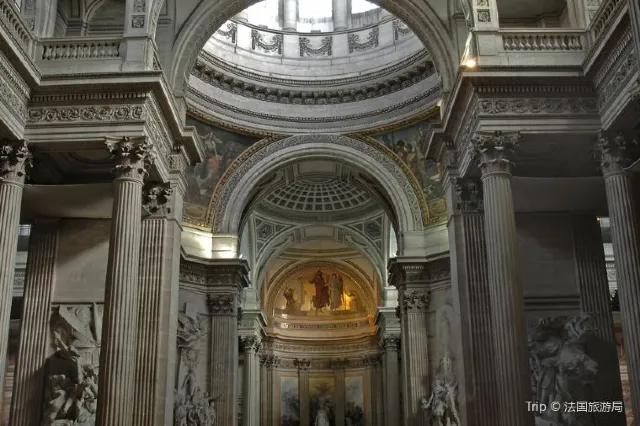
This entirely stone dome is designed to out pass the domes of St. Peter’s Basilica and St Paul’s Cathedral of Rome and London respectively. This dome is a combination of 3 domes set within the other. The ceiling of this vast dome is painted from inside and is visible from the opening of the second dome. The beautiful paintwork, the Apotheosis of Saint Genevieve, was done by renowned artist Jean-Antoine Gros and is evident from the opening in the lowest dome. The dome has a height of 83.0 meters (272 ft.) and is visible from all parts of the Paris city and also has an opening called the oculus. It also has a triangle in the center which represents the Trinity and is encompassed by a halo of light. The painting also includes few groups which symbolize the Kings of France who took measures for the protection of this Pantheon Paris. Not only this, the four pen datives, or arches also present the beauty of paintings of François Gérard. These paintings display the phenomenon of the Glory, Death, The Nation, and Justice.
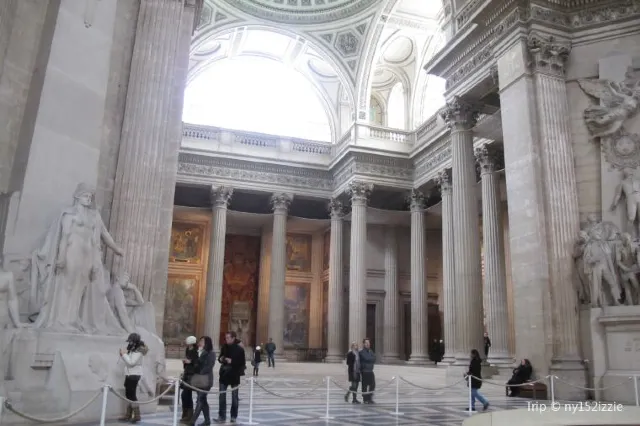
The splendid façade and peristyle not only features Corinthian columns and sculptures but also has the figures of distinguished scientists, philosophers, and statesmen. The statues present here are of Rousseau, Voltaire, Lafayette, Napoleon Bonaparte, along with soldiers from each military service and students in uniform from the École Polytechnique. Also, the motto is written there, which states, “To the great men, from a grateful nation.” This phrase is there since the time it was constructed in 1791. Though it was removed during the Restoration of the monarchy and was put back in 1830.
The Western Nave is complete with the showcase of a sequence of paintings displaying the saints of Paris, Saint Danis, and Saint Genevieve. Whereas, the Southern and Northern Naves have murals depicting the Christian heroes of France. The Pantheon Paris featured a 67-meter (220 ft) Foucault pendulum which was hung beneath the central dome and represented the rotation of the earth. It was displayed during renovation, and now the building has only a duplicate copy of the pendulum.
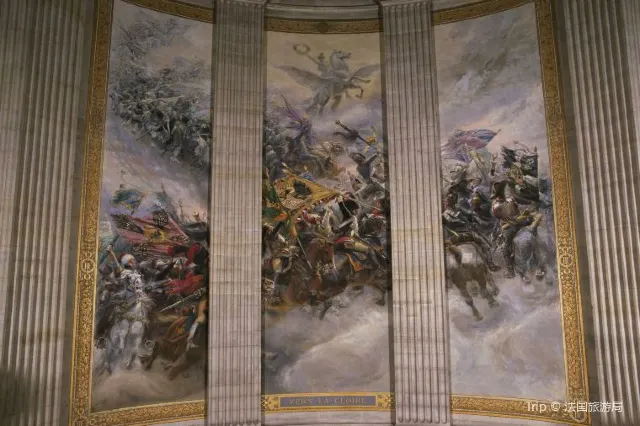
The crypt of the Pantheon Paris houses the tombs of the eminent personalities (76 men and two women) who have played an important role in the history of France. Among those buried here are from Voltaire and Rousseau to Alexandre Dumas. It also has the remains of the modern times famous personalities, including Simone Veil and her husband, Antoine Veil. There is a permanent exhibition which provides all essential details about the lives and works of all who were buried here.
The Pantheon Paris is now a Christian church and provides services for the community. Here the visitors can visit the mass every Sunday at 10:30 am and on Saturday at 5 pm.
Tips for visiting Pantheon Paris
Popular recommendations

A Must-have Guide to Plan Your Trip to Disneyland Paris
TripBlog
Climbing the 6 Most Famous Towers in Paris
TripBlog
Travel to Paris with The Movie Scene and Be the Perfect Protagonist for A Day
TripBlog
12 Best Things to Do in Paris
TripBlog
Top Places to Visit in Le Marais, Paris
TripBlog
10 Ultimate Things to do in Montmartre, Paris
TripBlog
Walk Around The Latin Quarter, Paris: Things to Do and See
TripBlogQ&A
What's the most popular attractions in Paris?
How to get to Venice from Paris?
How to get to Paris from Prague?
How to get to Paris from Interlaken?
What is the best season to visit Paris?
What do I need to know before visiting Paris?
Trending Travelogues
Popular Trip Moments
Popular Attractions
Popular Ranked Lists
Popular Destinations
Recommended Attractions at Popular Destinations


About






of the year 2025



Site Operator: Trip.com Travel Singapore Pte. Ltd.