Top 10 China Chat & Calling Apps for Foreigners


I’ve lived and worked in China as a digital nomad for years, with a wide circle of Chinese and international friends. If you’re new here, you’ll quickly find that WhatsApp, X and YouTube are blocked. You’ll need to get used to local communication apps to chat, call, work and socialize smoothly here.
I’ve tested every major local app through my time in different Chinese cities and companies, and I break down the 10 most useful chatting apps below.
to Shanghai
to Guangzhou
to Beijing
See all flights

Top 10 Chinese Chat & Calling Apps

All apps work in China without a VPN, categorized into 4 core use cases. I also list key functions and the best scenarios for foreigners visiting China.
Category | App Name | Core Functions | Best For |
|---|---|---|---|
Daily Communication | Instant messaging, voice/video calls, mobile payment, mini-programs, official accounts | Daily life communication with Chinese locals/friends; all-in-one daily life services | |
Instant messaging, large file transfer, group chats, voice/video calls | Sending big files; connecting with young Chinese in gaming/anime/outdoor communities | ||
Business Tools | Lark (Feishu) | Team chat, real-time document collaboration, video meetings, project management | Corporate work in China; cross-team and remote collaboration |
Tencent Meeting | Hd video/audio conferences, screen sharing, meeting recording, virtual backgrounds | Formal team/client video meetings; online classes/seminars in China | |
DingTalk | Attendance tracking, team chat, task management, internal announcements | Internships/ work in Zhejiang/Hangzhou; Chinese small and medium enterprises | |
WeChat Work | Business chat, client management, seamless link to personal WeChat | Foreign expats working in China; sales and marketing roles | |
Social Media & Socializing | Xiaohongshu (RedNote) | Visual content sharing, local recommendations, community chats | Finding like-minded people; renting apartments; local life and hobby guides |
Bilibili | Video sharing, live streams, community forums, creative content interaction | Connecting with young Chinese; sharing creative content; niche interest communities | |
Douyin | Short videos, live streams, location-based content, local discovery | Following Chinese social trends; casual local friend-finding via city content | |
Other Chatting Apps | HelloTalk | Language exchange, cross-cultural chat, AI translation | Learning Mandarin; making language partners |
Doubao AI | AI chat, information queries, Chinese/English translation, daily Q&A | Quick local info checks; simple translation; casual AI conversation |
China Chatting App - Daily Communication Apps in China
These 2 apps are the most used for daily communication in China. WeChat is the universal tool for all ages and scenarios, while QQ fills the gaps for large file transfers and young social circles (baesd on my experience).

I use WeChat for nearly 90% of my daily communication in China; every local I know has this app. It’s far more than a chat tool, it’s the core app for daily life, covering everything from calling friends to paying for daily expenses. For foreigners, it’s the first app you need to master.
- Download and setup: Get it from the App Store, Google Play (outside China) or local app stores (Huawei, Vivo, Oppo) inside China. You can register with an international or Chinese phone number; a Chinese number unlocks full features like WeChat Pay.
- Language setting: Switch Wechat to English easily by going to Me > Settings > General > Language > English. The entire interface is fully localized for English speakers.
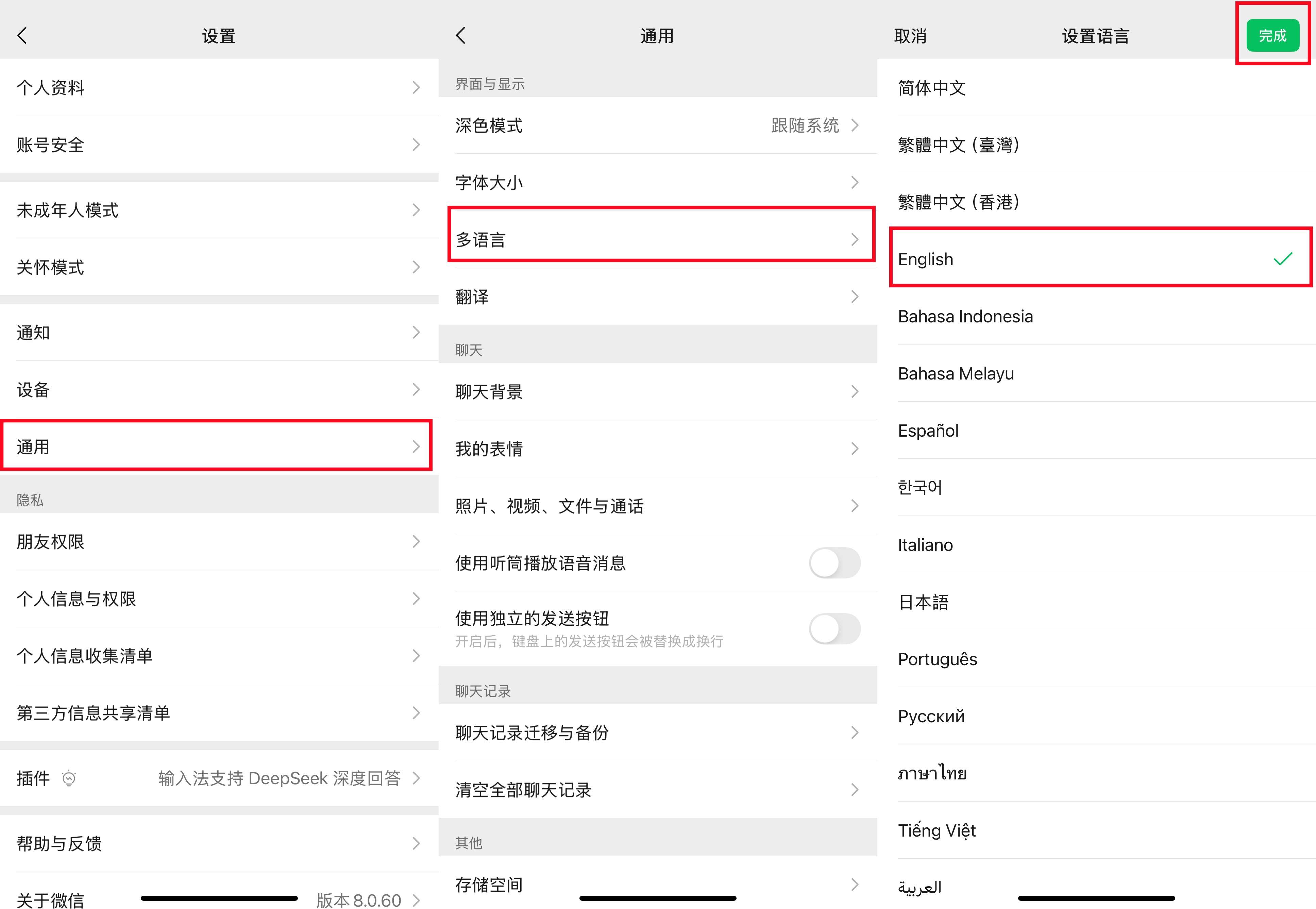
- Chat and calls: Free one-on-one and group voice/video calls (up to 50 people) and instant messaging with text, voice notes and stickers. It also supports location sharing and basic file transfer (up to 200MB) for quick sends.
- WeChat Pay for foreigners: Link your Visa, Mastercard or JCB card by going to Me > Service > Wallet > Add a Card. You’ll need to upload your passport for identity verification. Overseas cards can’t send red packets or peer-to-peer transfers, but work for all QR code payments in stores and online. A 3% fee applies for transactions over ¥200, with no fee for smaller amounts.
- Mini-programs: This is one of the most useful features for expats. You don’t need to download separate apps for daily services—just search for Ele.me (food delivery), Didi (taxi booking), Taobao (shopping) or local transport services in WeChat’s search bar to access their mini-programs.
- Official accounts and Moments: Follow official accounts for restaurants, city tourism and public transport—major Chinese cities offer English versions for these accounts. Moments is China’s version of Instagram’s feed, where you can share photos and updates with your Chinese friends and control who sees your posts.
- Built-in translation: The app has real-time translation for text and voice notes, which is perfect for chatting with locals who don’t speak English.

QQ is often overlooked by expats, but I use it every day. It’s similar to Telegram, with more versatile features than WeChat, and it’s still extremely popular with Chinese Gen Z and young millennials. While older Chinese people rarely use it now, it’s the best app for connecting with young local groups and sending large files.
- Large file transfer: This is QQ’s biggest advantage. It supports file transfers up to 10GB, a huge upgrade from WeChat’s 200MB limit. I use this to share raw photos, video clips and large work documents with Chinese friends and collaborators.
- Community and group chats: QQ groups are far more active than WeChat groups for niche hobbies. I found my hiking, gaming and photography groups on QQ, and there are thousands of local interest groups to join across China.
- Extra features: It comes with 10GB of free cloud storage, screen sharing and a built-in music player. These small features make it more practical than WeChat for specific social and work scenarios.
China Chatting App - Business Apps for Working in China
Chinese companies use dedicated tools for work communication and collaboration. These three apps are the most widely used, each with a clear niche. I’ve used all three during my time at three different Chinese companies, and they’re free for basic use with paid premium features for large enterprises.

Lark (Feishu)
Lark is my go-to business app in China. I’ve used it at every corporate job I’ve had here, and it’s the standard for efficient team collaboration and remote work. Developed by ByteDance, it’s designed for productivity with no unnecessary features, just smooth document sharing, video meetings and project management.
- Key features include real-time co-editing for documents, slides and spreadsheets, AI meeting notes that transcribe both Chinese and English, and task tracking with OKR integration.
- It’s ideal for foreign expats in Chinese tech and corporate companies. Its English interface is intuitive, and it’s much more user-friendly than other business apps for international teams.
Tencent Meeting
Tencent Meeting is China’s most popular video conference app—every Chinese company uses it for formal meetings. I use it for all my cross-team and client meetings, and it’s far more stable than international video conference tools (which often need a VPN and have poor connection in China). It’s also used for online classes, seminars and industry events across China.
- Key features: HD video/audio calls (supports up to 300 people for free), screen sharing with annotation tools, meeting recording and virtual backgrounds. It also supports real-time translation for Chinese and English chat during meetings.
- Pro tip: It’s fully compatible with WeChat and QQ—you can share meeting links directly to WeChat/QQ groups, and participants can join with one click without creating an account.

DingTalk
DingTalk, developed by Alibaba, is the default business app in Zhejiang and Hangzhou. I first used it during my university internship in Hangzhou, and every local company there relies on it. It’s built for team management and attendance tracking, making it popular with Chinese small and medium enterprises and universities.
- Key features include facial recognition attendance, urgent internal announcement push notifications and task management with manager approval workflows.
- It’s a more top-down tool than Lark, great for following company rules and structured workflows, but less flexible for creative and remote work environments.

WeChat Work
WeChat Work is the best business app for foreign expats working in China, thanks to its seamless connection to personal WeChat. You can chat with colleagues on WeChat Work and message friends on personal WeChat without switching between apps, which saves a lot of time.
- Key features include business-only chat (no personal information sharing), client management tools for tagging and tracking customers, and official account integration for brand and marketing work.
- I recommend it for expats in sales and marketing roles. You can add Chinese clients on WeChat Work without sharing your personal phone number or WeChat info, keeping work and personal life separate.
China Chatting App - Social Media Apps
Chinese social media is not just for scrolling content—it’s the best way to make local friends and find niche interest communities. I met most of my Chinese friends through these three apps, and they’re perfect for expats looking to immerse themselves in local culture.

Xiaohongshu (RedNote)
Xiaohongshu is my favorite app for socializing in China. It’s a mix of visual content sharing, local recommendation platform and community forum. I used it to find a rental apartment, my hiking group and hidden local coffee shops in Shanghai. It has a highly active community with both expats and locals, and most users are open to making new friends.
- Use it by searching for hashtags like #ShanghaiHiking #ExpatInChina #PhotographyLovers. Join the comment sections of posts you like, and people will message you directly to connect.
- It’s also the best app for local life recommendations. Chinese users share honest reviews for restaurants, travel spots and daily services—far more detailed than most international map and review apps.

Bilibili
Bilibili is China’s main video platform, the go-to place for young Chinese people to watch creative content, anime and live streams. I posted a short cover song video here a year ago that unexpectedly gained a lot of views. I made dozens of online friends from it, and we even met up for a concert later.
- Key features include real-time subtitle comments (danmaku), creative content communities for music, art and vlogging, and interactive live streams with chat rooms.
- It’s perfect for expats who create their own content. Chinese users love international creators sharing their life and experiences in China, and it’s a great way to connect with young locals who share your creative interests.

Douyin
Douyin is the most popular social app in China, used by people of all ages, and it’s the Chinese version of TikTok. I’m not a big fan of short videos, so I rarely use it, but it’s widely used for local friend-finding and discovering city-specific content.
- Locals use it for socializing by posting short videos of themselves exploring their city with hashtags like #BeijingExpat #GuangzhouFood and a caption looking for friends. Other users will comment or message to hang out.
- It’s a more casual social platform than Xiaohongshu or Bilibili, great for making random local friends and discovering popular local spots, rather than niche interest groups.
China Chatting App - Language Learning Apps for Foreigners
These 2 apps are not just for chatting, they are also practical tools to help expats learn Mandarin, gain local information and communicate more easily in China.

HelloTalk
HelloTalk is the best language exchange application in China, with 60 million users from 200 countries and can be accessed without a VPN. I use it to practice my language, and I also make language partners who help me improve my spoken German and English skills-in return, I help them learn Chinese.
- Key features include artificial intelligence translation in more than 160 languages (text, voice, and video), grammar correction for native speakers, and language partners matching age, interest, and location filters.
- Voice chat rooms are a great feature for shy expats. You can listen first and join the conversation when you are comfortable, and there are themed rooms for daily conversations and travel Mandarin practice.

Doubao AI
Douyin AI is a ByteDance AI chat robot. I use it for daily rapid information query and translation. It's perfect for expats who don't speak much Mandarin because it's more accurate than generic translation apps for Chinese slang and local terms.
- The main functions include real-time Chinese/English translation, voice chat and local life information inquiries, such as subway operating hours, restaurant operating hours and travel tips in China.
- It's not a social app, but it's a savior of daily life. I often use it to check local information and translate local people's messages that the built-in WeChat translation cannot handle.
What Apps Work in China Without a VPN?


This is the most common question I get from foreign friends moving to China. While WhatsApp, X and YouTube are blocked here, all the Chinese apps listed in this guide work without a VPN, so you can access them with a local Chinese mobile network or a China eSIM.
A small number of international communication tools also work without a VPN, but almost no Chinese people use them. They’re only useful for chatting with friends and family outside China:
- FaceTime: Basic voice and video calls work normally without a VPN, but it’s not a popular tool among locals.
- Outlook/Hotmail: Email and basic messaging work without a VPN, suitable for international work emails.
- Skype: Text messaging works without a VPN, but voice and video calls are often unstable. A VPN is needed for smooth calls.
Do I Need a VPN for Communication in China?
You only need a VPN if you want to use international communication and social apps like WhatsApp, Instagram, Facebook and X. For daily communication with locals, work and socializing in China, a VPN is not necessary.
- China local eSIM (no VPN): Lets you access all local apps and Chinese websites. International apps and sites (Google, Instagram, WhatsApp) remain blocked. This is the best option for daily life in China.
- China local eSIM (with VPN): Gives you full internet access to blocked international apps and sites, while still using fast local network speeds. This is the ideal choice for digital nomads.
- International roaming (home eSIM): May unlock some blocked international apps, but the connection is slow, expensive and unreliable. I do not recommend this for long-term use in China.
See all attractions
 886526 booked




Tips for Using China Chat Apps as a Foreigner

China Baidu ERNIE Bot Now Ranking As The #1 Chinese AI Chatbot
These simple tips come from my years of experience using local apps in China and will make your experience smoother and more convenient:
- Set all apps to English. Most apps on this list have a full English interface, so you don't need to read Mandarin characters.
- Get your China phone number. It can unlock full features such as Weixin Pay and remove restrictions on Group chats. Local eSIM is the cheapest and most convenient option.
- Save local contacts in Chinese. Most China people use Chinese names on their apps. Saving in character form can avoid losing contacts, and WeChat has built-in name translation.
- Join an interest group. China culture values casual and gradual social interaction. Don't send messages directly to strangers; join QQ or Xiaohongbook groups based on your hobbies and chat with members first.
- Use Weixin Mini Programs. they can replace more than 10 separate apps to provide daily services, saving phone space and saving time switching between tools.
- Enable push notifications. China apps do not send default push notifications. Turn them on in your phone settings, otherwise you will miss important messages and calls from friends and colleagues.
[5% Off] Must-Visit Attractions in China
Check some of the top attractions in China below!👀






*Prices are approximate and vary by season, availability, and ticket type. All prices in CNY.
[10% Off] Best China Hotel Recommendations
Top Shanghai Hotels
Top Beijing Hotels
Top Guangzhou Hotels
See All Hotels























What to Prepare for a Trip to China?
- Visa & Entry Tips China’s 240-hour visa-free transit policy now covers 54 countries, incl. the US, UK, Canada, and Brazil, allowing up to 10 days during layovers. Learn more about China Entry Tips to land in China easily.
- Getting Connected VPNs are vital for accessing Google, WhatsApp, Instagram, etc in China. Set one up before arriving. China eSIMs are the easiest option for data and bypassing restrictions. Pocket Wi-Fi devices work best for group but are pricier and require pickup/return.
- Money Exchange & Tax Refunds Exchange money in China banks (better rates than airports). ATMs accept foreign cards, but notify your bank first. For tax refunds, spend over ¥500 at stores with a "Tax-Free" sign. Keep receipts and get forms stamped at customs before departure.
Must-Have Apps in China
- China Payment Apps Forget cash. Chinese use Alipay (I like it better) or WeChat Pay to pay for everything in China. Scan a QR code at noodle stalls, metros, even temples. Link your foreign Visa/Mastercard before landing.
- China Map Apps Amap (Gaode Map) & Baidu Map (limited English) is what locals use, with real-time navigation, metro/bus routes, and traffic updates. Apple Maps does a good job too if you're already an IOS user.
- China Transport Apps Street taxis are cheap, but drivers rarely speak English. Use China Taxi App like DiDi (China’s Uber)—set your destination in English, pay by Alipay.
- China Travel Apps 15+ China trips taught me: Use Trip.com. It's the best English app for booking China trains/flights/hotels + finds Trip.com deals.
- China Dating Apps Locals use Tantan (China’s Tinder) and Momo. WeChat’s “People Nearby” works too, but expect language barriers unless your Mandarin’s decent.
- China Food App Use Meituan (also helps find nearby restaurants) or Ele.me for food delivery—both have English mode. No English menu in restaurants? Scan the QR with Alipay's translator.
FAQs about China Chatting App
-
What is the most used chat app in China?
-
Do foreigners need a VPN to use chat apps in China?
-
Can foreigners use WeChat Pay in China?
-
What Chinese app is best for making local friends?
-
How do I switch WeChat to English?
Disclaimer: This article has been provided by an individual contributor or third party platform. If there is any discrepancy regarding the copyright, please contact us directly and we will delete the content immediately.
Trending Searches
-
Air Travel Guide
-
Latest Flight Deals
-
Popular Flight & Hotel Packages
-
Getting Around
-
eSIM/SIM card
- Medellin Vacation Packages
- Hong Kong Vacation Packages
- Tokyo Flight and Hotel
- Koh Samui Flight and Hotel
- Hong Kong Flight and Hotel
- Trabzon Vacation Packages
- Niagara Falls Vacation Packages
- Bucaramanga Vacation Packages
- Astana Vacation Packages
- Santa Cruz Vacation Packages
- Tripoli Vacation Packages
- Seoul Flight and Hotel
- Liverpool Vacation Packages
- Hurghada Vacation Packages
- Darwin Vacation Packages
- Kansai Airport to Nara
- Lijiang Airport
- Shanghai Metro
- New York Subway
- How to Get to Furong Ancient Town
- Suvarnabhumi Airport Transfer
- Wuxi Airport
- Macau to Shenzhen
- Kyoto Station
- China Metro
- Beijing Airport to City
- Qingdao Airport
- Hong Kong Airport to Shenzhen
- Kobe Transportation
- Narita Airport to Shinjuku
- Macau to Hong Kong
- Wakayama Transportation